Holiday reading
Les petites affaires du port
Forty puzzles, a retired detective and a train journey. Holiday reading in French, with three original challenges to try here in English.
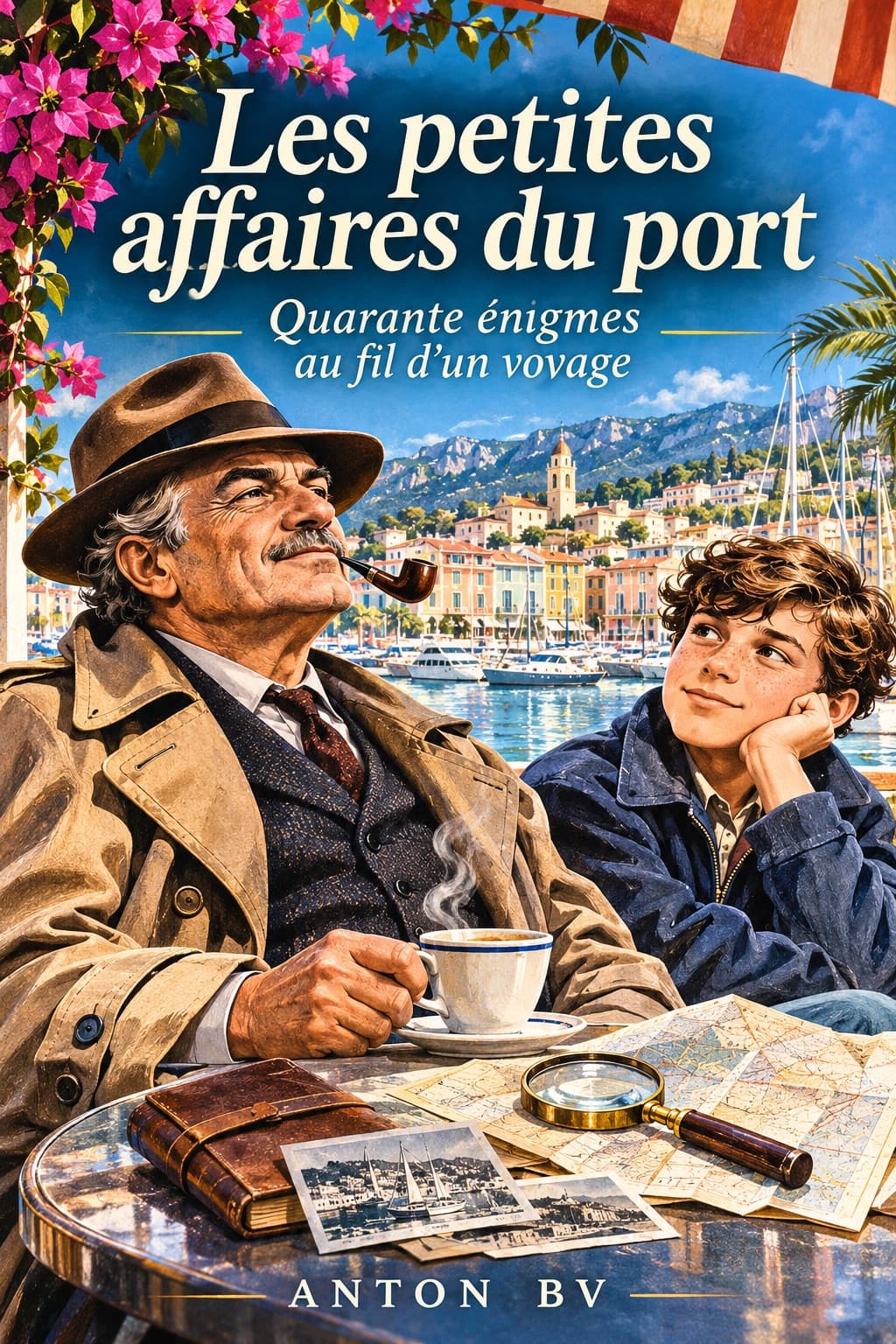
Les petites affaires du port
Quarante énigmes au fil d’un voyage
Anton BV · 2026 · French
40 puzzles · Kindle & Paperback
French-language editions only. Not an English translation or a bilingual book.
Author's book recommendation. The description is based on the 2026 edition supplied by Anton BV, not an independent review.
Forty mysteries and a train journey
Please note: This book is written entirely in French. This English-language article introduces it for international readers, but the Kindle and paperback editions currently linked below are French-language editions, not English translations.
A holiday on the French Riviera doesn't have to be packed with sightseeing.
Sometimes the best moments are the quiet ones.
A coffee on a sunny terrace.
A train journey along the Mediterranean.
An evening back at your apartment after a long day exploring Menton.
And occasionally, a small puzzle that turns out to be rather more interesting than it first appeared.
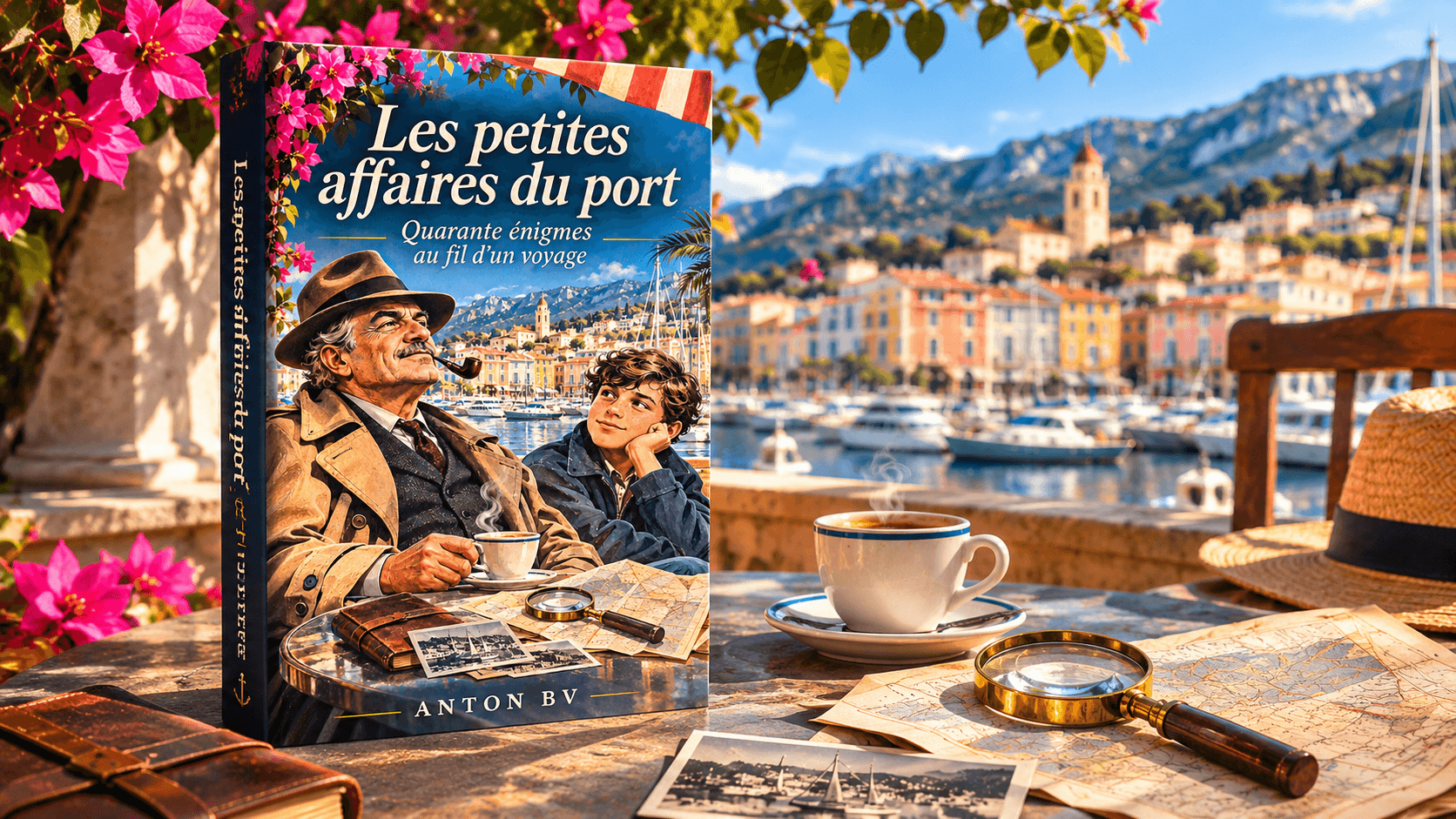
That's the idea behind Les petites affaires du port: Quarante énigmes au fil d'un voyage, an illustrated French-language puzzle book by Anton BV.
Its title roughly translates as The Little Cases of the Harbour: Forty Puzzles Along a Journey.
The book combines forty progressively challenging puzzles with an ongoing story about a retired police commissioner and his fourteen-year-old grandson.
It's designed for people who enjoy logic, observation, deduction and the satisfaction of discovering a solution for themselves.
And while the book isn't set in real Menton, its relaxed atmosphere makes it a natural holiday companion for visitors spending time on the Riviera.
1. Meet Lucien and Milo
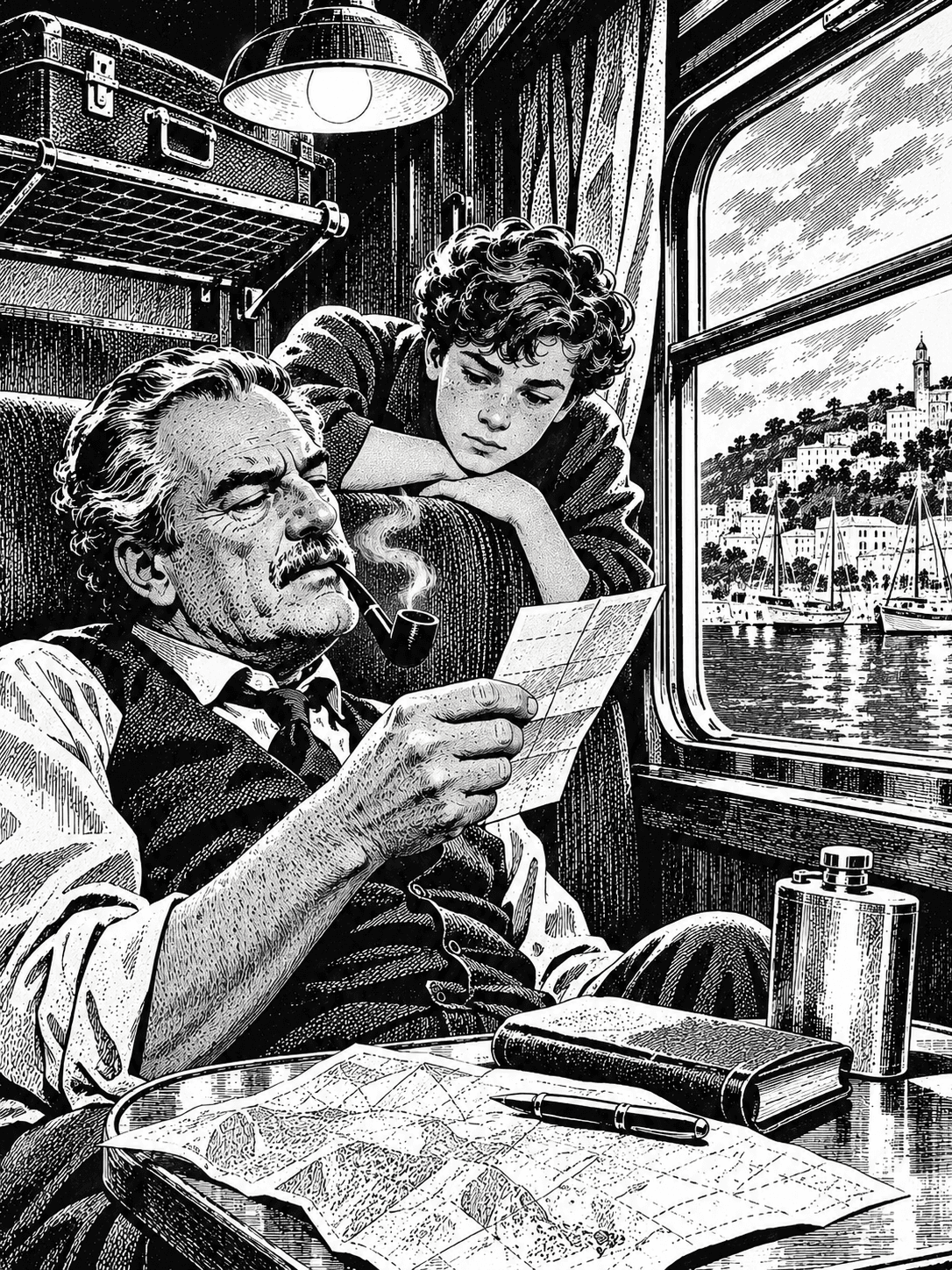
Lucien Morel spent his professional life investigating crimes.
Retirement hasn't quite cured him of his curiosity.
He still notices details other people overlook, questions statements that sound too confident and remains suspicious of conclusions reached too quickly.
His grandson Milo is fourteen.
He's perfectly comfortable with technology and sees nothing particularly wrong with searching for answers online.
Lucien prefers a notebook.
The two set out on a train journey from the fictional harbour town of Port-des-Brumes to the equally fictional Parc des Lanternes.
Along the way, Lucien begins sharing small cases and reasoning problems.
Some involve times and appointments.
Others concern parcels, missing objects, suspicious statements, routes, money or mathematical patterns.
As the journey continues, other characters join the conversation.
Marianne, Nora and René bring their own questions and different approaches to solving problems.
And Milo quickly discovers that his grandfather doesn't always have the best answer.
More than a collection of brainteasers
The forty puzzles are woven into a continuous narrative.
Rather than moving through an unrelated list of exercises, readers follow the characters and their journey.
You can enjoy the dialogue, stop to solve a problem and then return to the story.
The result is a mixture of light fiction and genuine reasoning challenges.
A geographical clarification: Port-des-Brumes, Parc des Lanternes and the characters are fictional. This is not a guide to actual French Riviera locations, nor is it advertised as a novel set specifically in Menton.
Its connection with AzurMenton is as a French-language book to enjoy during a holiday.
2. What's inside the book?
You won't need specialist police knowledge or advanced mathematics.
Every puzzle provides the information required to solve it.
Some can be answered mentally.
Others benefit from writing down possibilities, drawing diagrams or checking whether you've considered every solution.
The important part isn't always finding an answer.
Sometimes it's proving that your answer is the only possible one.
| Feature | What to expect |
|---|---|
| 40 puzzles | Deduction, logic, arithmetic, observation, probability and strategy |
| Five sections | A gradual progression alongside the train journey |
| Increasing difficulty | From accessible opening challenges to more demanding problems |
| Two hints per puzzle | Graduated clues that help without immediately revealing the answer |
| Detailed solutions | Explanations of the reasoning, not merely the result |
| Illustrations | Black-and-white artwork inspired by classic detective stories |
| Formats | Kindle and paperback |
| Language | French |
3. Why bring a puzzle book to Menton?
Menton is a wonderful base for exploring the eastern French Riviera.
But an enjoyable holiday doesn't have to mean visiting a different attraction every hour.
A puzzle book fits naturally into the slower moments.
On a coastal train
Regional trains connect Menton with Monaco, Nice, Ventimiglia and other destinations.
You might solve one puzzle between stations, or spend the journey thinking about a particularly difficult one.
There's no pressure to finish before you arrive.
At a café
Order a coffee.
Find a comfortable seat.
Open the book and try a short challenge.
Some problems take only a few minutes.
Others may keep you thinking through the afternoon.
Back at your apartment
After a day of sightseeing, a quiet evening can be just as enjoyable as another excursion.
One person reads a puzzle aloud.
Everyone suggests an answer.
Then you compare your reasoning.
It's a simple way to spend time together without needing a board game or any special equipment.
With a curious teenager
The story features fourteen-year-old Milo, although the puzzles themselves are primarily designed for adults who enjoy reasoning challenges.
Older children and teenagers who like problem-solving may enjoy working through selected puzzles with an adult.
Some will be quite demanding.
The aim is to make the process enjoyable, not turn a holiday into extra homework.
4. Try three original puzzles
Here are three small challenges created specifically for this AzurMenton article.
These puzzles are not taken from the book. They are examples of the kinds of deduction and reasoning you might enjoy if you read Les petites affaires du port.
All three are presented in English.
You'll find their solutions at the end of the article.
Puzzle 1. Three postcards
Alice, Bilal and Chloé each buy one postcard at a small harbour kiosk.
The postcards are blue, green and red.
Each card will be sent to a different destination: Menton, Nice or Monaco.
Here are the clues:
1. Chloé bought the red postcard.
2. The postcard going to Nice is green.
3. Bilal didn't buy the blue postcard.
4. Alice isn't sending her postcard to Nice.
5. The red postcard is going to Monaco.
Your challenge: Who bought each postcard, what colour was it, and where is it going?
Difficulty: Easy.
Puzzle 2. The little lighthouse train
At an imaginary seaside resort, a small tourist train leaves its stop at 10:00 a.m. and then every 18 minutes.
The ride takes 14 minutes.
You leave a café at 10:08 a.m.
It takes 11 minutes to walk from the café to the train stop.
Alternatively, you can walk directly from the café to the lighthouse in 34 minutes.
You can't board a train that has already left, and no other transport is available.
Your challenge: Should you take the train or walk to reach the lighthouse as early as possible? What time will you arrive?
Difficulty: Intermediate.
Puzzle 3. The captain's three boxes
An old sea captain has three closed boxes labelled A, B and C.
Exactly one gold coin is hidden in one of the boxes. The other two are empty.
Each box carries a statement.
Box A: "The coin is in Box B."
Box B: "The coin is not in Box B."
Box C: "The coin is not in Box A."
The captain guarantees that exactly one of these three statements is true.
Your challenge: Which box contains the gold coin?
Difficulty: Intermediate.
Try to find a solution that satisfies every condition. A plausible guess isn't quite the same as a proof.
5. How the puzzles work in the book
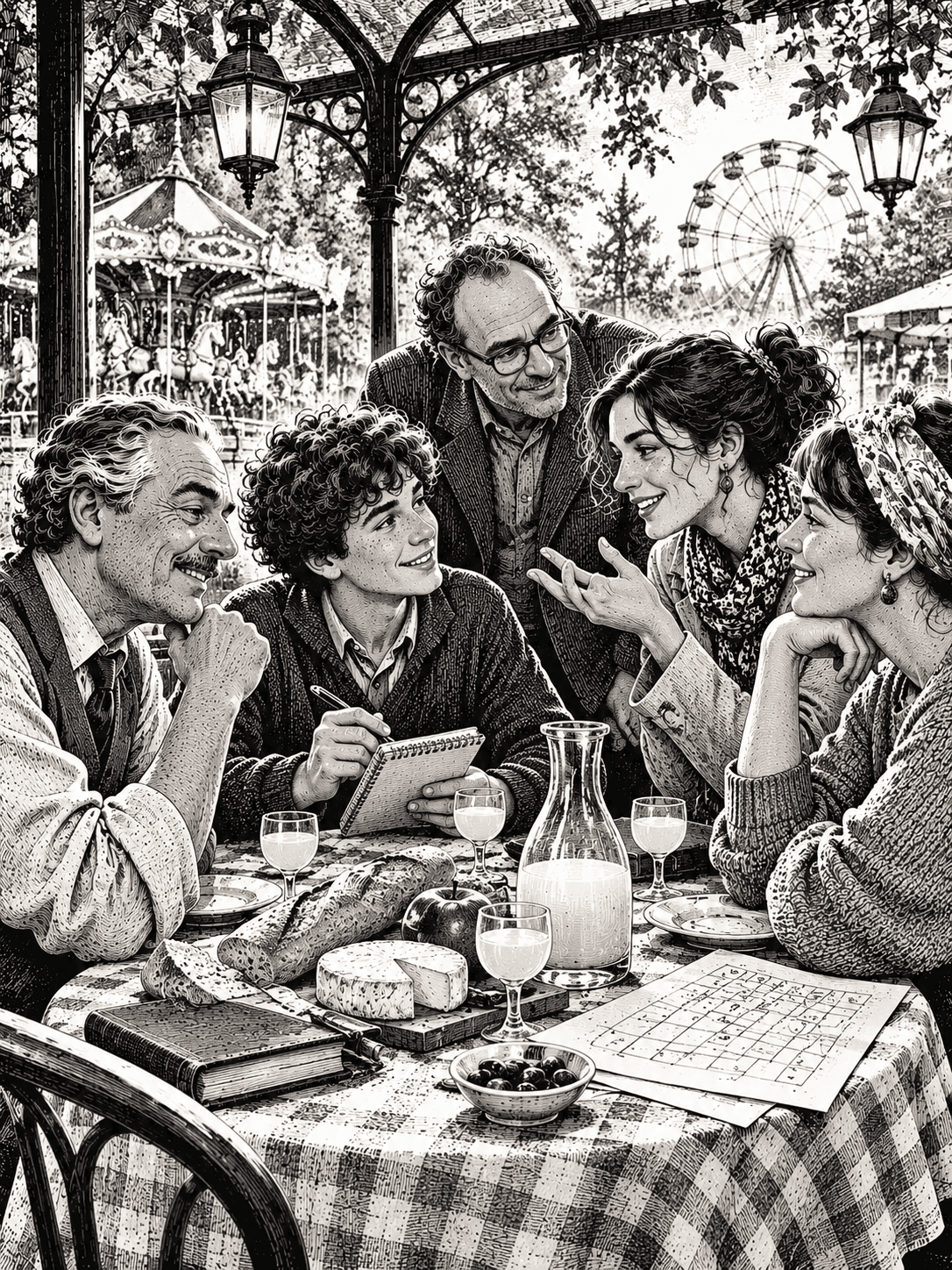
Each challenge emerges naturally from the characters' conversation.
Lucien introduces a situation.
Milo asks questions, notices possible mistakes or suggests a solution.
Other travellers may challenge his assumptions or offer a different way of thinking.
Then the reader has a chance to stop and work independently.
Two levels of help
Every puzzle comes with two graduated hints.
The first suggests a direction.
The second gives a little more assistance.
Full explanations are collected separately after the story.
This makes it possible to ask for help without immediately spoiling the solution.
Some problems require proof
The easier puzzles often have one straightforward answer.
Later challenges may ask readers to identify every possible solution, establish a minimum number of moves or prove that no alternative can work.
Those questions are more demanding, but they're also part of the fun.
The satisfaction comes from understanding why the answer is correct.
6. Who would enjoy this book?
Les petites affaires du port is a good choice for people who enjoy classic logic puzzles with a light narrative.
It may particularly appeal to readers who like detective-style deduction, structured reasoning, mathematical puzzles and games of strategy.
The atmosphere is relaxed rather than dark.
Despite the retired police commissioner and the references to investigations, this is not a conventional murder mystery.
The book focuses on small problems that lead to interesting questions.
It also isn't a collection of effortless riddles.
Some of the later puzzles require patience, careful notation and systematic thinking.
The main requirement for international visitors is sufficient French to understand the puzzle instructions.
Readers with intermediate or advanced French may find it an enjoyable way to combine language practice and logic, provided they are comfortable working through detailed problem statements.
7. Where to buy the book
Les petites affaires du port: Quarante énigmes au fil d'un voyage
By Anton BV, 2026.
Language: French only.
Buy the paperback on Amazon.fr
Get the Kindle edition on Amazon.fr
The paperback is particularly suitable for readers who enjoy using a notebook to make calculations or diagrams.
The Kindle version is convenient for travelling light.
For further information, visit the author's English-language book page.
A little mystery for your next holiday?
A good holiday book doesn't necessarily need an enormous plot or a dramatic setting.
Sometimes all you need is an interesting question and the satisfaction of solving it.
Les petites affaires du port offers forty such challenges, brought together through a light-hearted journey with a retired detective, his grandson and the people they encounter along the way.
You can read a little, think for a while, put the book down and return when you're ready.
On a train, at a café or during a quiet evening in Menton, that's a perfectly good way to enjoy your time.
Discover the French Kindle edition
The three puzzles in this article were created independently for AzurMenton and do not appear in the book. All characters and places in the book are fictional. The content description is based on the author's supplied 2026 edition.
Solutions to the three sample puzzles
Ready to check your reasoning?
Here are the answers, with explanations.
Solution 1. Three postcardsReveal solution
Alice: Blue postcard, Menton.
Bilal: Green postcard, Nice.
Chloé: Red postcard, Monaco.
Chloé has the red postcard, which is going to Monaco.
The card for Nice is green.
Alice isn't sending her card to Nice and cannot have the red card, so she cannot have the green or red postcard.
Bilal cannot have the blue card.
Therefore, Bilal has the green card for Nice, Alice has the blue card for Menton and Chloé has the red card for Monaco.
All five clues are satisfied.
Solution 2. The little lighthouse trainReveal solution
Walking is faster. You arrive at 10:42 a.m.
Leaving the café at 10:08 a.m., you reach the tourist train stop at 10:19 a.m.
The trains leave at 10:00, 10:18, 10:36 and 10:54.
You've just missed the 10:18 departure.
The next train leaves at 10:36 and arrives at the lighthouse at 10:50.
Walking directly takes 34 minutes from 10:08, which means arriving at 10:42.
Walking gets you there eight minutes earlier.
Solution 3. The captain's three boxesReveal solution
The coin is in Box A.
If the coin is in A, the statement on A is false, the statement on B is true and the statement on C is false.
Exactly one statement is true.
If the coin is in B, both statements A and C are true.
If the coin is in C, both statements B and C are true.
Only Box A satisfies the captain's condition.