Follow Cocteau from the town hall to the sea
In the summer of 1955, Jean Cocteau arrived in Menton and discovered a town that would become the setting for some of his final great artistic projects.
He was already one of the most extraordinary creative figures of twentieth-century France: a poet, novelist, playwright, filmmaker, visual artist and designer who had worked with some of the most influential people in European modernism.
Yet Menton offered him something different.
Here, between the mountains and the Mediterranean, he found a place where mythology, architecture, everyday life and the sea could become part of the same work of art.
He decorated a wedding hall with mythological figures. He transformed an abandoned seventeenth-century fortress into an intimate museum. And he developed a visual language that still shapes the way the city remembers him.
Today, you can follow that story on foot.
This isn't simply a list of museums. It's a walk through Cocteau's relationship with Menton, starting with a public commission and ending beside the sea, where his work found one of its most personal expressions.
Before you start: which Cocteau sites are actually open?
Menton has several places associated with the artist, but they don't all have the same visiting arrangements.
Important: The large Séverin Wunderman museum has been closed since flooding in October 2018. A proposed reopening target of 2029 was announced in July 2026, but it is not a confirmed visitor opening date.
The smaller historic Bastion museum operates separately.
Before travelling, check its current exhibition and whether any temporary closure has been announced.
| Place | Current visiting status | Time to allow | What matters |
|---|---|---|---|
| Salle des Mariages | Open under municipal visiting arrangements | 20–45 min | Original interiors created by Cocteau |
| Lower Menton streets | Public streets | 15–25 min | The architectural context of his work |
| Musée Jean Cocteau – Collection Séverin Wunderman | Closed to visitors | 10 min outside | Museum architecture and the story of the collection |
| Le Bastion – Musée Jean Cocteau | Open according to its current exhibition programme | 30–60 min | Cocteau's personal museum project |
| Old Port and Sablettes waterfront | Public outdoor spaces | 20–30 min | The Mediterranean landscape surrounding his work |
Stop 1. Salle des Mariages: where Cocteau turned marriage into mythology
Address: Hôtel de Ville, 17 Rue de la République, Menton.
Our journey begins in a rather unexpected place: the town hall.
A municipal wedding room might not sound like a masterpiece of modern art.
But when Menton's mayor, Francis Palmero, invited Jean Cocteau to decorate the city's marriage hall in the mid-1950s, the artist saw an extraordinary opportunity.
He wanted to transform an administrative space into something poetic.
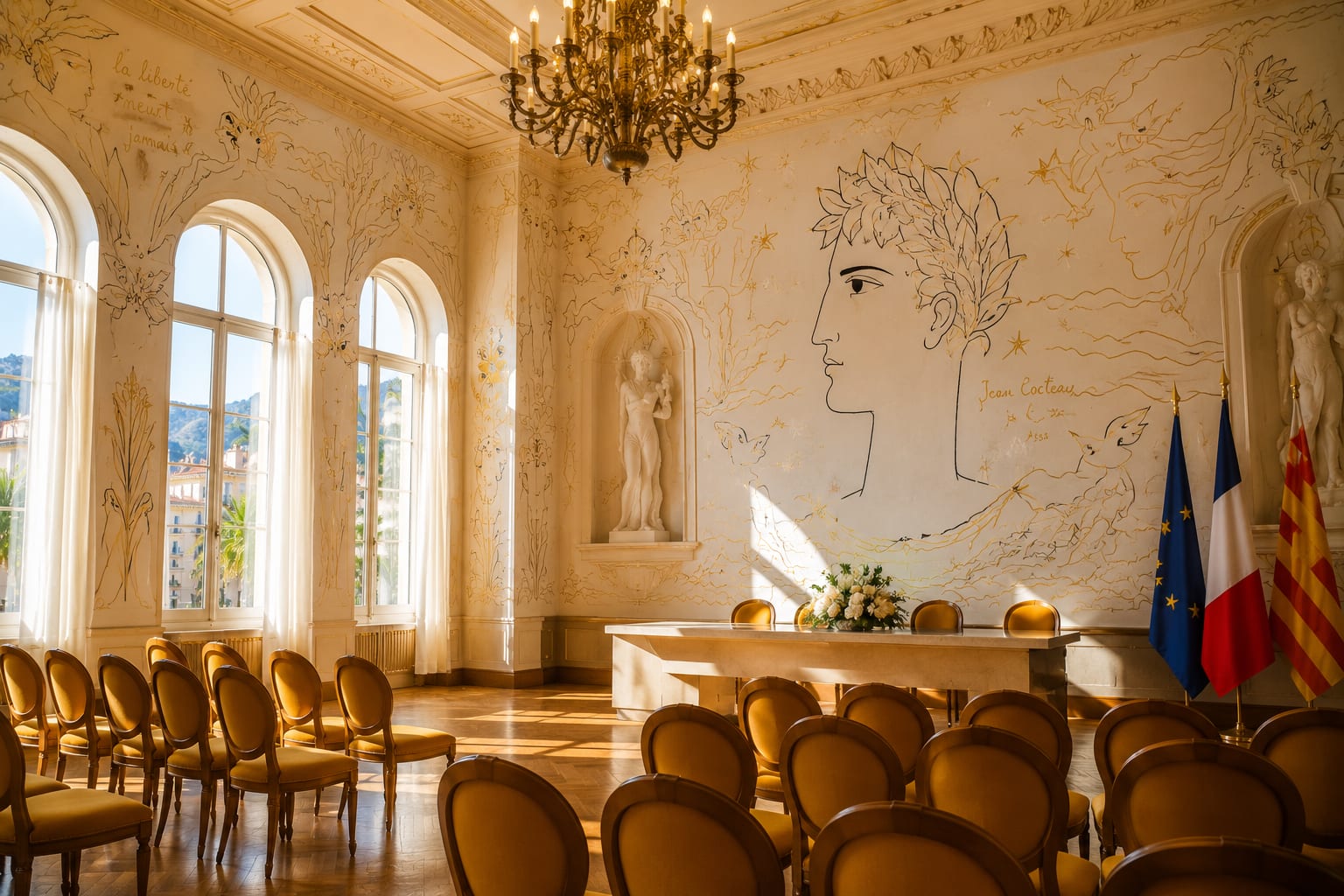
Rather than presenting marriage simply as a legal ceremony, he surrounded it with mythology, symbolic figures, movement and theatrical imagery.
What should you look for?
Begin with the walls.
Cocteau's figures appear to move almost effortlessly through the architecture. Their outlines twist, curve and connect, creating a flowing visual language that belongs somewhere between drawing, decoration and performance.
Look for Orpheus and Eurydice, one of Cocteau's recurring mythological subjects.
The story of Orpheus, who descends into the underworld to recover his beloved, fascinated the artist throughout his life.
It also appears in his films, particularly Orpheus (1950).
In Menton's wedding hall, the myth takes on an especially appropriate meaning.
Marriage is presented not merely as a civic institution, but as part of a larger human story about love, transformation and the relationship between the everyday world and the unknown.
Look beyond the paintings
The room is remarkable because Cocteau didn't simply paint pictures on existing walls.
He designed the entire decorative environment.
The doors, bronze candelabra, carpets and wall compositions form a unified work.
Notice how decorative details echo the movement of the figures.
This is one of the most revealing aspects of Cocteau's approach: he didn't see a strict boundary between fine art and applied design.
For him, a room could become an immersive artistic world.
A moment to consider
Think about the couples who have married here since the room was inaugurated in March 1958.
Cocteau's figures aren't isolated behind museum glass.
They continue to occupy a working civic space, where real ceremonies take place.
That's one reason this room feels different from a conventional gallery.
It's both an artwork and part of Menton's everyday life.
Visiting information
Independent visits: The museum and city websites publish regular weekday visiting hours of 8:30 a.m.–noon and 2–4:30 p.m., excluding weekends and public holidays. Standard adult admission is listed at €2.
Guided visits: The tourism office advertises a 45-minute French-language tour on Mondays at 3:45 p.m. and Thursdays at 2:30 p.m., priced at €5 for adults.
Guided visits must be booked through the organiser.
Town hall ceremonies, civic requirements or restoration work may affect availability, so confirm access before setting out.
Official information:Official visitor information
museum
museum
La Salle des Mariages Jean Cocteau
A Cocteau-decorated civic interior inside Menton's town hall, best treated as a short cultural stop.
Mairie de Menton, Place Ardoïno, 06500 Menton
Check current hours before visiting
Stop 2. Lower Menton: discovering the city behind the artist's lines
Leave the town hall and make your way through the lower central streets towards the sea.
Don't rush.
This part of the walk isn't about finding another Cocteau artwork.
It's about looking at Menton through the eyes of an artist fascinated by line, ornament and Mediterranean colour.
The town's architecture provides a fascinating visual context for his work.
Pastel façades, curved balconies, decorative ironwork, shutters and sunlit walls create a landscape where architectural detail and natural light constantly interact.
Why does this matter?
Cocteau's artistic language was highly distinctive.
His drawings often use elegant, continuous lines. Figures become decorative motifs, while decorative forms begin to resemble living figures.
In Menton, similar rhythms can be discovered in the curves of balconies, floral decoration and ornamental façades.
The comparison isn't meant to suggest that every building influenced Cocteau directly.
Rather, it helps explain why his work feels so naturally at home here.
A small observation exercise
Choose one architectural detail.
Perhaps an iron balcony, a curved window or the shadow of a plant against a wall.
Look at its outline.
Now think about the flowing shapes you saw in the Wedding Hall.
The connection is visual rather than literal, but it's a useful way to understand the aesthetic world Cocteau created in Menton.
Continue towards the waterfront.
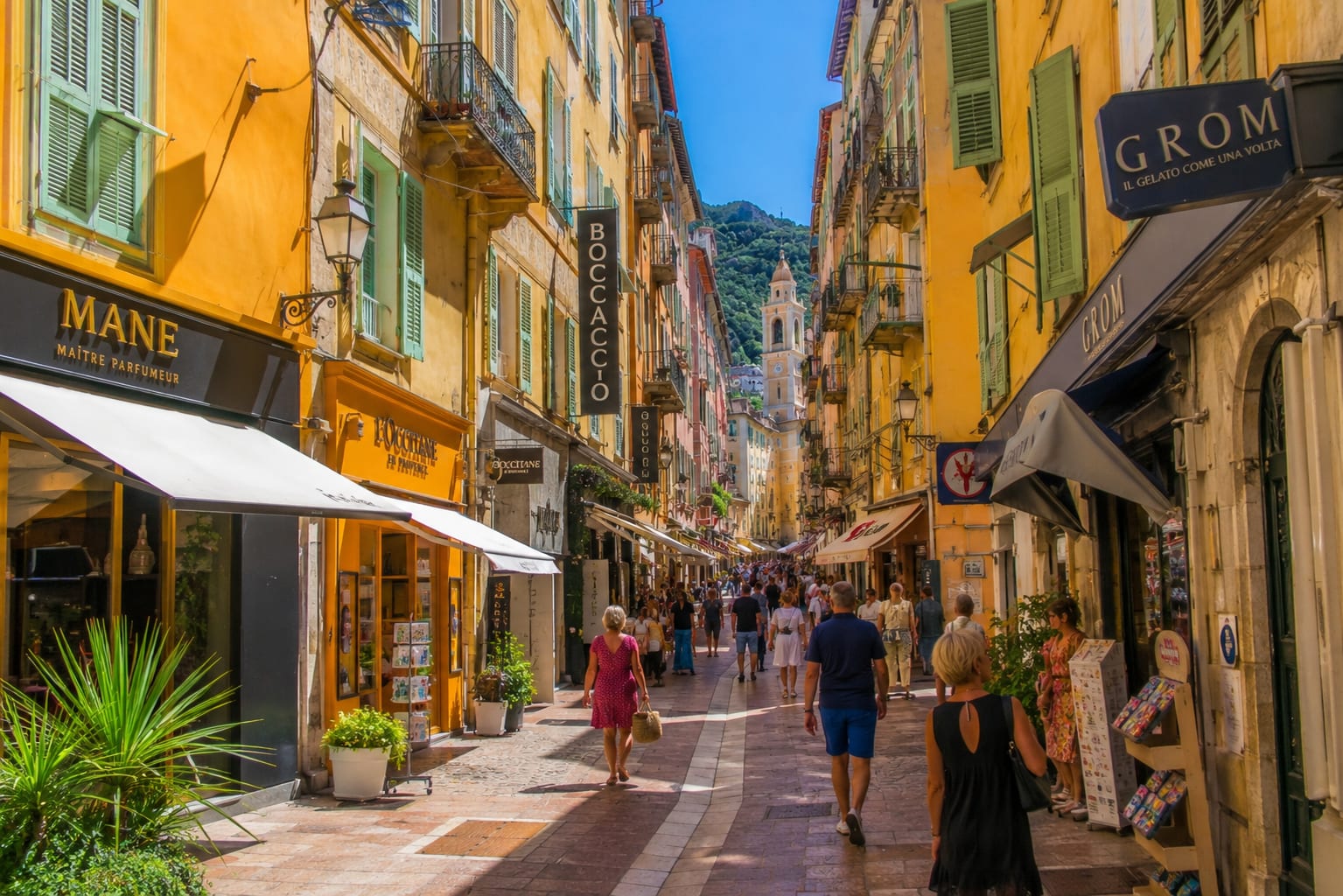
neighbourhood
neighbourhood
Rue Saint-Michel
Menton's central pedestrian old-town street, useful for ice cream, small shops, evening walks and family-friendly wandering.
Rue Saint-Michel, 06500 Menton
Stop 3. The Séverin Wunderman Museum: a building waiting for its next chapter
Location: Seafront near Quai de Monléon, Menton.
As you approach the sea, you'll encounter one of Menton's most distinctive modern buildings.
Its dramatic white concrete structure, designed by architect Rudy Ricciotti, has become an important element of the town's contemporary waterfront.
This is the Musée Jean Cocteau – Collection Séverin Wunderman.
Unfortunately, it is currently closed.
But its exterior still provides an important chapter in the story.
Why was this museum created?
Séverin Wunderman was a passionate collector of Cocteau's work.
Over many decades, he assembled an extraordinary collection of drawings, paintings, photographs, ceramics and objects connected to the artist.
In 2005, he donated his collection to the City of Menton.
The donation brought together more than 1,800 pieces from Wunderman's collection with the city's existing Cocteau holdings.
The new museum opened in November 2011.
It was intended to provide a permanent home for one of the world's most important collections devoted to Cocteau.
Architecture as a tribute
Rudy Ricciotti's building doesn't resemble a conventional historic museum.
Its sculptural structure and dramatic relationship with the seafront make it an architectural landmark in its own right.
Look at how its forms frame light and shadow.
The building belongs to a much later era than Cocteau's work, but its expressive design seems appropriate for an artist who moved so freely between disciplines.
Why is it closed?
The museum suffered severe flooding during a storm in October 2018.
The damage forced the closure of the building and led to extensive conservation concerns.
As of October 2026, the museum remains closed to visitors.
In July 2026, the municipality announced a reopening ambition for 2029.
This should be treated as a future target rather than a confirmed date.
What can you see today?
The building's exterior can be viewed from public areas of the seafront, subject to any construction or safety restrictions.
Don't expect to enter the collection.
Some works can be seen elsewhere while this building is closed: the published programme lists Les jardins enchantés de Jean Cocteau at the Galerie des Musées in the Palais de l'Europe, from 28 March 2026 to 30 January 2027. This optional extension has its own visiting arrangements; it is not access to the closed museum.
And don't confuse this building with Le Bastion, which is a separate museum located a short walk away.
A moment to consider
The closed museum reveals something important about cultural heritage.
Art isn't preserved simply by collecting it.
Buildings must be maintained, artworks must be conserved and institutions must adapt to changing circumstances.
The story of Cocteau in Menton is still developing, decades after the artist's death.
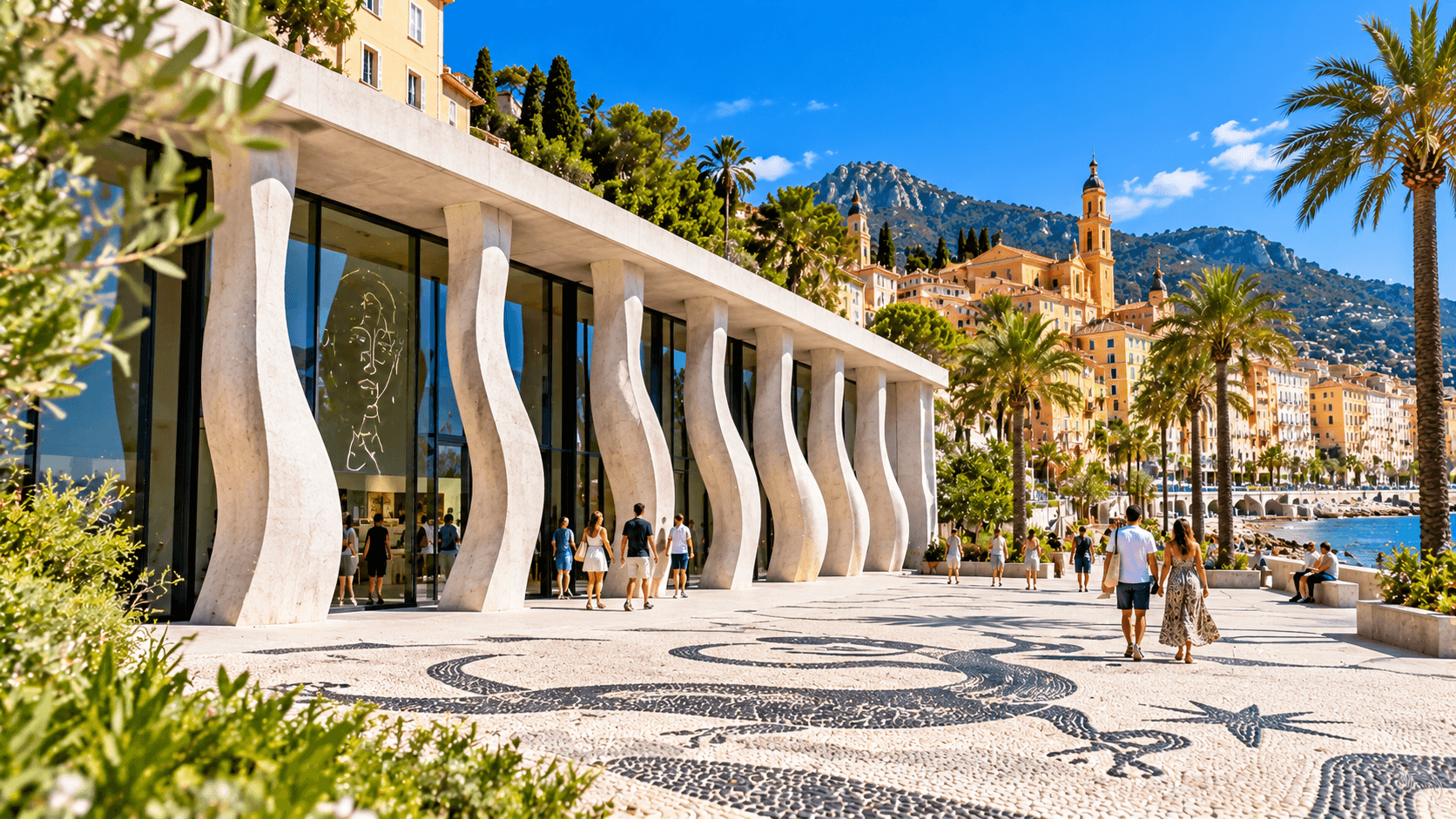
museum
museum
Musée Jean Cocteau – Collection Séverin Wunderman
Rudy Ricciotti's seafront museum remains closed after the 2018 flooding. View the exterior only; this is not the separate Bastion museum.
2 quai de Monléon, 06500 Menton
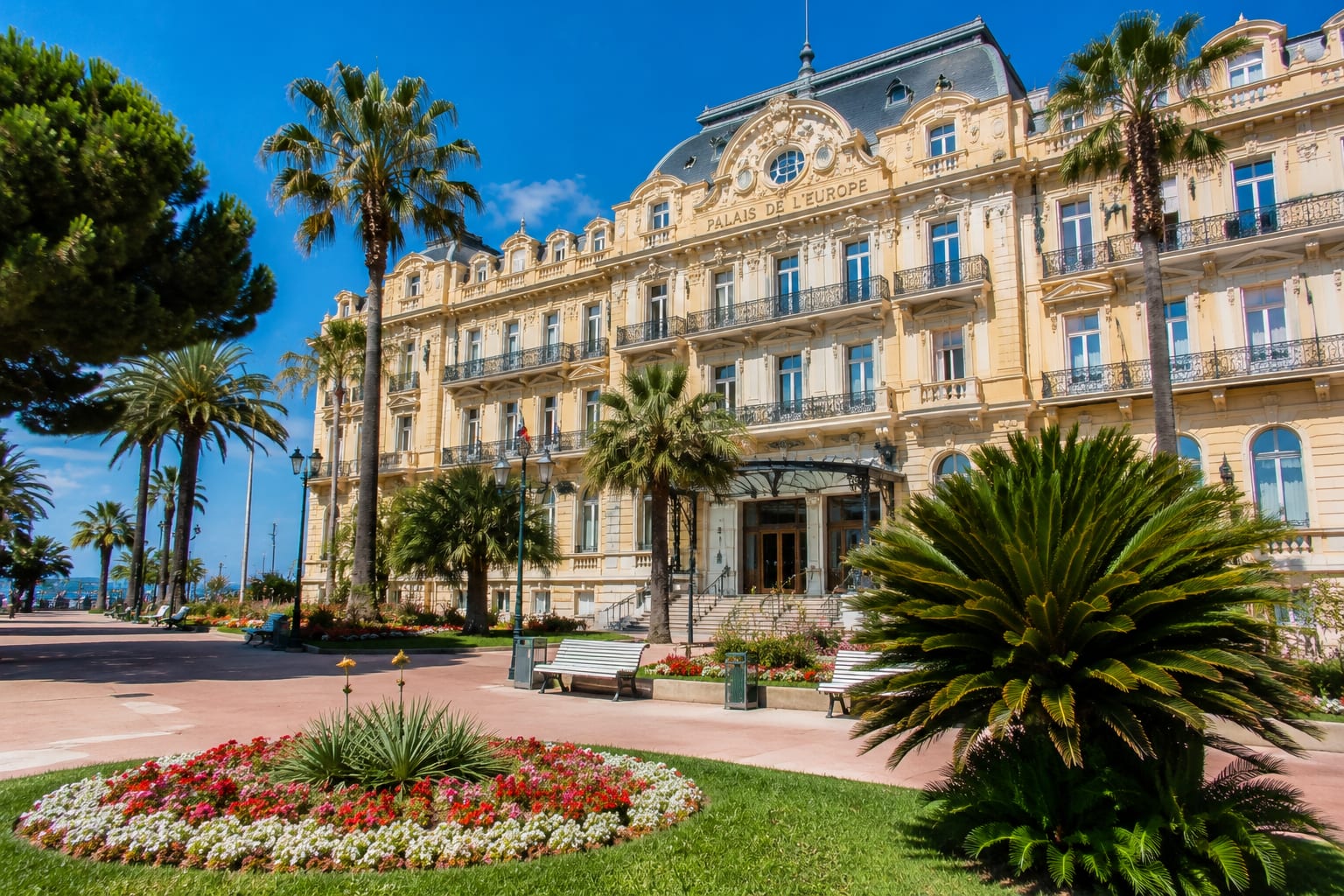
civic
civic
Palais de l'Europe
A central Menton venue for exhibitions, touring performances, concerts and festival events rather than a dedicated theatre.
Menton centre
Stop 4. The Old Port: where Cocteau discovered an abandoned fortress
Continue towards the old port.
Ahead, near the end of the harbour wall, stands a compact stone fortification.
At first glance, it might seem like a small remnant of Menton's maritime history.
For Cocteau, it became something much more personal.
A meeting between artist and place
Cocteau first visited Menton in the summer of 1955 while staying with his friend Francine Weisweiller in Saint-Jean-Cap-Ferrat.
His friendship with Mayor Francis Palmero eventually led to the commission for the Wedding Hall.
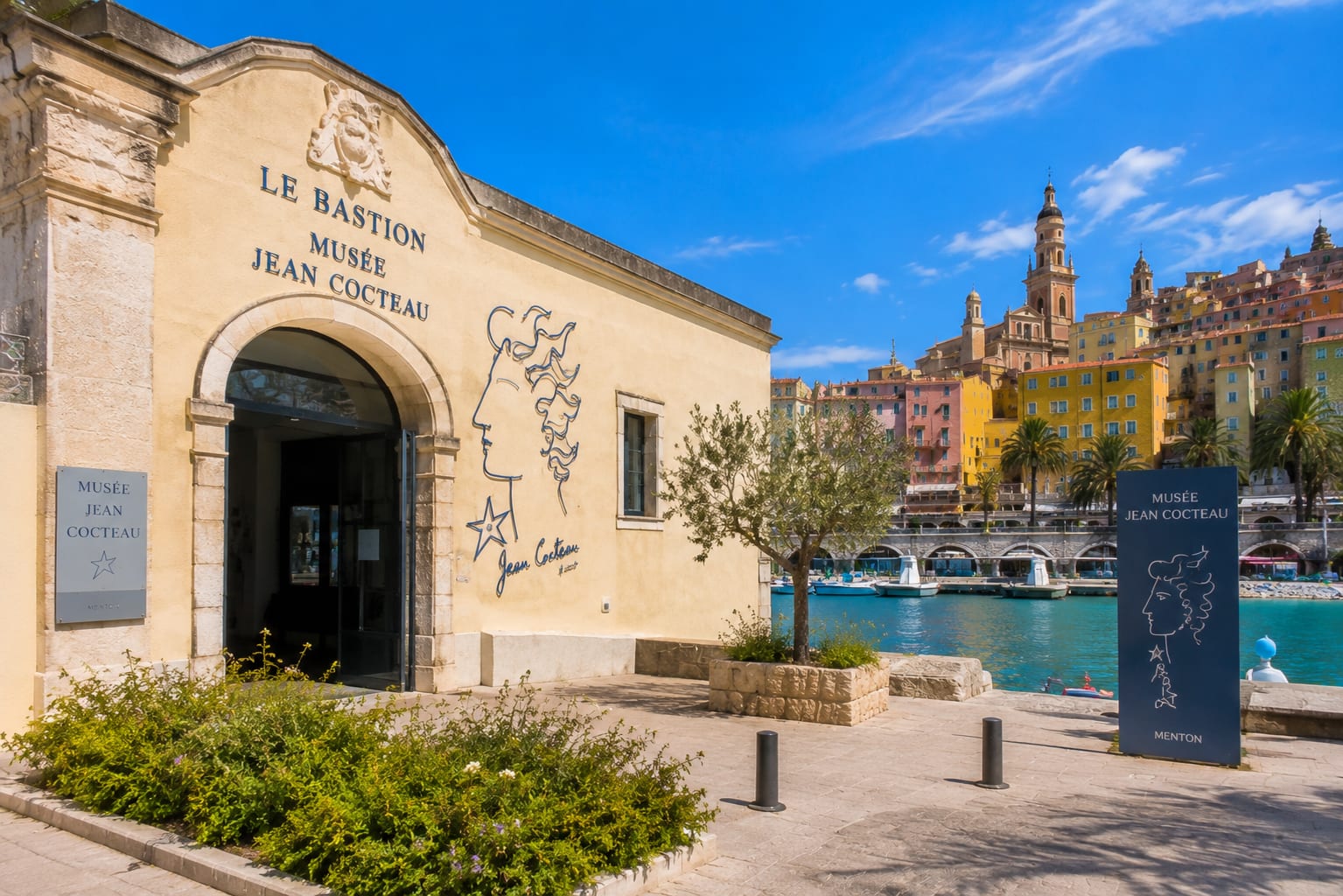
While working in Menton, Cocteau became interested in the abandoned seventeenth-century Bastion beside the harbour.
In September 1957, Palmero proposed that the building could become a museum for the artist's work.
Cocteau embraced the project.
But he wanted something more personal than a conventional museum.
He imagined a place in which his own works would live alongside the building's historic architecture.
Before entering, look at the setting
Stand back and look at the Bastion in relation to the water.
The fortress once belonged to a defensive maritime landscape.
Under Cocteau, its meaning changed.
A building designed to protect a harbour became a place for imagination, artistic reflection and memory.
This transformation is central to the story of Cocteau in Menton.
He wasn't simply placing objects in a historic building.
He was giving that building a new identity.
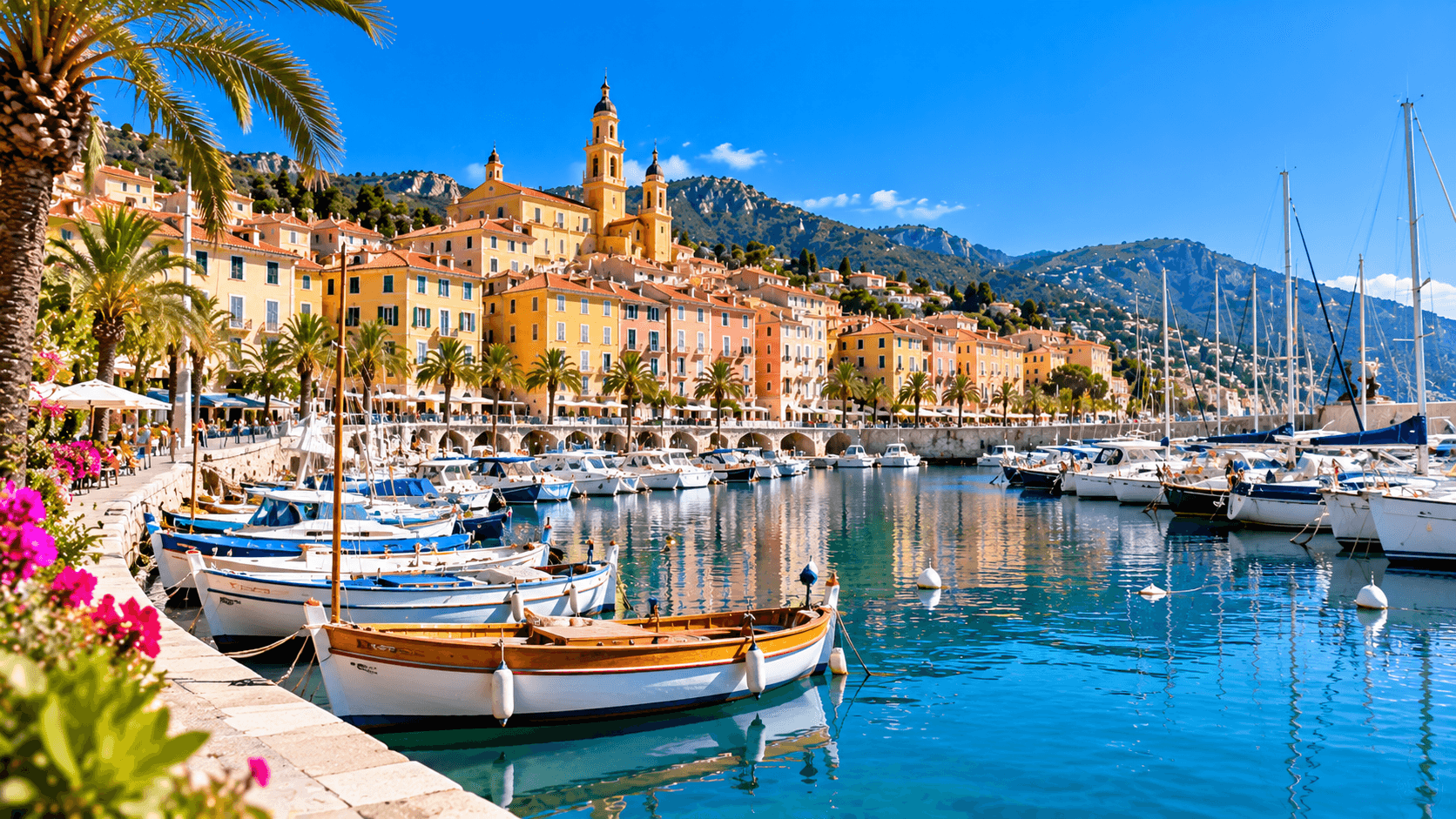
port
port
Vieux Port de Menton
Historic harbour beside Cocteau's Bastion, useful for viewing the fortress in its maritime setting before continuing to Sablettes.
Quai Napoléon III, 06500 Menton
Stop 5. Le Bastion: Cocteau's final artistic statement
Address: Quai Napoléon III, Bastion du Vieux Port, Menton.
Le Bastion is the emotional centre of this itinerary.
Unlike the large modern museum, this small historic fortress was directly shaped by Cocteau's vision.
He participated in its restoration and designed decorative elements specifically for the interior.
The building eventually opened as a museum in 1966, three years after his death.
It became the first museum devoted to his work.
What makes this museum different?
The Bastion isn't simply a place where Cocteau's drawings happen to be displayed.
The space itself is part of the experience.
He designed floor mosaics and decorative elements associated with the building.
The ground-floor mosaic includes a lizard, a playful symbol connected with the Mediterranean atmosphere.
Other decorative details continue throughout the interior.
The architecture, the artist's imagery and the sea beyond the walls form a single experience.
The world of Cocteau
The historic collection includes drawings, ceramics and other works reflecting themes that fascinated Cocteau in the later part of his career.
Among these are mythological figures, mysterious creatures, lovers and symbolic transformations.
The museum's historic holdings include groups of drawings known as the Innamorati, sphinxes and studies for the Wedding Hall decoration.
The selection visible to visitors changes according to the exhibition.
Don't assume that every work mentioned in the collection is permanently on display.
Current exhibition: Le Château de la Bête
Published dates: 4 July–16 November 2026.
The published 4 July–16 November 2026 programme lists an exhibition devoted to the 80th anniversary of Cocteau's film La Belle et la Bête (1946).
The exhibition explores the visual imagination, production history and artistic legacy of the film.
It brings together archival material and works connected to Cocteau, alongside contemporary artistic responses.
This is a particularly appropriate exhibition for the Bastion.
La Belle et la Bête demonstrates Cocteau's ability to turn ordinary objects, architecture and gesture into something magical.
That same sensibility can be found in the way he transformed this little fortress into an artistic environment.
How long should you spend inside?
Allow approximately 30–60 minutes.
The Bastion is relatively small, but its size is part of its appeal.
Rather than rushing from room to room, take time to consider the connection between the objects and the architecture.
Practical information
Published opening hours: 10 a.m.–12:30 p.m. and 2–6 p.m.
Regular closing day: Tuesday.
Additional published closures: 1 January, 1 May, 1 November and 25 December.
Adult ticket: €5.
Reduced tickets: Available for eligible visitors.
Free admission: Children under 18, certain other visitor categories and everyone on the first Sunday of the month.
Accessibility: The museum's official website states that the historic building is not wheelchair accessible.
Check for temporary changes before your visit, particularly around exhibition changeovers.
Sunday 1 November 2026 is a published holiday closure. It takes precedence over the usual first-Sunday free-admission offer.
Official website:Official visitor information
museum
museum
Musée Jean Cocteau - Le Bastion
A compact cultural stop by the old port; useful as an indoor pause when the afternoon heat is strong.
Quai Napoléon III - Bastion du Vieux Port, 06500 Menton
Check current hours before visiting
Stop 6. Sablettes waterfront: the Mediterranean as Cocteau's final backdrop
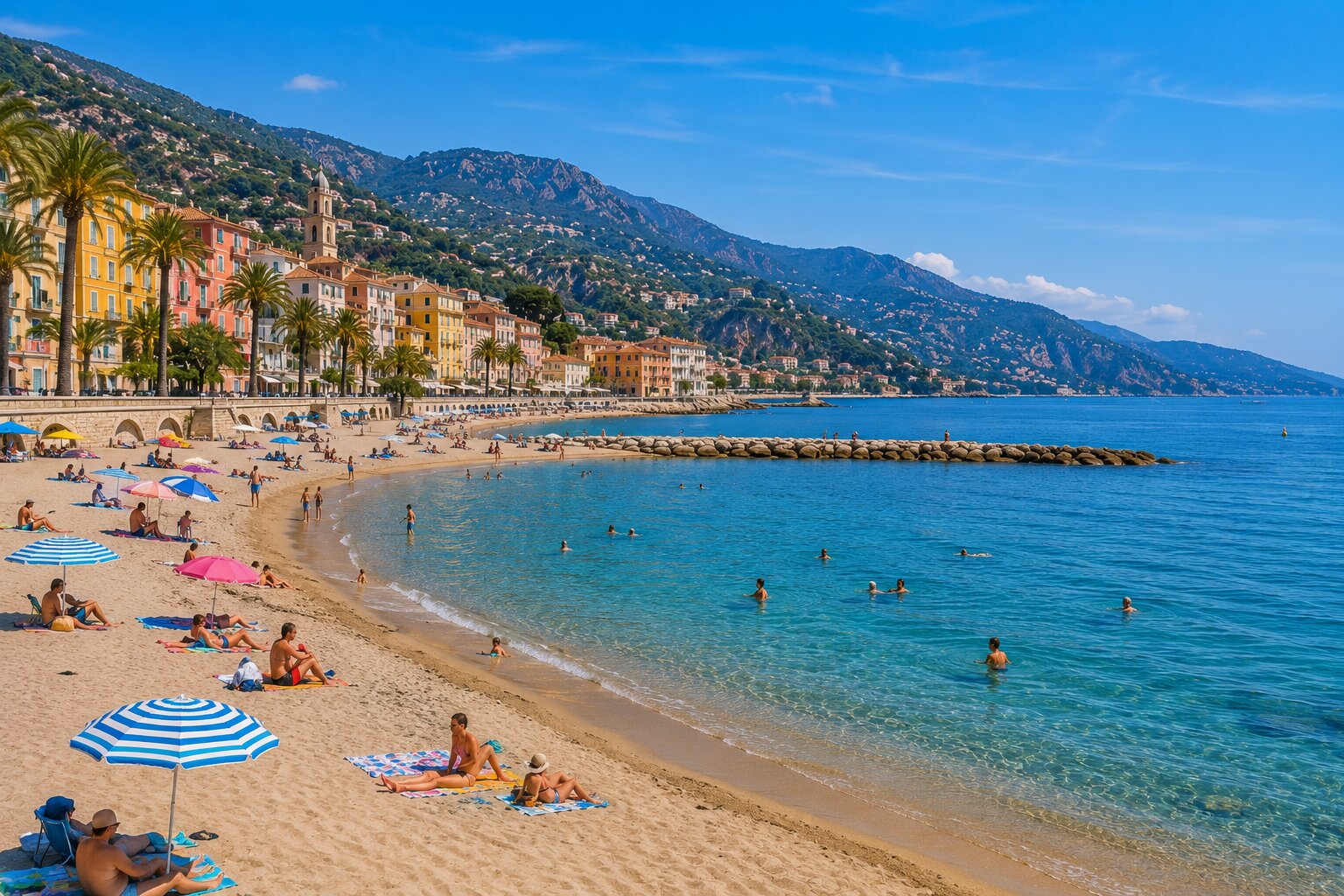
After leaving the Bastion, continue to the waterfront beneath Menton's colourful old town.
This is where the itinerary becomes quieter.
There is no additional museum ticket to buy.
Instead, look back at the landscape.
The sea stretches towards the horizon, while the pastel buildings of Menton rise towards Saint-Michel Basilica.
The view is one of the most recognisable images of the town.
Why finish here?
The Mediterranean wasn't simply a picturesque background to Cocteau's later work.
It was connected to his fascination with ancient mythology, transformation, imagination and the relationship between visible and invisible worlds.
The sunlit colours and flowing shapes of Menton provided a setting that suited his visual language.
Look back towards the Bastion.
Then imagine the artist discovering it in the 1950s: a neglected coastal fortification waiting to be transformed.
The journey from Wedding Hall to Bastion reveals two complementary aspects of his work.
In the town hall, Cocteau made public civic life more poetic.
At the Bastion, he turned a historical structure into an intimate artistic statement.
Both projects remain part of Menton's identity.
beach
beach
Plage des Sablettes
A central beach area that works well with old-town walks and family beach time.
near old port / old town
The complete walking itinerary
Allow approximately 2–3 hours, depending on opening times, guided-tour reservations and how long you spend in the museums.
The route can be completed as a relatively compact walk through central Menton, although individual pedestrian surfaces and accessible connections should be checked according to your mobility needs.
| Stop | Place | Suggested time |
|---|---|---|
| 1 | Salle des Mariages | 20–45 min |
| 2 | Lower Menton streets | 15–25 min |
| 3 | Séverin Wunderman Museum exterior | 10 min |
| 4 | Old Port and Bastion exterior | 10–15 min |
| 5 | Le Bastion museum | 30–60 min |
| 6 | Sablettes waterfront | 20–30 min |
When should you take this walk?
The best day depends on which interiors you want to visit.
Monday
An excellent option if you want the official guided visit of the Wedding Hall.
The currently published French-language guided session begins at 3:45 p.m., so consider visiting the Bastion earlier in the day and following the story in reverse order.
Thursday
Another good choice for the guided Wedding Hall visit, with a published 2:30 p.m. session.
Visit the Bastion in the morning, enjoy lunch and finish with the Wedding Hall.
Wednesday or Friday
Suitable for combining normal weekday access to the Wedding Hall with the Bastion's published opening schedule, subject to civic events and temporary closures.
Saturday or Sunday
The Wedding Hall is normally closed for ordinary visits.
You can still enjoy the Bastion and the outdoor parts of the route.
A first Sunday of the month can be particularly attractive because the Bastion normally offers free admission.
Tuesday
Not ideal for visiting both interiors, because the Bastion is normally closed.
If you have only one hour
Choose the Bastion if it's open.
The combination of original architectural intervention, museum history and rotating exhibitions makes it the most distinctive Cocteau experience in Menton.
Spend a little time outside afterwards looking at the old harbour.
If the Bastion is closed but the Wedding Hall is open, the room is a strong alternative.
Don't travel to the closed Séverin Wunderman museum expecting an exhibition.
If you love Cocteau's films
Before or after your visit, consider watching one of his major films.
La Belle et la Bête (1946)
A visually imaginative adaptation of the classic fairy tale.
Its mysterious interiors, theatrical effects and dreamlike atmosphere make it an excellent introduction to Cocteau's cinematic imagination.
Orpheus (1950)
An interpretation of the Orpheus myth that brings ancient mythology into a modern setting.
It's particularly relevant to the figures and symbolism of the Wedding Hall.
Testament of Orpheus (1960)
A late, deeply personal film that explores the artist's identity, imagination and relationship with his own work.
Watching it can enrich the experience of visiting the Bastion, where Cocteau's final creative concerns feel especially present.
These films aren't required preparation.
But they help reveal how the same artistic imagination moved between cinema, drawing, theatre and architectural decoration.
Jean Cocteau in Menton: a short timeline
The timeline explains why Menton has more than one Cocteau site.
They emerged at different moments in the history of the artist's relationship with the town.
| Year | What happened |
|---|---|
| 1955 | Cocteau discovers Menton and establishes a relationship with the town |
| 1956–1958 | He develops and completes the Wedding Hall decoration |
| 1957 | Work begins on the Bastion project |
| 1958 | Salle des Mariages is inaugurated on 22 March |
| 1963 | Cocteau dies |
| 1966 | Le Bastion opens as a museum devoted to his work |
| 2005 | Séverin Wunderman donates his major Cocteau collection to Menton |
| 2011 | The new museum designed by Rudy Ricciotti opens |
| 2018 | Severe flooding forces the large museum to close |
| 2026 | Le Bastion continues its exhibition programme; a 2029 reopening target is announced for the large museum |
Accessibility and practical considerations
The lower part of Menton offers relatively convenient walking routes, but not every section is completely level.
Visitors using wheelchairs or with limited mobility should plan carefully.
The Wedding Hall is listed by the tourist office as independently wheelchair accessible.
The Bastion, however, is housed in a seventeenth-century building and is officially described as not wheelchair accessible.
The exterior waterfront portions are generally easier to enjoy, although they have not been independently audited for every gradient and crossing.
For visitors who cannot manage stairs, the Wedding Hall and public seafront provide the most practical starting points.
See ourMenton accessibility guides for further planning.
Frequently asked questions
What are the main Jean Cocteau attractions in Menton?
The two principal interior sites are the Salle des Mariages in the town hall and the Musée Jean Cocteau – Le Bastion. The large Séverin Wunderman museum building is currently closed to visitors.
Is the Jean Cocteau Museum in Menton open?
There are two different museum buildings. The historic Bastion museum is operating according to its published exhibition schedule. The larger Musée Jean Cocteau – Collection Séverin Wunderman remains closed following the 2018 flooding.
Can you visit the Jean Cocteau Wedding Hall?
Yes, during published municipal visiting times or as part of an organised guided visit. Access may be affected by civic ceremonies or other temporary restrictions.
How much does the Jean Cocteau Bastion Museum cost?
The official website currently lists €5 for standard adult admission, with reduced and free-entry categories.
How long does the walking route take?
Allow approximately two to three hours for the complete experience, including visits to the Wedding Hall and Bastion.
Is the route suitable for children?
Yes, particularly for children interested in drawing, mythology or visual storytelling. However, some interiors have limited space and the Bastion isn't wheelchair accessible.
Can you visit the Bastion on Sunday?
Normally, yes. Its published schedule includes Sundays, with free entry for everyone on the first Sunday of the month. Check temporary exhibition and closure notices beforehand.
Why did Cocteau become associated with Menton?
After discovering the town in 1955, he formed connections with local officials and undertook significant artistic projects, particularly the Wedding Hall and Bastion, which established a lasting relationship with Menton.
Final thoughts: a city transformed into an artwork
Jean Cocteau didn't come to Menton to establish a conventional museum.
He found a town whose colours, architecture and Mediterranean atmosphere seemed to suit his imagination.
He turned a wedding room into a theatre of mythology.
He transformed an abandoned fortress into an artistic memorial.
And he left behind a body of work that continues to connect the town with twentieth-century art, cinema and literature.
The most rewarding way to discover that legacy is to walk between the places rather than visit them as isolated attractions.
Start with the Wedding Hall.
Follow the streets towards the sea.
Pause outside the great modern museum that awaits its next chapter.
Then visit the little Bastion, where the artist's imagination still feels unusually close.
Finish beside the Mediterranean, looking back at Menton.
By then, the city may feel a little different.
Not just a beautiful Riviera town, but a place whose streets and buildings became part of an artist's final creative story.
Official resources and further reading
Jean Cocteau Museums: Official Website
Salle des Mariages: Visitor Information
Le Bastion: Opening Hours and Tickets
Official Guided Tour: Jean Cocteau and the Wedding Hall
Menton Tourist Office: Cocteau's Legacy
Original research: 27 October 2026; source review: 30 October 2026. Museum opening times, temporary exhibitions and guided tours may change. The large Séverin Wunderman Museum is currently closed, and its prospective reopening date is not guaranteed. Some museum pages blocked direct access during verification; municipal pages, official tourism listings and the museum's indexed notices were cross-checked instead.