Look up: Menton's grand-hotel heritage
Look up while walking through Menton and you'll discover something extraordinary. Behind the palm trees and pastel façades are buildings that seem almost too grand for a relatively small Mediterranean town. Enormous balconies overlook the sea. Decorative towers rise above former hotel entrances. Elegant façades stretch along quiet streets, while monumental staircases disappear behind gates and gardens. Many of these buildings aren't hotels anymore. They're private residences, apartments and institutions whose architecture preserves the memory of a remarkable period in Menton's history. During the late nineteenth and early twentieth centuries, Menton became one of Europe's most fashionable winter destinations. Aristocrats, wealthy industrialists, writers and members of royal families travelled here to escape northern winters and enjoy a climate that doctors increasingly recommended for their health. To accommodate them, the town built an impressive collection of luxury hotels, villas, promenades, gardens and entertainment venues. Today, you can still follow that history on foot. This self-guided walk connects the most revealing examples, from the elegant heart of town to the spectacular former palace hotels overlooking the Mediterranean. The route focuses on what you can genuinely appreciate from public spaces, with clear distinctions between freely accessible locations and private property.
1. Why does Menton have so many Belle Époque buildings?
Menton's transformation began long before the modern summer beach holiday. In the second half of the nineteenth century, European doctors began promoting the benefits of milder Mediterranean winters. One influential figure was the English physician James Henry Bennet, whose writings helped establish Menton's reputation as a winter health resort. Railway connections, expanding promenades and growing international interest brought increasing numbers of wealthy visitors. Queen Victoria's visit in 1882 strengthened Menton's fashionable reputation. The resulting architectural boom continued into the early twentieth century. Luxury hotels competed to offer beautiful views, refined interiors, landscaped gardens and the latest conveniences. Many were designed primarily for winter visitors, not summer beach tourism. That explains an important feature of Menton's architecture: its great buildings were designed to capture sunlight, fresh air and Mediterranean views. Balconies, terraces, large windows and gardens weren't simply decorative luxuries. They were central to the experience the hotels sold. Today, many former palaces have been converted into private apartments, but their imposing façades remain.
2. The walking route at a glance
The central section is relatively straightforward. The final extension towards Winter Palace and Riviera Palace involves a more demanding uphill approach. For visitors who prefer a shorter or easier walk, finish at the seafront hotels and explore the hillside buildings on another day.
| Stop | What you'll discover | Access | Suggested time |
|---|---|---|---|
| 1. Palais de l'Europe | The former Casino-Kursaal and Belle Époque social life | Public areas, subject to opening | 15 min |
| 2. Jardins Biovès | Historic landscape design and resort promenades | Public garden | 15–20 min |
| 3. Le Majestic and former hotels of Rue Partouneaux | Luxury hotels integrated into the modern town | Exterior viewing; individual properties private or commercial | 20 min |
| 4. L'Orangeraie | The former Grand Hôtel de Venise | Working hotel; garden tours by reservation | 15–30 min |
| 5. Royal Westminster and Balmoral | Grand seafront hotels still operating | Public exterior; hotel interiors for guests or customers | 20 min |
| 6. Winter Palace | Monumental former hotel architecture | Private residential property; exterior viewing | 20 min |
| 7. Riviera Palace | Rival palace hotel and terraced landscape | Private residential property; exterior viewing | 15–20 min |
3. Stop 1: Palais de l'Europe, the former Casino-Kursaal
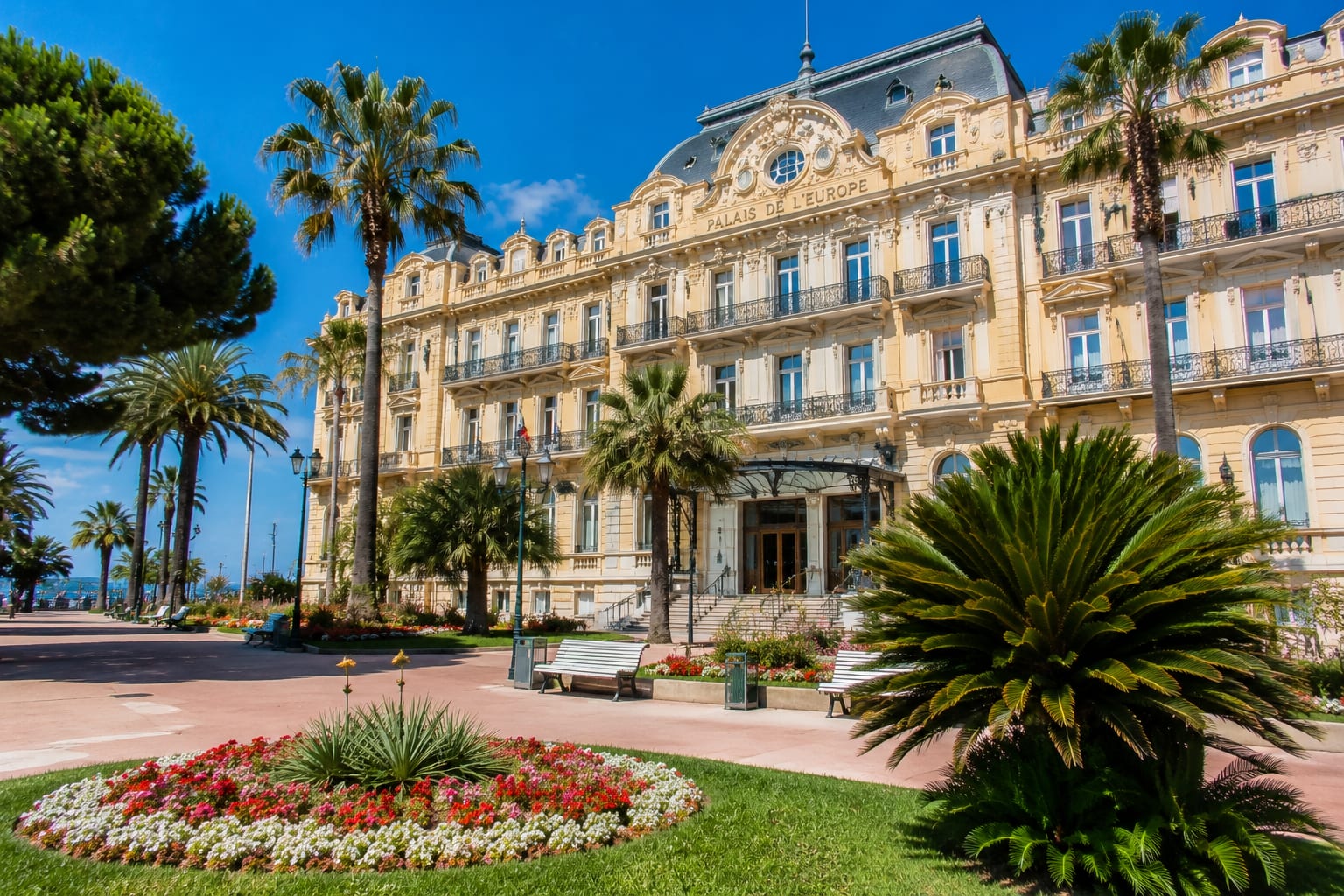
Address: 8 Avenue Boyer, Menton Begin at Palais de l'Europe, one of Menton's most important surviving Belle Époque public buildings. Today, it accommodates cultural activities and the tourist office. But when it opened in 1909 as the Casino-Kursaal, it represented a very different kind of entertainment. The building was designed for the international high society that spent winters in Menton. Visitors came for dances, theatrical performances, fine dining, gambling and fashionable social gatherings. The original complex even included a roller-skating hall where people could skate to live orchestral music. It's a wonderful reminder that Belle Époque holidays weren't exclusively about quiet walks and medical treatments. They were also about spectacle, fashion and being seen. What to look for Stand outside and examine the symmetry and scale of the building. Look for the carefully organised façade, its monumental proportions and the relationship between decorative detail and public entrances. Unlike a private villa, this architecture was designed to impress large numbers of visitors. The building announces itself as a social institution. Can you go inside? Public areas, including the tourist office, can be entered during their published opening hours. This doesn't mean every room or historical interior is freely accessible. Some spaces may be used for exhibitions, meetings or private functions. For a self-guided walk, the exterior provides a useful introduction.
civic
civic
Palais de l'Europe
A central Menton venue for exhibitions, touring performances, concerts and festival events rather than a dedicated theatre.
Menton centre
4. Stop 2: Jardins Biovès, the landscape of the winter resort
Location: Avenue Boyer and Avenue de Verdun Directly outside, continue through Jardins Biovès. These gardens are an important part of Menton's transformation into a fashionable winter resort. Created in 1895 by landscape architect Édouard André, they offered visitors a carefully organised green promenade. André was associated with major French landscape projects, including the celebrated Parc des Buttes-Chaumont in Paris. Why were gardens so important? For wealthy winter visitors, the Mediterranean climate was itself an attraction. Gardens allowed them to experience subtropical vegetation, flowers and sunshine in a setting that was deliberately designed for leisure. Palm trees and exotic plants reinforced the impression of having travelled somewhere different from northern Europe. The landscaping helped transform Menton into an elegant resort rather than simply a town beside the sea. What to look for Notice the formal arrangement of the promenade. Look at the way the planting creates views and frames the surrounding architecture. The relationship between buildings, gardens and streets is just as important as any individual flower bed. Access Jardins Biovès is a public garden with free ordinary access. During the Lemon Festival, sections may be occupied by ticketed displays or subject to temporary restrictions. For this route, allow fifteen or twenty minutes.
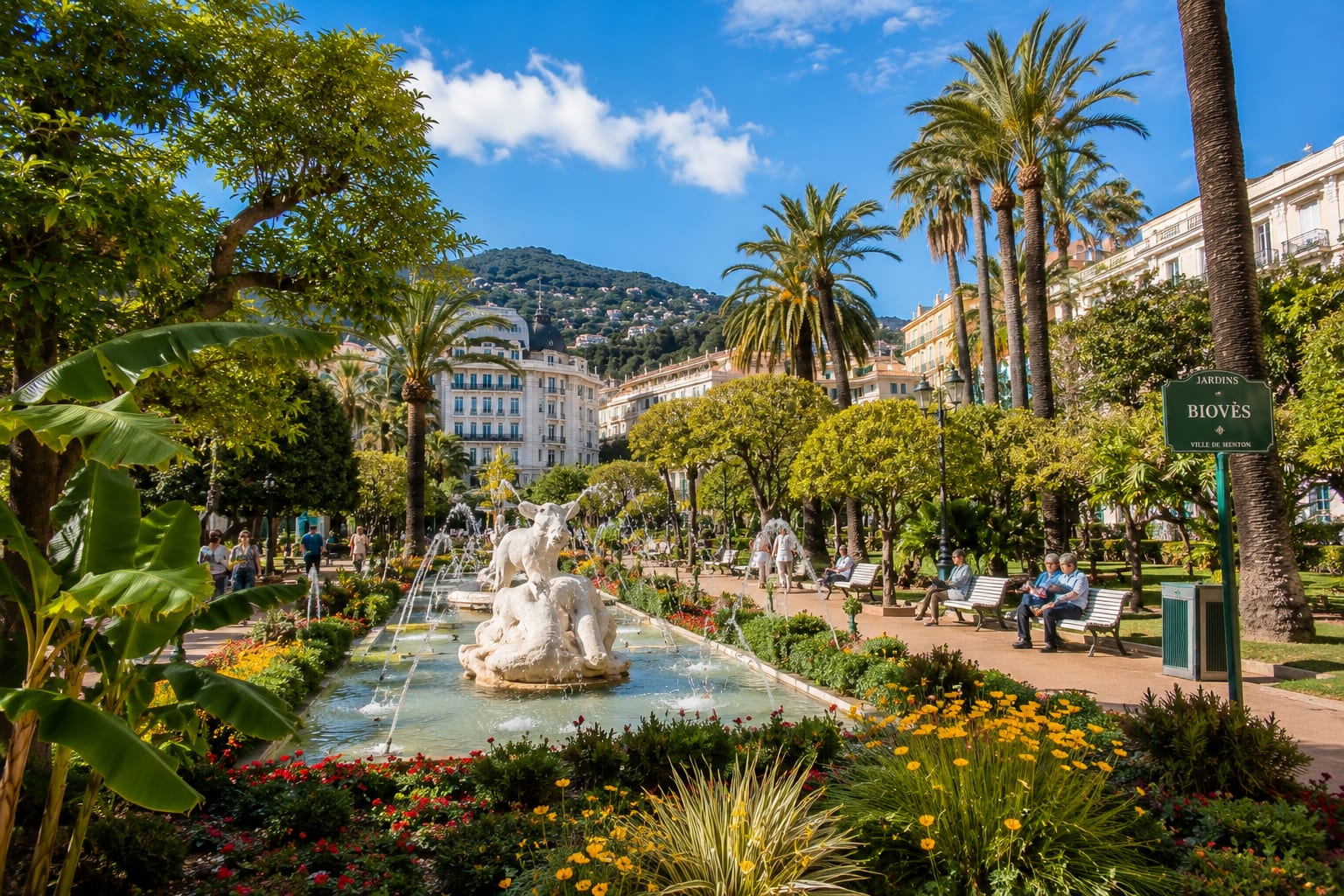
garden
garden
Jardins Biovès
Central gardens used for the Lemon Festival citrus sculpture displays and an easy town-centre walk.
Menton centre
5. Stop 3: Rue Partouneaux and the grand hotels of central Menton
Walk towards Rue Partouneaux. Today, this is part of Menton's everyday commercial and residential landscape. During the Belle Époque, it was closely connected to the infrastructure of the international winter resort. Several grand hotels were located around the street and surrounding avenues. Le Majestic Address: 1 Rue Partouneaux Le Majestic belongs to the remarkable collection of former palace hotels identified by the City of Menton. Today, the building survives as part of the urban fabric rather than functioning as the luxury hotel it once was. What to look for Examine the building's scale relative to neighbouring properties. Look at the repeated window bays, balconies, cornices and the balance of horizontal and vertical elements. Grand hotels were designed to accommodate many guests while still presenting an elegant unified façade. The repetition of windows and balconies wasn't accidental. It reflected the organisation of guest rooms and the commercial need to offer light, air and views. Other former hotels The official heritage walking route also identifies the former Hôtel du Louvre at 11 Rue du Louvre and former hotels along nearby central streets. You don't need to visit every one. Instead, use this part of the walk to learn how to recognise the architecture. Once you notice the distinctive scale, decorative façades and prominent balconies, you'll start spotting Belle Époque buildings throughout Menton. Access These are exterior heritage stops. Many former hotels are now residential properties. Do not enter private building entrances, courtyards or staircases without permission. The municipality has installed heritage information plaques at numerous former palace sites. These are useful for identifying the buildings without entering them.
civic
civic
Le Majestic
Former palace hotel, now a private property. Admire the façade from the public street only.
1 Rue Partouneaux, 06500 Menton
civic
civic
Ancien Hôtel du Louvre
Former grand hotel in central Menton; exterior heritage stop, not a public interior visit.
11 Rue du Louvre, 06500 Menton
6. Stop 4: L'Orangeraie, a surviving grand hotel atmosphere
Address: 15 Rue Partouneaux L'Orangeraie was originally the Grand Hôtel de Venise, established towards the end of the nineteenth century. Unlike many of its contemporaries, it remains part of Menton's hospitality landscape. The building and garden retain a connection with the town's grand-hotel tradition. What makes it interesting? Belle Époque hotels weren't simply places to sleep. They combined accommodation, leisure, garden design and a particular vision of refined Mediterranean living. At L'Orangeraie, the garden is an essential part of the story. The relationship between architecture and planted outdoor space illustrates the expectations of wealthy winter visitors. Can you visit the garden? The tourist office offers organised guided tours of L'Orangeraie's garden. At the October 2026 check, the advertised adult price was €4, with scheduled sessions published through the official booking calendar. The tour introduces the building's history and garden design. However, don't assume unrestricted garden access simply because the hotel remains open. If you're not a guest or customer, enter private areas only as part of an authorised visit. Official booking information:L'Orangeraie Garden Guided Visit
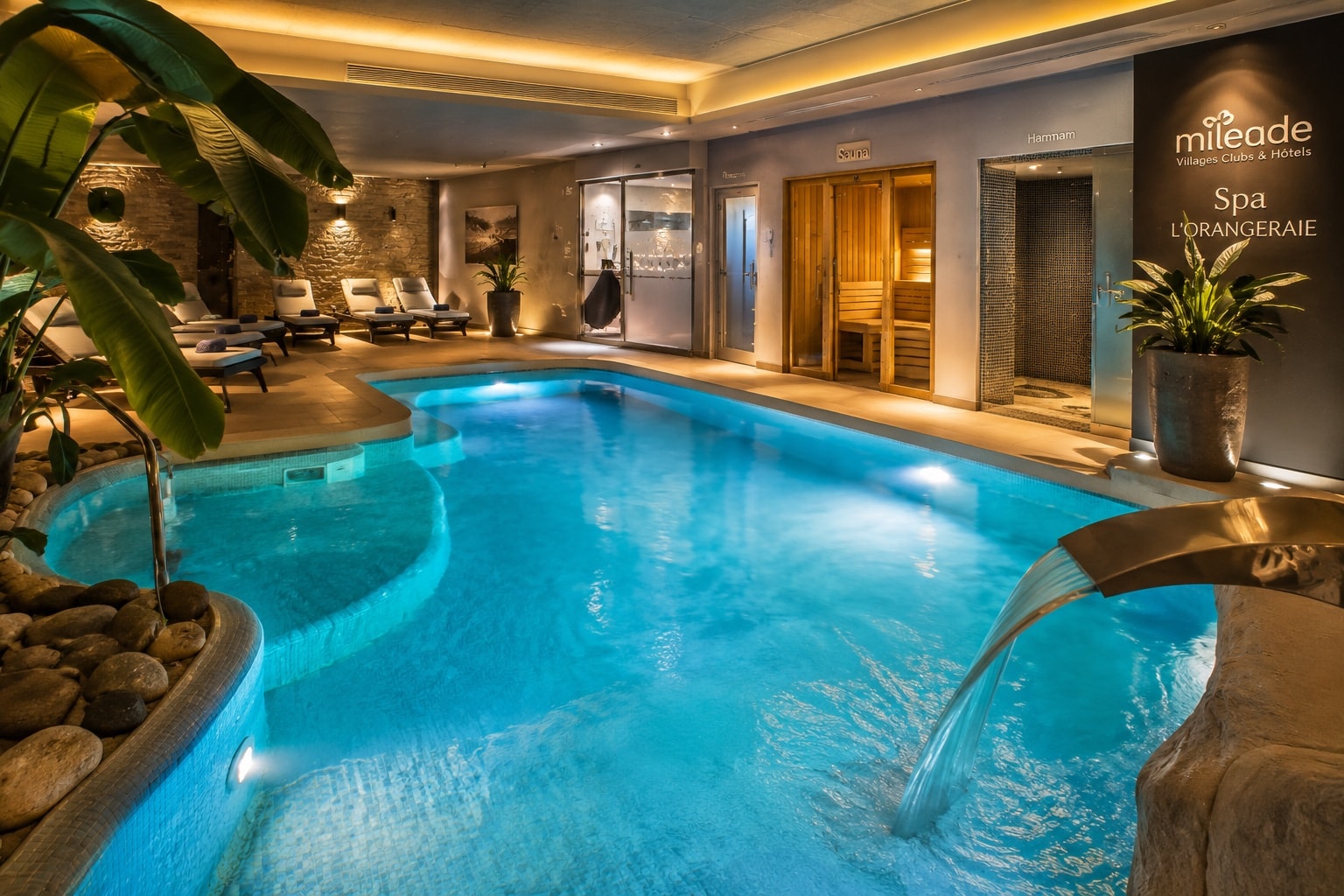
fitness centre
fitness centre
Hotel L'Orangeraie - Mileade Spa
A central hotel wellness area with a relaxation pool, sauna, hammam and treatment rooms. Ask directly about access for non-resident guests.
15 Rue Partouneaux, 06500 Menton
7. Stop 5: Royal Westminster and Balmoral, the palaces that survived as hotels
Continue towards the seafront. Here, two historic hotels offer an opportunity to see Belle Époque architecture still serving its original broad purpose. Royal Westminster Address: 28 Avenue Félix Faure The Royal Westminster is among Menton's surviving historic palace hotels. Its large seafront-facing façade reflects the importance of location to the winter resort. Guests wanted easy access to the promenade, views of the Mediterranean and the prestige of a prominent building. What to look for Study the long façade and its arrangement of balconies and windows. Notice how the building addresses the sea rather than turning inward. The architecture was part of the hotel's identity and advertising. Le Balmoral Address: 38 bis Avenue Félix Faure Nearby, Le Balmoral is another surviving historic hotel property. Together, these buildings help explain the density of high-end accommodation that once characterised the Menton waterfront. Why are they different from the former palaces? Some historic hotels have been converted into private apartments. Royal Westminster and Balmoral, by contrast, continue to function as hospitality establishments. That makes their original purpose easier to imagine. But working hotels are not public museums. Access Their façades can be admired from the public street and promenade. Hotel interiors, gardens and terraces are subject to the establishment's own guest and customer policies. You may be able to enjoy a restaurant or café as a paying customer, but don't assume unrestricted access to reception areas, lounges or upper floors.
civic
civic
Royal Westminster
Historic seafront hotel still operating. Interior, garden and restaurant access follows the hotel's customer policies.
28 Avenue Félix Faure, 06500 Menton
civic
civic
Le Balmoral
Operating historic hotel. View the façade from public space; do not assume unrestricted access to rooms or gardens.
38 bis Avenue Félix Faure, 06500 Menton
8. Look up: how to read a Belle Époque façade
Before continuing uphill, take a moment to examine what you've already seen. Menton's Belle Époque architecture is eclectic rather than uniform. Some buildings follow disciplined neoclassical principles, while others borrow freely from Italian, French and occasionally Moorish decorative traditions. Here's a simple visual guide. Try comparing two buildings. One may look strict and symmetrical, while another seems almost theatrical. Both can belong to the Belle Époque because the term describes a historical period rather than a single architectural style.
| Architectural detail | What to look for | Why it matters |
|---|---|---|
| Balconies | Stone balustrades or decorative iron railings | Outdoor living, air and views |
| Cornices | Projecting horizontal mouldings near the roof | Create a formal visual finish |
| Pilasters | Flat column-like elements attached to façades | Introduce classical rhythm |
| Pediments | Triangular or curved decorations over windows | Evoke classical architecture |
| Bay windows | Windows projecting beyond the façade | Increase light and views |
| Towers and roof pavilions | Decorative roof structures | Give buildings a recognisable silhouette |
| Stucco and floral motifs | Sculpted plants, garlands and scrollwork | Express luxury and fashionable taste |
| Terraces and gardens | Landscaped spaces facing the sea | Link architecture with climate and leisure |
9. Stop 6: Winter Palace, a hotel built to impress Europe
Address: 20B Avenue Riviera The next section of the walk leads uphill. If you're comfortable with slopes, make your way towards Avenue Riviera. For visitors with limited mobility or anyone who prefers not to climb, consider local transport or a separate outing. At 20B Avenue Riviera stands the former Winter Palace. This is one of the most impressive survivals of Menton's era of luxury hospitality. The story of Winter Palace Designed by architect Albert Tournaire, the building was completed around 1901 and opened to guests on 1 January 1903. Its facilities reflected the expectations of the international elite. There were restaurants, reception rooms, entertainment spaces and landscaped gardens. The hotel became a symbol of the resort's ambition. What to look for The building's silhouette is particularly striking. Notice the two distinctive pyramid-roofed towers. Look at the monumental arrangement of the façade and the way the building dominates its surroundings. This wasn't architecture intended to disappear into the landscape. It was designed to be seen. Why build so high above the town? The hillside location offered views, air and a degree of separation from the busiest streets. During the Belle Époque, this could be a considerable advantage. Hotels marketed the experience of living above the Mediterranean, surrounded by gardens and panoramic scenery. Can you enter? No ordinary public interior access should be assumed. Winter Palace has been converted into private apartments. Its historic interest doesn't make the corridors, garden terraces or communal facilities open to visitors. The tourist office occasionally organises authorised heritage visits associated with former palace properties. These require confirmation and, where applicable, advance booking. For an independent walk, admire the exterior from public space. Heritage reference:French Ministry of Culture: Winter Palace
civic
civic
Winter Palace
Former palace hotel converted into private apartments. Uphill exterior stop; interiors and gardens require permission.
20B Avenue Riviera, 06500 Menton
10. Stop 7: Riviera Palace, the rivalry that shaped luxury
Address: 28 Avenue Riviera A short distance from Winter Palace stands another remarkable former hotel: Riviera Palace. The two buildings were once rivals. Their competition helps explain the extraordinary investment in luxury accommodation during the early twentieth century. A race to attract wealthy guests Riviera Palace was one of Menton's most prestigious hotels. To distinguish itself from competitors, its owners invested in improvements, extensions and luxurious interior arrangements. The former hotel included elegant reception rooms and an unusual wine cellar cut into the rock. These features were part of a competitive hospitality market attracting Europe's wealthy winter travellers. What to look for Notice the building's relationship with the slope. The architecture uses the hillside setting to create a commanding presence. Look at the terraces, balconies and the arrangement of the exterior spaces. The building communicates both elegance and exclusivity. Current access Like Winter Palace, Riviera Palace is now a private residential property. The façade can be appreciated from public areas. Do not enter residential gates or terraces without permission. The presence of historic architectural details doesn't create a public right of entry. The story behind the buildings Try imagining what these two hotels represented around 1905. They weren't simply places where visitors slept. They were competing worlds, offering dining, music, gardens, social events and exceptional views. Their architecture was designed to make that experience visible from a distance.
civic
civic
Riviera Palace, Menton
Menton's former Riviera Palace, not the similarly named Beausoleil property. Private apartments; view from public areas.
28 Avenue Riviera, 06500 Menton
11. Optional extension: villas, gardens and the eastern Riviera
The main route concentrates on central Menton's former hotels. If you'd like to explore the villa culture of the Belle Époque as well, consider a separate excursion towards Garavan. Villa Maria Serena Address: 21 Promenade Reine Astrid Built in 1886, Villa Maria Serena represents another aspect of the era: private Mediterranean villas surrounded by carefully designed gardens. The villa is associated with elegant historic architecture, while its garden is celebrated for subtropical planting. Palm trees and other exotic vegetation reflect the fascination with climate and botanical collecting during the period. Can you visit? The garden is accessible through organised guided visits rather than ordinary walk-in access. Reservations are required, and the route includes gradients and some steps. Do not assume unrestricted access to the villa interior. Consult the tourist office's current programme before making plans. For visitors who particularly enjoy gardens, this is a good complement to the former palace hotels. Other historic villas Menton and the surrounding coastline contain many other nineteenth- and early-twentieth-century villas. Some remain private homes. Others have been adapted for public, cultural or commercial use. Their exteriors may be visible from public roads, but access to gardens and interiors depends on individual arrangements. The purpose of this guide isn't to encourage visitors to search for ways into private estates. It's to understand the architecture while respecting the buildings' present use.
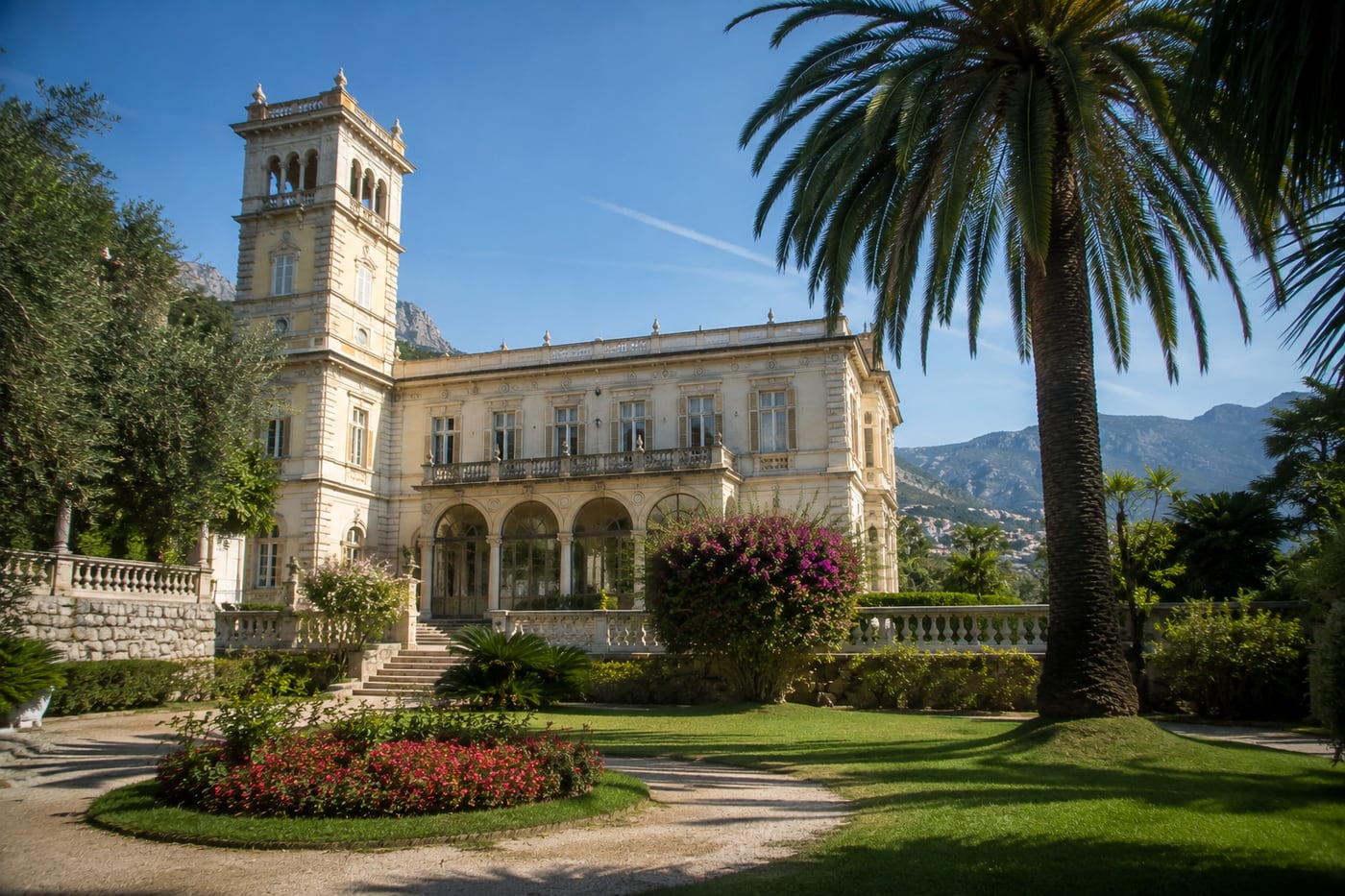
garden
garden
Villa Maria Serena
A historic Garavan villa and garden used as a filming location; access depends on municipal arrangements, tours or events.
Promenade de la Reine Astrid, 06500 Menton
Check current hours before visiting
12. How to choose the right version of the route
The easy central walk Duration: Approximately 60–90 minutes. Visit Palais de l'Europe, Jardins Biovès, Rue Partouneaux and the seafront hotels. This covers the main themes without the strenuous hillside extension. It's a good choice for visitors interested in architecture but not seeking a long walk. The complete architectural walk Duration: Approximately 2–3 hours. Follow the central itinerary, then continue towards Winter Palace and Riviera Palace. The uphill section requires additional effort. Choose suitable footwear and avoid the hottest summer hours. The architecture and gardens experience Duration: Half a day or longer. Combine the central walk with one authorised guided garden visit, such as L'Orangeraie or Maria Serena. Book the guided activity first, then arrange the walking route around the confirmed time.
13. Can you enter Menton's former palace hotels?
This is worth answering clearly. Many buildings that look like luxury hotels are now private residential properties. Their architectural significance doesn't mean visitors can enter. Generally accessible Public streets and promenades, ordinary paths in Jardins Biovès, the tourist office and other designated public areas. Conditionally accessible Operating hotel restaurants and public-facing facilities, depending on their current policies. Historic gardens or former palace grounds included in authorised guided visits. Normally private Residential entrances, internal staircases, private gardens, courtyards, balconies, hallways and roof terraces. Never follow residents through secured doors or assume that an open gate constitutes permission. For photographs, use public areas and respect people's privacy. The best viewpoint is often across the street, where you can appreciate the building's full proportions.
14. Join an official guided Belle Époque tour
If you'd like more historical context, Menton's tourist office offers a guided visit entitled La Belle Époque. The tour explores the development of the resort, its grand hotels and the international society that shaped the town. Published information for 2026 Starting point: Palais de l'Europe, 8 Avenue Boyer. Adult price: €8. Teenagers aged 14–18: €4. Language: French. Accessibility: The published guided route is not wheelchair accessible. Booking: Through the tourist office's scheduled programme. The guided tour is separate from this self-guided itinerary. Check the actual departure date and availability before making plans. Official Belle Époque guided tour
15. When is the best time for this walk?
Spring and autumn are particularly enjoyable. The weather is generally comfortable for walking, and the architecture can be appreciated without the strongest summer heat. Winter also has a special appeal. After all, Menton's historic grand hotels were built largely for winter visitors. A sunny January afternoon can provide a surprisingly appropriate atmosphere for exploring the town's Belle Époque heritage. In July and August, begin early and carry water, particularly if you're walking uphill towards Avenue Riviera. The central exterior itinerary is not dependent on museum opening hours, but guided interiors and garden visits require confirmed schedules.
Frequently asked questions
What is Belle Époque architecture? Belle Époque broadly refers to the period between the late nineteenth century and the outbreak of the First World War in 1914. Its architecture often combines historical styles, decorative façades, modern comforts and an emphasis on elegance. Why are there so many former luxury hotels in Menton? Menton developed into a fashionable European winter resort, attracting wealthy visitors seeking the mild Mediterranean climate. Numerous luxury hotels were built to accommodate them. What are the most impressive former palace hotels in Menton? Winter Palace and Riviera Palace are particularly striking examples. Other important historic hotels include L'Orangeraie, Royal Westminster, Balmoral and several former palaces around central Menton. Can you visit Winter Palace? The building is now a private residential property. Ordinary public interior access isn't available, although authorised heritage visits may occasionally be organised. Is Riviera Palace open to tourists? Not as a conventional hotel or public museum. Its exterior can be admired from public areas, and special heritage visits may be available when organised. Can you enter L'Orangeraie's garden? The tourist office offers organised guided garden visits on published dates. Independent public access shouldn't be assumed. Is the walking route free? Yes. The outdoor self-guided route is free. Organised tours or access to special interiors and gardens may require payment. Is the walk suitable for visitors with limited mobility? The central part is more manageable. The extension towards Winter Palace and Riviera Palace involves uphill walking. Exact gradients and continuous wheelchair accessibility have not been independently measured for this guide. How long should I allow? Approximately one to one and a half hours for the central section, or two to three hours including the hillside former palaces.
Final thoughts: the grand hotels that became part of the city
Menton's Belle Époque architecture tells an unusual story. The buildings were created for a very specific world: wealthy winter visitors, international society and the belief that Mediterranean sunlight was both fashionable and restorative. Many of the people who stayed in those grand hotels have long been forgotten. The hotels themselves have changed. Some continue to welcome guests. Others have become apartment buildings, offices or cultural institutions. But the façades remain. Their balconies, towers, terraces and decorative details still reveal the ambitions of the people who built them. That's what makes this walk so rewarding. You're not simply looking at beautiful buildings. You're discovering how Menton became one of the Riviera's great winter resorts, and how its architecture continues to shape the city long after the original hotels have disappeared. Look up, take your time and enjoy the details. Sometimes the most interesting part of Menton is above eye level.
Official sources and further reading
Menton Tourist Office: The Belle Époque Route City of Menton: Former Palace Hotels Official Belle Époque Guided Tour French Ministry of Culture: Winter Palace L'Orangeraie Garden: Guided Visits Explore More AzurMenton Guides Historical and access information reviewed on 28 October 2026. The walking itinerary is an editorial route based on published heritage information, not a field-measured accessibility survey. Private property, opening arrangements and guided-tour availability must be respected.