Menton to Monaco
Often one of the simplest options, especially during busy event periods.
Useful links
The Monaco marketplace that was actually in Menton
There's something rather wonderful about the way cinema changes geography. A film needs a bustling marketplace in Monaco in the early 1960s. But Monaco has changed dramatically since then. Modern buildings, busy roads and urban development make it difficult to recreate the Principality as it appeared sixty years earlier. So the filmmakers travel a few kilometres east. They find a beautiful square surrounded by historic architecture, with an impressive baroque church, patterned paving and narrow streets leading towards the Mediterranean. The cameras begin rolling.
And suddenly, Menton becomes Monaco. This is one of the most interesting location stories behind Grace of Monaco, the 2014 historical drama starring Nicole Kidman as Princess Grace Kelly. The production used the square in front of Menton's Basilica of Saint-Michel-Archange to represent a marketplace in Monaco. Today, visitors can explore that same public square, discover its real architectural history and understand why filmmakers chose it. But there's a second story here.
Grace of Monaco is a fictionalised interpretation of real historical events, and its portrayal of the Princess and the political crisis of 1962 was publicly disputed by Monaco's Princely Family. This guide keeps three things separate: the actual filming location, the place it represents on screen, and the historical events behind the screenplay.
| Context | What to know |
|---|---|
| Actual filming location | Parvis Saint-Michel, Menton |
| On-screen setting | A Monaco marketplace in 1962 |
| Historical background | The France–Monaco tax dispute, not a documentary biography |
1. About the film
Grace of Monaco (2014)
Director: Olivier Dahan
Princess Grace: Nicole Kidman
Prince Rainier III: Tim Roth
Screenwriter: Arash Amel
Genre: Historical drama
Historical setting: Primarily Monaco in 1962
Cannes premiere: 14 May 2014, as the opening film of the 67th Cannes Film Festival
The film explores a period when Grace Kelly had been Princess of Monaco for approximately six years. Once a celebrated Hollywood actress, she was adapting to the demands of royal life while navigating questions about family, public duty and her former career. The screenplay places those tensions against the political crisis between Monaco and Charles de Gaulle's France. It also incorporates the possibility of Grace returning to cinema through a proposed collaboration with Alfred Hitchcock.
The result is a romanticised historical drama about identity, marriage and public responsibility. It should be approached as a filmmaker's interpretation rather than a documentary reconstruction.
2. Where was Grace of Monaco filmed in Menton?
The strongest individually identified Menton location is Parvis Saint-Michel, the square directly in front of the Basilica of Saint-Michel-Archange. The location is independently confirmed by French tourism sources and reporting on cinema locations along the Riviera.
What did it represent?
A marketplace in Monaco. The scene uses Menton's historic architecture to evoke the Principality during the period in which the film takes place.
Why was Menton chosen?
Olivier Dahan explained in the film's official production notes that Monaco had changed too much since 1962 to provide every required period setting. The production therefore used Menton and parts of Italy to recreate the atmosphere of the earlier Riviera. Other scenes were filmed in Monaco itself, while the royal residence was recreated using sets and historic buildings elsewhere. The director described the resulting setting as a deliberately imagined Monaco.
Filming-location evidence
The table distinguishes the verified filming site from nearby places that are interesting to visit but have not been individually identified as camera positions.
| Location | What it represents | Verification |
|---|---|---|
| Parvis Saint-Michel, Menton | Monaco marketplace | Independently documented |
| Surrounding old-town streets | Architectural context for the location | Useful visitor extension; precise individual shots not established |
| Monte Carlo, Monaco | Actual Principality exteriors | Confirmed production location |
| Royal Palace, Genoa | Elements of the fictional palace environment | Confirmed in production accounts |
| Belgian locations and studio sets | Palace interiors and other settings | Confirmed in production accounts |
3. Parvis Saint-Michel: the square that became Monaco
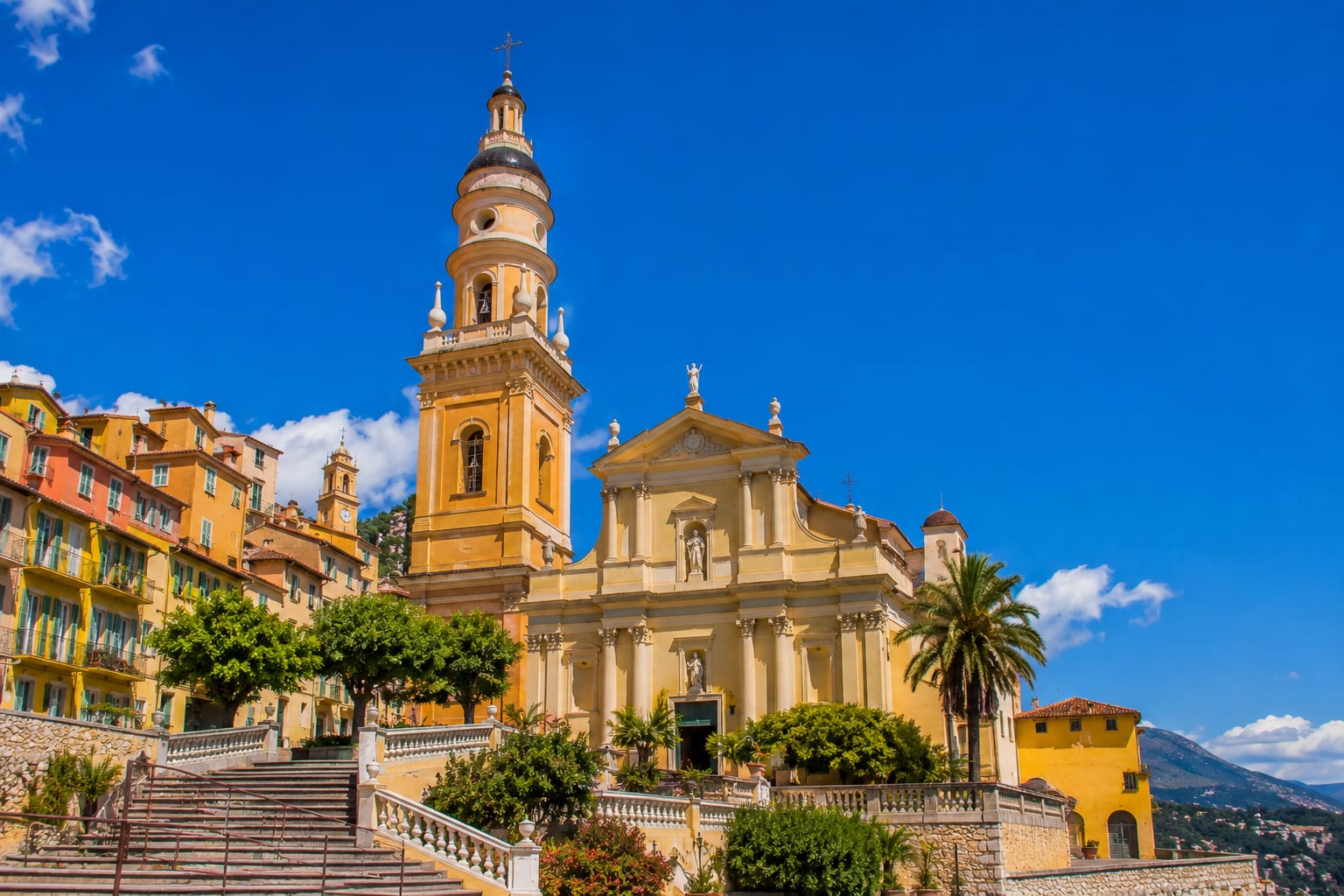
Location: Parvis Saint-Michel, Menton's old town. This is the essential destination for the entire walk. The Basilica of Saint-Michel-Archange stands above Menton's colourful historic centre, surrounded by architectural details that make the square feel almost theatrical. Its pale baroque façade, tall bell tower, historic paving and neighbouring buildings create an unusually complete Mediterranean setting. It's easy to understand why a film crew would find it attractive.
Look at the square before thinking about the film
The basilica has a history reaching back to the seventeenth century. The church was opened for worship in 1653 and consecrated in 1675, although its architecture continued evolving afterwards. The square is famous for its patterned pebble paving. The neighbouring Chapel of the White Penitents adds another historic façade to the setting. Together, these buildings create one of Menton's most distinctive public spaces.
Now imagine the film crew arriving
For a period marketplace, the filmmakers need more than an old building. They need an environment in which modern details can be hidden or controlled. Parvis Saint-Michel offers a coherent architectural background. The camera can frame the basilica, paving and surrounding buildings while excluding parts of the contemporary town. With period costumes, market stalls, props and carefully controlled movement, the square becomes a plausible version of Monaco. The audience follows the characters and accepts the setting. The real national border has disappeared through filmmaking.
What should you compare?
If you have the film available for reference, pay attention to the architectural details behind the market action. Look for the church façade, the proportions of the square, the distinctive paving and adjoining buildings. Those are more reliable identifiers than temporary stalls, costumes or decorative props. Verification note: The square's role as a filming location is established, but an independently verified exact scene timestamp and camera-position map are not yet available for this guide.
civic
civic
Basilica Saint-Michel-Archange
Menton's old-town landmark above the sea, useful for classic views, music-video mood and visual walks.
Place de l'Eglise, 06500 Menton
4. How to visit the real square
Parvis Saint-Michel is a public historic space. You don't need to purchase a film-location ticket or join a special tour to appreciate it. However, getting there requires some walking.
From Menton's lower old town
Begin around the lower pedestrian streets and head towards the historic steps leading up to Saint-Michel. The approach itself is part of the experience. Colourful façades, narrow passages and changing views over the rooftops reveal how the old town climbs the hillside. Allow time to stop along the way.
At the square
Begin by looking towards the basilica. Then turn around and examine the relationship between the square, nearby rooftops and the sea. Think about how much of this setting a filmmaker could include in a single shot. A camera placed at one edge of the square may make the surrounding architecture appear almost enclosed. A wider view reveals Menton spreading towards the Mediterranean. The place remains the same. The perceived geography changes through framing.
Can you enter the basilica?
Interior access depends on religious services, opening arrangements and special events. The basilica is not simply a film set, and it remains an active religious building. Treat the interior as a separate cultural visit rather than assuming it was used for the market scene.
Accessibility
The traditional approach involves substantial stairs and slopes. The square is therefore not a suitable default destination for a step-free walking itinerary. Visitors with limited mobility should investigate current transport access and suitable drop-off arrangements rather than relying on the historic stairway.
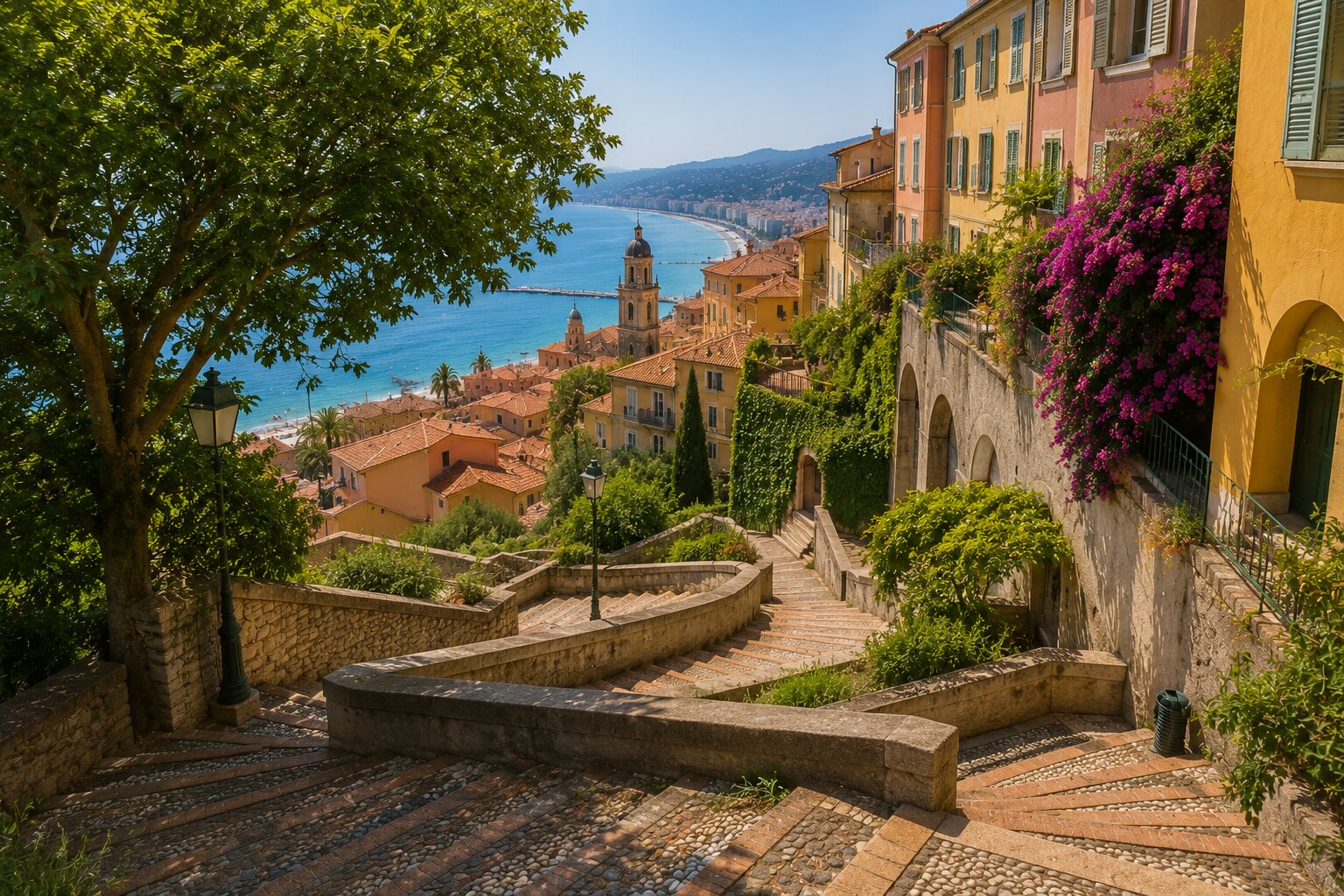
viewpoint
viewpoint
Les Rampes Saint-Michel
A classic old-town climb for colour, steps and sea-facing views.
Old town / Saint-Michel
Includes stairs; check an alternative if needed.
Source checked:
5. Why filmmakers preferred Menton to modern Monaco
It's tempting to assume that filming a story set in Monaco must require the production to shoot in Monaco. But historical dramas face a different problem. They need a place that looks right for the period. A location's present-day identity matters less than its visual compatibility with the fictional setting.
The real Monaco of 1962
By 1962, Monaco was already an established international destination, associated with royalty, tourism, finance and luxury. But its urban appearance was very different from today. The decades that followed brought substantial changes to the waterfront, road infrastructure and cityscape. Recreating the earlier Principality therefore required careful location choices.
Menton's advantage
Menton's old town retains architectural spaces that have avoided the same scale of modern redevelopment. Its narrow streets and historic square can evoke a different period without needing to construct every building. The town also shares a Mediterranean architectural vocabulary with the wider region. Its Italianate façades, baroque monuments and strong relationship with the sea create a convincing visual environment. But similarity doesn't make the two towns historically interchangeable. Menton is in France. Monaco is a sovereign Principality.
And the film uses one to represent the other. That's the central distinction of this guide.
6. What about the palace interiors?
The Saint-Michel marketplace is only one part of the production's constructed geography. Olivier Dahan explained that the filmmakers rebuilt the palace through studio work and location filming in historic palaces in Italy and Belgium. The production used the Royal Palace in Genoa for some of the palace environment, while Belgian locations and sets contributed additional spaces. Other scenes were filmed in Monaco itself.
Why use multiple buildings?
Because one historic building may have the perfect exterior but an unsuitable interior. Another may have a magnificent hall but stand in a completely different country. A third may provide the right staircase or office. The production connects these separate environments through costumes, lighting, production design and editing. The audience experiences a unified royal residence. The physical locations are scattered across Europe.
This is particularly relevant to Grace of Monaco, because its portrayal of the Principality is visually persuasive even when its settings are geographically composite.
7. What really happened between France and Monaco in 1962?
The film's political background is based on a genuine historical crisis. In 1962, relations between Monaco and France deteriorated over taxation and the treatment of French nationals and businesses established in the Principality. The dispute involved the French government under President Charles de Gaulle and the government of Prince Rainier III. The crisis was serious enough to challenge the relationship between the two neighbouring states.
The documented outcome
Negotiations eventually produced a new fiscal convention between France and Monaco, signed on 18 May 1963. The agreement established rules concerning taxation and administrative cooperation. It entered into force on 1 September 1963. This is documented in French governmental publications and Monaco's legal records.
What should viewers be cautious about?
The existence of the crisis doesn't establish that the film's private conversations, personal motivations or dramatic interventions occurred as depicted. A real political event can be transformed into a very different narrative when a screenplay places one character at its emotional centre. The filmmakers used the crisis as a backdrop for Grace's personal transformation. That's a legitimate subject for dramatic storytelling, but it shouldn't be confused with a sourced account of diplomatic negotiations.
8. How historically accurate is Grace of Monaco?
This question is unusually important because the film's historical interpretation was challenged publicly. On 2 May 2014, shortly before its Cannes premiere, the Princely Palace issued a statement distancing the family from the production. The Palace argued that the film contained historical inaccuracies and fictional elements and should not be treated as a biographical account of Princess Grace. The filmmakers, meanwhile, approached the material as an interpretative historical drama.
The production notes discuss the deliberately stylised visual world and the use of cinematic references, including Hitchcock-inspired costume ideas.
Three useful distinctions
The most useful way to enjoy the film is to recognise both things at once. It draws on real history. And it reshapes that history into a highly stylised personal drama.
| Element | Historical status |
|---|---|
| Grace Kelly became Princess of Monaco in 1956 | Documented fact |
| Prince Rainier III ruled Monaco during the 1962 crisis | Documented fact |
| France and Monaco experienced a serious tax dispute | Documented fact |
| A fiscal agreement was signed on 18 May 1963 | Documented fact |
| Grace's private conversations and internal conflicts as shown | Dramatised interpretation |
| Her precise role in resolving the crisis as depicted by the film | Not established by the diplomatic record cited here |
| Menton's Saint-Michel square as a Monaco marketplace | Screen geography, not historical geography |
9. A short filming-location walk in Menton
For this film, the genuinely verified Menton location is compact. There's no need to invent a large itinerary of supposed scenes. Instead, combine the actual filming square with the surrounding historic environment.
Stop 1. Rue Longue: enter the old town
Begin in Menton's historic streets. Rue Longue provides an atmospheric introduction to the architecture of the area. Its narrow perspective, closely spaced buildings and stonework are useful for understanding why the old town attracts film productions. Important: Rue Longue is a contextual stop. Its use as a specific Grace of Monaco filming location has not been independently confirmed.
Stop 2. The Saint-Michel steps
Continue uphill towards the basilica. The stairway reveals the town's steep topography and the dramatic transition from the lower streets to the elevated square. Pause where it's safe to appreciate the perspective. This is part of the route to the confirmed filming location, not a separately verified scene from Grace of Monaco.
Stop 3. Parvis Saint-Michel: the actual screen location
Spend the most time here. Examine the façades and paving. Imagine the square populated by extras, market stalls and period costumes. Look for architectural details that could help match the real space with the marketplace shown on screen. This is the central verified stop.
Stop 4. Les Sablettes: see the wider town
Finish by descending towards Esplanade des Sablettes. From the waterfront, look back at Menton's old town and the basilica rising above it. The view explains how compact the historic setting is. It also makes the distinction between real and screen geography clear. You are looking at Menton, not Monaco. Route duration: Approximately 45–90 minutes, depending on stops and walking pace. The itinerary includes stairs and uneven historic surfaces.
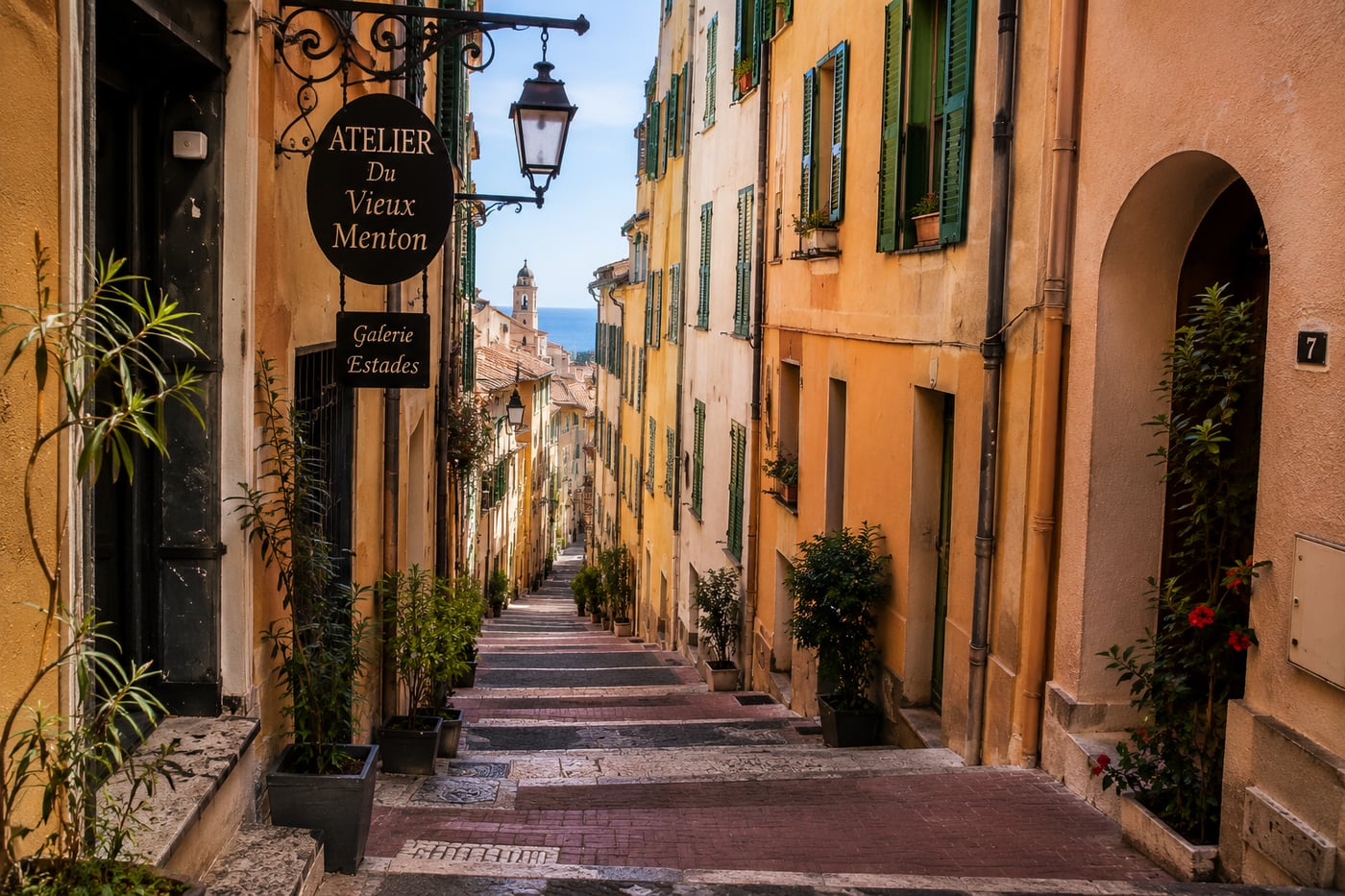
neighbourhood
neighbourhood
Rue Longue
A narrow old-town street with warm facades and steep visual rhythm; a useful stop on the Menton-on-screen walk.
Rue Longue, 06500 Menton
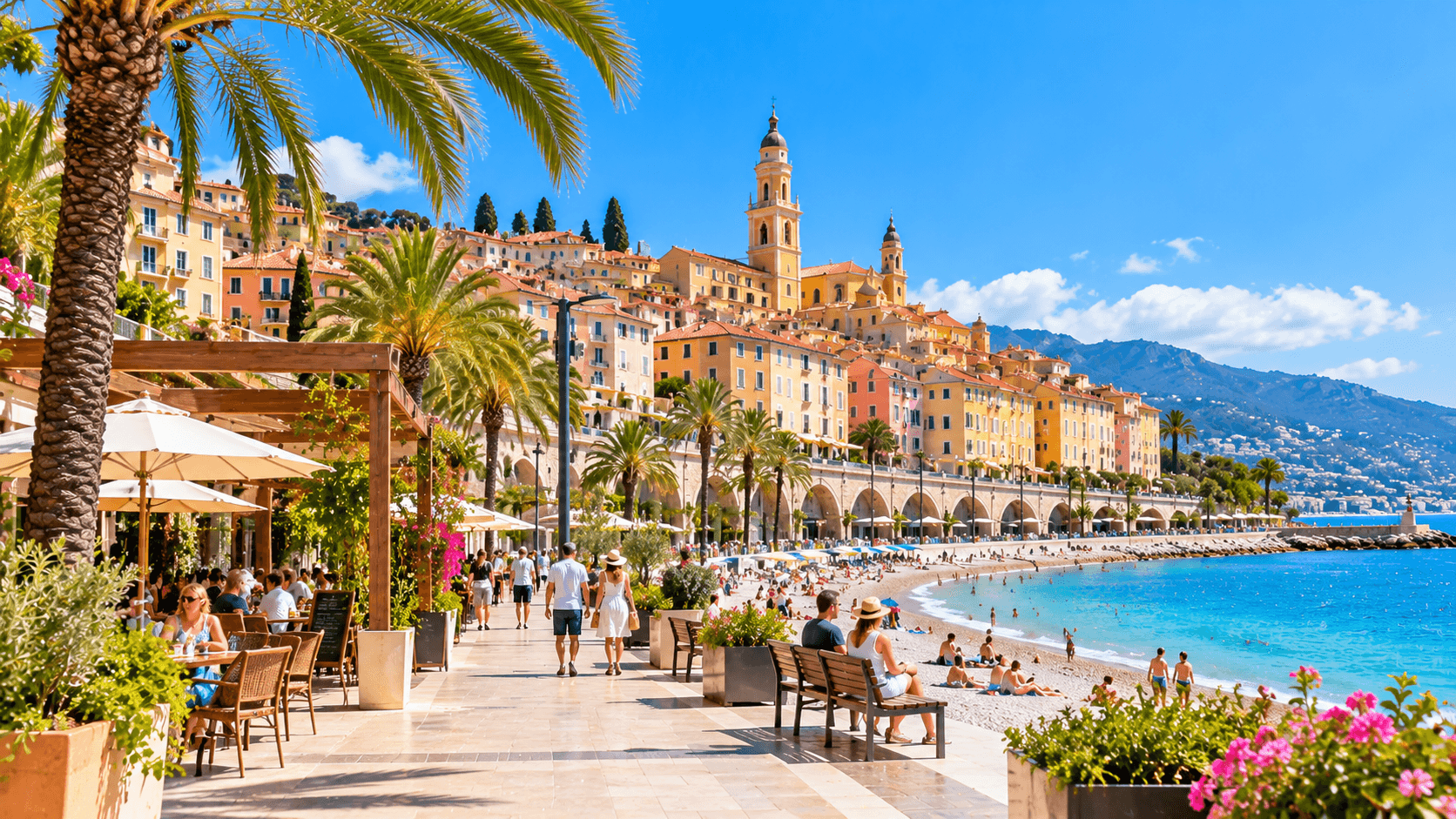
viewpoint
viewpoint
Esplanade des Sablettes
Pedestrian esplanade below the old town, distinct from the beach. Operator-reported wheelchair access; confirm your entrance, level changes and any lift before relying on it.
Esplanade des Sablettes, 06500 Menton
The published accessibility classification is not a measured survey of every approach. Beach access and seasonal assisted bathing are separate.
Source checked:
10. How to compare the real location with the film
For visitors interested in filming locations, the most useful activity is a comparison between the screen image and the present-day square.
Before your visit
Watch the marketplace sequence and note identifiable background features. Record the timestamp in your particular edition of the film. Different releases and streaming platforms may have slightly different cuts or timings.
At Saint-Michel
Compare the architecture first. Look for columns, doorways, windows, paving and changes in ground level. Then consider which temporary elements the production added. Market stalls, signs, vehicles and costume details may have been created specifically for filming.
After your visit
Compare your photographs with the scene again. You may notice how selectively the camera uses the location. A few metres of real architecture can become an entirely different place on screen.
What remains unverified?
Although independent sources identify Parvis Saint-Michel as the marketplace location, we haven't completed a frame-by-frame audit establishing exact camera positions. For a future Then & Now feature, the strongest editorial improvement would be a documented comparison of a legally sourced film still with a present-day photograph from the same public viewpoint.
11. Is this walk worth doing if you haven't seen the film?
Yes. Parvis Saint-Michel is one of Menton's most remarkable historic spaces. The basilica, historic paving and surrounding streets are worth exploring independently. The film provides an additional story about the location. It shows how an ordinary public square can acquire another identity through cinema. For visitors who have already watched Grace of Monaco, that connection is particularly enjoyable. For everyone else, it's an introduction to both Menton's architecture and the craft of location filmmaking.
Frequently asked questions
Was Grace of Monaco filmed in Menton?
Yes. Film France, the regional tourism authorities and independent reporting confirm filming in Menton. Parvis Saint-Michel is identified as a marketplace location.
Which Menton location appears in the film?
The square in front of the Basilica of Saint-Michel-Archange, in Menton's historic old town.
Does Menton represent Monaco in the film?
Yes. The Saint-Michel square was used to depict a marketplace in Monaco.
Why didn't the production film everything in Monaco?
Director Olivier Dahan explained that modern Monaco looked different from the Principality of 1962. The production therefore used locations in Menton, Italy and elsewhere to recreate the earlier setting.
Was the film shot inside Monaco's Princely Palace?
The palace environment was recreated using historic buildings and studio sets, rather than filming the main interior sequences inside the actual Princely Palace.
Is the square open to visitors?
Parvis Saint-Michel is a public historic square. The basilica interior has separate visiting and religious-service arrangements.
How long does the location walk take?
Allow approximately 45–90 minutes for the old-town approach, square and a waterfront finish.
Is the route accessible without stairs?
The traditional old-town route includes substantial steps and isn't a step-free itinerary.
Is Grace of Monaco historically accurate?
It is a fictionalised historical drama based on real people and events. Monaco's Princely Palace publicly disputed its accuracy in May 2014.
Was the 1962 France–Monaco crisis real?
Yes. The dispute concerned taxation and bilateral relations, and a new fiscal convention was signed in May 1963.
Does the guide reveal the film's ending?
No. It discusses the setting, production and historical background without recounting the final dramatic developments.
Final thoughts: one square, two identities
The square in front of Saint-Michel Basilica has always been part of Menton. Its architecture reflects the town's history, its relationship with the Mediterranean and the generations who built and maintained its historic centre. But for a few moments in Grace of Monaco, it becomes something else. A Monaco marketplace in 1962. The film's achievement isn't that it recreates every historical detail. It's that the camera makes a real French town convincing as a different place. For visitors, that creates an unusual opportunity.
You can stand in the actual location, appreciate its genuine history and then discover how cinema transformed it. And you can do so without confusing an evocative film scene with a documentary record of Princess Grace's life. Sometimes the most interesting thing about a filming location is not simply where the camera stood. It's where the filmmakers wanted us to believe it stood.
Official sources and further reading
Grace of Monaco, Festival de Cannes
Official Film Press Kit, Unifrance
French Tourist Office: Grace of Monaco Filming in Menton
Film France CNC: Production Locations
Prince's Palace of Monaco: Official Film Statement, 2 May 2014
French Government: France–Monaco Fiscal Convention
City of Menton: Basilica History
Genoa–Liguria Film Commission First-Hand Production Account
AzurMenton: Films Shot in Menton
Explore More AzurMenton Guides
Film-location and historical sources checked on 2 November 2026. Saint-Michel Square is a documented Menton filming location. The surrounding walking stops provide architectural context and are not independently established filming positions. The film is a fictionalised interpretation of historical people and events, not a documentary biography.