Menton to Monaco
Often one of the simplest options, especially during busy event periods.
Useful links
Menton to Nice
Good for museums, events, Jazz Fest, Carnival and airport access planning.
Useful links
Menton to Ventimiglia / Italy
A practical choice for markets, Italian food and a short cross-border trip.
Useful links
Monte Carlo assembled on screen
When the young heroine of Rebecca arrives in Monte Carlo, everything seems impossibly glamorous.
There are grand hotels, elegant rooms, Mediterranean gardens and beautiful coastal roads. She is working as a companion to the wealthy Mrs Van Hopper when she meets Maxim de Winter, a mysterious English widower.
Their acquaintance develops amid the sunshine and luxury of the French Riviera.
It's a world that appears to promise romance and freedom.
But viewers familiar with Daphne du Maurier's novel know that Monte Carlo is only the beginning.
Most of the story will unfold later at Manderley, Maxim's imposing English country estate, where the memory of his first wife becomes impossible to escape.
For director Ben Wheatley's 2020 adaptation, the contrast between the two worlds was essential.
The Riviera needed to feel bright, luxurious and full of possibility. Manderley needed to feel darker, older and psychologically oppressive.
The production found its Mediterranean settings in Nice, Antibes and Monaco.
Yet the finished screen geography is much more complicated than it first appears.
A former luxury hotel in Nice becomes a Monte Carlo hotel. A historic villa in Antibes provides an elegant Riviera setting. Contemporary reporting identifies Monaco's Exotic Garden among the settings of the couple's excursions; the Film France entry itself establishes Monaco at city level.
And some of the hotel's interiors were actually filmed in an English country house.
This guide explores the real locations behind those opening scenes and explains how several buildings, hundreds of kilometres apart, became one believable Riviera world.
You can visit many of the surrounding public spaces while staying in Menton.
But not every building is open to visitors, and not every part of the fictional hotel exists in the place where the film suggests it does.
1. About Rebecca (2020)
Title: Rebecca
Director: Ben Wheatley
Screenplay: Jane Goldman, Joe Shrapnel and Anna Waterhouse
Released on Netflix: 21 October 2020
Starring: Lily James, Armie Hammer, Kristin Scott Thomas, Keeley Hawes, Ann Dowd and Sam Riley
Based on: Daphne du Maurier's 1938 novel Rebecca
Production design: Sarah Greenwood
Genre: Gothic romance / Psychological drama
Running time: Approximately 123 minutes
In the film, Lily James plays the unnamed young woman who becomes the second Mrs de Winter.
Armie Hammer plays Maxim de Winter, while Kristin Scott Thomas portrays Mrs Danvers, the imposing housekeeper at Manderley.
The Monte Carlo opening introduces the heroine's uncertain position in a world of wealth and privilege.
She is staying in an expensive hotel, but only because she works for Mrs Van Hopper.
She belongs to the setting physically, not socially.
Her relationship with Maxim seems to offer an escape from that situation.
But the story soon moves away from Mediterranean sunlight towards the darker emotional world of Manderley.
How is this different from the original novel?
The broad premise comes from du Maurier's 1938 book.
However, the Riviera scenes in the film reflect the choices of a modern production team.
The camera locations are not necessarily the places described in the novel, nor do they establish the real-world inspiration for du Maurier's fictional hotel.
A literary setting and a filming location are two different things.
For the novel's Monte Carlo background, see our companion guide, Before Manderley: Rebecca's Monte Carlo and the Romance of the Riviera.
This article focuses specifically on the 2020 film.
2. The Riviera filming locations at a glance
The French locations are confirmed in Film France-CNC's official production listing. Their exact screen functions are further described in interviews with production designer Sarah Greenwood, National Trust material and contemporary film reporting.
Precise frame-by-frame camera positions have not all been independently established.
| Real location | Screen role or production use | Visitor access |
|---|---|---|
| Le Régina, Nice | Exterior and hotel environment representing Monte Carlo | Private residential building; exterior only |
| Villa Eilenroc, Cap d'Antibes | Riviera villa and garden sequences | Limited public access according to scheduled openings |
| Jardin Exotique de Monaco | Romantic garden scenes | Public ticketed garden |
| Plage de l'Argent Faux, Antibes | Coastal filming location identified by Film France-CNC | Coastal access must be checked |
| Plage de la Croupatassière, Antibes | Additional coastal filming location | Access and terrain require verification |
| Grande Corniche | Riviera driving sequences | Road location, not a pedestrian film route |
| Waddesdon Manor, England | Parts of the fictional Monte Carlo hotel interiors | Separate country; not part of this Riviera itinerary |
3. Le Régina, Nice: a Monte Carlo hotel that wasn't in Monaco
Address: 71 Boulevard de Cimiez, Nice.
Le Régina is perhaps the most surprising Riviera filming location in Rebecca.
Its monumental façade was originally built for international winter visitors in the late nineteenth century.
The building opened as the Excelsior Hôtel Régina in 1897 and famously accommodated Queen Victoria during her visits to Nice.
Today, it is a residential property.
But for the 2020 film, the production temporarily returned it to the world of grand-hotel luxury.
Why was it chosen?
The building already had the right architectural character.
Its size, façades, balconies and Belle Époque appearance communicated the prestige expected of an expensive Monte Carlo hotel.
Production designer Sarah Greenwood explained that the team used Le Régina to recreate the glamorous hotel environment of the film's opening.
The filmmakers dressed and transformed the space to evoke the 1930s.
From royal hotel to private apartments
Le Régina's genuine history is interesting in its own right.
Queen Victoria stayed there during three winter seasons between 1897 and 1899.
During the twentieth century, the building's original hotel function ended.
It was converted into residential apartments.
Henri Matisse later acquired apartments there and worked in the building during his Nice period.
So this is a building with several distinct cultural identities.
A Victorian luxury hotel.
A residential landmark.
An artist's working environment.
And, for the 2020 film, a fictional hotel in Monte Carlo.
Can you visit?
Le Régina is not an operating public hotel or museum.
The building contains private residences.
You can appreciate its architecture from public streets, but visitors should not enter entrances, courtyards or residential areas without permission.
There is no reason to try to recreate the film's arrival scene by accessing private property.
What should you look for?
The façade's monumental proportions.
The relationship between balconies and windows.
The building's position on the Cimiez hillside.
And the way its architecture communicates an image of prestige even after its original hotel function has disappeared.
Suggested visit: 10–20 minutes for exterior observation, combined with a longer cultural walk through Cimiez.
viewpoint
viewpoint
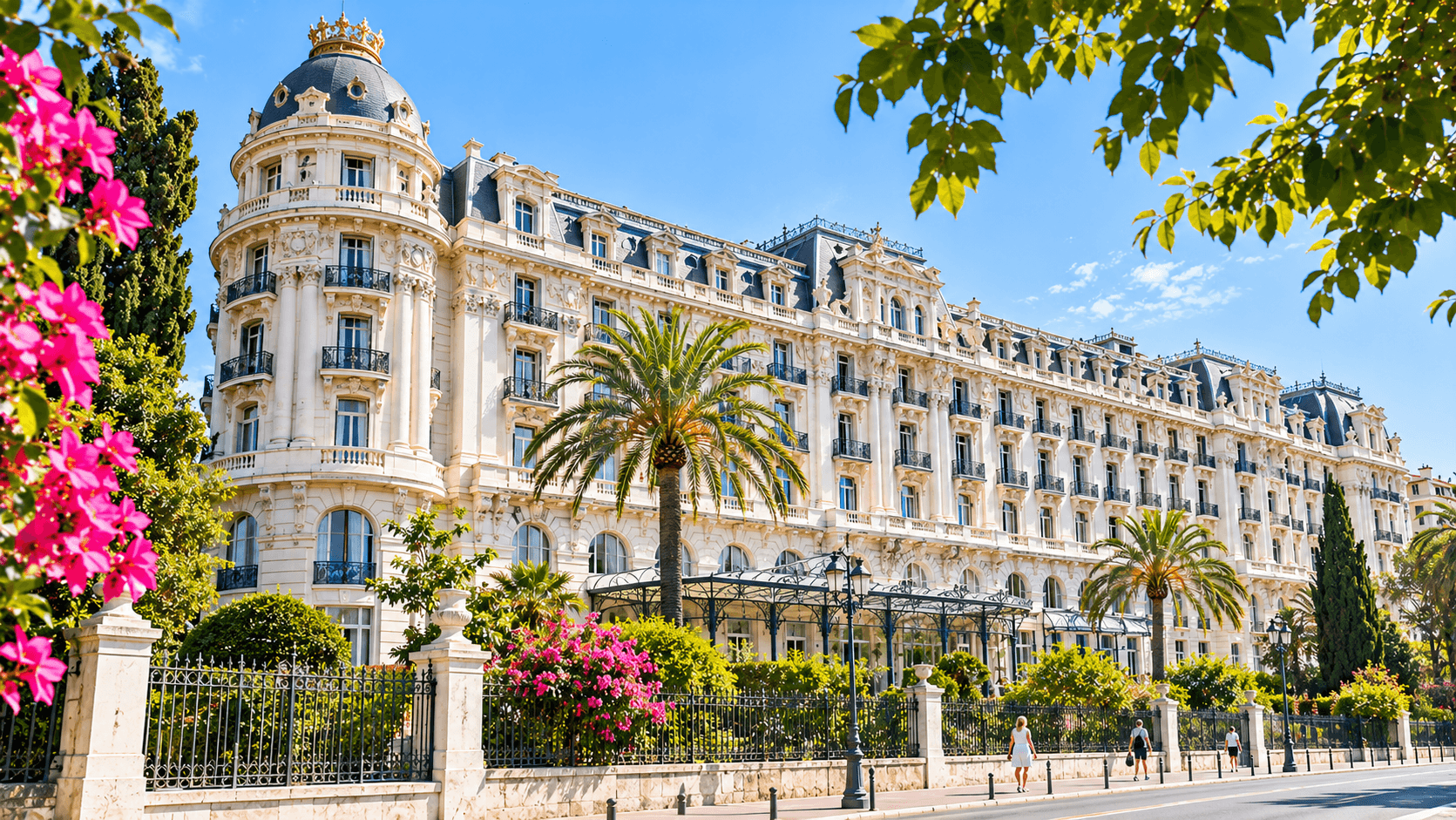
Le Régina / Ancien Excelsior Régina Palace
Former grand hotel where Matisse lived and worked. Not the Musée Matisse and no ordinary public apartment tour. Respect private entrances and gardens; combine public-street viewing with the separate museum.
71 Boulevard de Cimiez, 06000 Nice
Check current hours before visiting
4. Waddesdon Manor: the English interior of a Riviera hotel
This is one of the film's most interesting production details.
The fictional Monte Carlo hotel wasn't created using Le Régina alone.
Waddesdon Manor in Buckinghamshire, England, provided parts of its interiors.
The National Trust confirms that rooms in the manor were transformed into the glamorous hotel shown during the film's opening.
Which spaces were used?
The production made use of areas including the Breakfast Room, Dining Room, Conservatory and East Gallery.
Furniture, textiles and decorative objects were temporarily removed or replaced to accommodate the film's design.
How does this work on screen?
The heroine arrives at a hotel represented by a building in Nice.
A subsequent interior scene may take place in an English country house.
Editing connects the spaces.
Production design ensures that their decorative styles feel compatible.
The viewer accepts both as belonging to one fictional hotel.
In reality, the buildings are in different countries.
Why does this matter for a visitor?
Because it's easy to arrive at a real filming location expecting to recognise everything seen in the film.
But part of the screen building may never have existed there.
Le Régina is a genuine Nice landmark.
The Monte Carlo hotel is a constructed cinematic environment.
The distinction makes the production more interesting, not less.
5. Villa Eilenroc: the Riviera villa and gardens
Location: Avenue Mrs Beaumont, Cap d'Antibes.
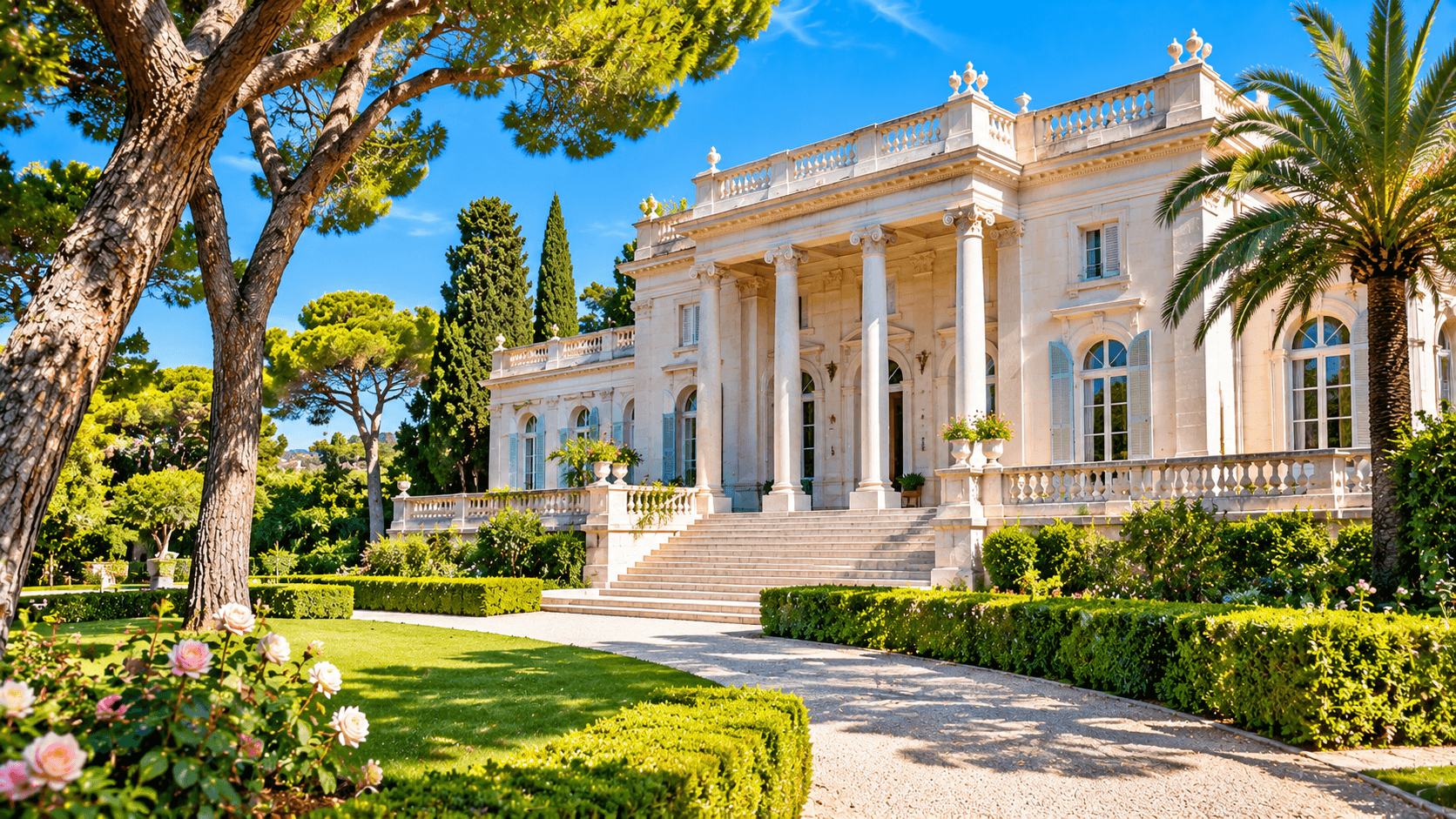
Villa Eilenroc is one of the most remarkable historic properties on the Cap d'Antibes peninsula.
Built in the nineteenth century, the villa stands within extensive landscaped grounds overlooking the Mediterranean.
Its elegant architecture, gardens and coastal location made it well suited to the romantic Riviera atmosphere of Rebecca.
What is confirmed about filming?
Film France-CNC lists Villa Eilenroc among the production's Antibes locations.
Contemporary reports of the shoot also identify it as part of the film's Monte Carlo and Riviera setting.
However, the exact exterior and garden shots should be matched with the film before specific features are labelled as definite camera positions.
What makes the estate attractive?
The balance between architecture and landscape.
The villa is formal and elegant.
Its gardens provide shaded paths, open views and Mediterranean planting.
The coastline creates a visual link with the sea and the surrounding peninsula.
These qualities support the film's romantic opening, in which the Riviera appears both luxurious and inviting.
Can you visit Villa Eilenroc?
The estate is owned by the City of Antibes and has been opened to visitors under specific schedules, events and garden-access arrangements.
It should not be treated as a property with guaranteed unrestricted daily admission.
Checked 4 November 2026: the dedicated municipal and tourism pages list Saturday opening, 10:00–17:00, last admission 16:30. Confirm your specific date and which rooms or gardens are included. Published sources disagree about winter admission: the municipal fee schedule lists free entry October–March, while the tourism listing still displays €2. Confirm directly rather than relying on either amount.
A public garden opening doesn't necessarily include access to every interior room.
An architectural visit beyond the film
Even without a specific frame comparison, Eilenroc is a worthwhile stop for travellers interested in historic Riviera villas.
Its architecture and landscape belong to the history of wealthy international residents who transformed Cap d'Antibes.
That is a real historical subject, separate from the fictional life of Maxim de Winter.
garden
garden
Villa Eilenroc
Municipal villa and gardens listed by Film France for Rebecca (2020). Limited openings, no unrestricted interiors; exact scenes unverified. Supplied artistic illustration.
Avenue Mrs Beaumont, 06160 Antibes
6. Jardin Exotique de Monaco: a romantic setting above the Principality
Location: Boulevard du Jardin Exotique, Monaco.
The Exotic Garden of Monaco is one of the film's most recognisable Mediterranean locations.
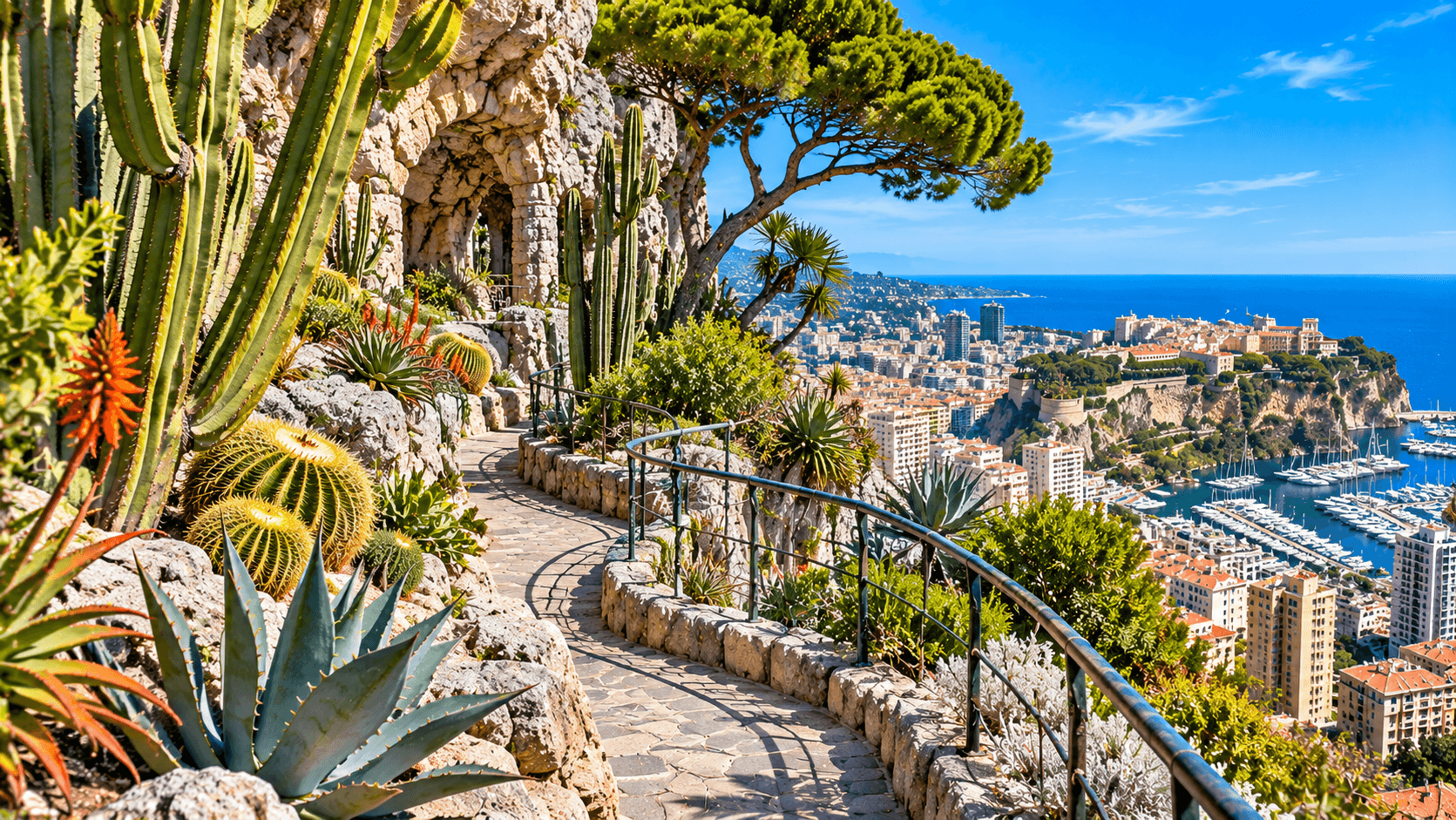
Built into the steep hillside above the Principality, it contains an extraordinary collection of succulent plants and offers extensive views over Monaco and the sea.
The garden opened in 1933, making its existence historically compatible with the broad period represented in the film.
Its role in Rebecca
Contemporary coverage reports the garden as a Riviera setting involving Maxim and the young narrator. This is not an independent verification of individual camera positions.
Contemporary production reporting identifies it as one of the settings for their excursions.
The landscape helps communicate a sense of romantic freedom away from the formal social world of the hotel.
A major visitor update for 2026
The Jardin Exotique reopened on 30 March 2026 following extensive renovation.
The official Monaco municipal website confirms the reopening and provides current visitor information.
The published standard adult admission is €12 for the garden alone.
Combined tickets with the Grotte de l'Observatoire or the botanical centre are also available.
Seasonal hours
The operator lists closures on 19 November and 25 December, as well as the 2026 Monaco Grand Prix period. Weather, maintenance or safety restrictions may also affect access.
Verify the relevant date before travelling.
Accessibility
The upper garden plateau is accessible to wheelchair users, but the full hillside layout includes steep paths and stairs.
Visitors requiring step-free access should confirm which areas are suitable.
Official website: https://www.jardin-exotique.mc/
Why it's worth visiting
This is one of the strongest locations in the article because it combines a documented film connection with a public garden that can actually be entered.
For visitors based in Menton, it makes an excellent half-day outing.
| Period | Published hours |
|---|---|
| January, November, December | 9:00–17:00 |
| February, March, April, October | 9:00–18:00 |
| May–September | 9:00–19:00 |
garden
garden
Jardin Exotique de Monaco
Reopened 30 March 2026. Rebecca garden connection reported by contemporary coverage, not a verified shot match. Wheelchair access only to upper plateau, not all paths or cave. Artistic illustration.
62 Boulevard du Jardin Exotique, 98000 Monaco
7. The Riviera beaches used in the film
Film France-CNC identifies additional locations around Antibes.
Among them are Plage de l'Argent Faux and Plage de la Croupatassière.
These are more specialised locations than the famous historic villas.
The importance of the coastal landscape
The film's Riviera sequence contrasts with the darker English landscape surrounding Manderley.
Here, the Mediterranean appears luminous and open.
The coastline provides the emotional setting for the narrator's growing attachment to Maxim.
Plage de l'Argent Faux
This rocky coastal area lies around Cap d'Antibes.
It's associated with the rugged shoreline rather than a large urban sandy beach.
Film France-CNC identifies it as a filming location.
However, exact camera positions and safe contemporary access points need further verification.
Plage de la Croupatassière
This is another coastal location identified in the official production list.
As with Argent Faux, the precise shot should not be assigned without comparing the film and contemporary geography.
Should you include both on a normal day trip?
Not necessarily.
The surrounding Cap d'Antibes coastline includes rocky terrain, private property and paths that may be difficult or temporarily closed.
A visitor shouldn't attempt to reach an uncertain camera position by climbing rocks or passing through private land.
For most readers, Villa Eilenroc and a properly accessible public coastal section will provide a more practical experience.
8. The Grande Corniche: Riviera driving scenery
Film France-CNC also lists Grande Corniche among the production's locations.
The catalogue groups this label under Antibes. Treat it as a production label, not a precise road segment, walking coordinate or verified continuous driving route.
The road and surrounding elevated coastline offer dramatic views and have long been popular with filmmakers.
What does the road contribute to Rebecca?
The Riviera scenes use movement between gardens, coastline and luxury settings to suggest freedom and possibility.
Road sequences help connect those places visually.
But the screen journey shouldn't be treated as a reliable driving map.
A car may be filmed on several roads and the results edited into one journey.
Visiting safely
This is a road location, not a recommended walking itinerary.
Use designated viewpoints, public transport or authorised parking where applicable.
Don't stop on narrow bends, tunnels or live carriageways to recreate a shot.
For this guide, the Grande Corniche is a production reference rather than a required visitor stop.
9. Where was Manderley filmed?
The central house in Rebecca is not on the Riviera.
The production assembled Manderley from several historic properties in England.
Director Ben Wheatley explained that no single house could provide everything the story required.
Principal English locations
Cranborne Manor: associated with major exterior views of Manderley.
Hatfield House: used for substantial interior sequences.
Osterley House: provided service areas and additional interiors.
Ham House: used for some private interior spaces.
Waddesdon Manor: served both parts of Manderley's broader production geography and the Monte Carlo hotel.
Other locations included Petworth House, Mapperton and parts of the Devon coastline.
Why include this in a Riviera guide?
Because the contrast between Monte Carlo and Manderley is essential.
The bright Mediterranean scenes aren't simply a pleasant opening.
They establish the emotional world the heroine believes she is leaving behind.
When she arrives in England, the architecture becomes darker and more imposing.
The film's production geography follows that narrative contrast.
A revealing filmmaking detail
The National Trust describes how the production sometimes moved between buildings that were dozens or hundreds of miles apart while presenting them as connected rooms.
That's the same technique used for the fictional Monte Carlo hotel.
One screen space.
Multiple real locations.
10. Novel, film and real geography: three different maps
For AzurMenton's Books & Films collection, this distinction is particularly important.
The fictional hotel
Du Maurier's Hôtel Côte d'Azur is a fictional establishment.
The 2020 film uses real properties to bring the hotel environment to life.
But neither Le Régina nor Waddesdon Manor should be advertised as the original hotel that inspired du Maurier.
The historic buildings
Le Régina has an authentic relationship with British winter tourism and Henri Matisse.
Villa Eilenroc has its own architectural and garden history.
Jardin Exotique is part of Monaco's botanical heritage.
These places are interesting independently of the fictional scenes created there.
| Layer | What it establishes |
|---|---|
| Daphne du Maurier's 1938 novel | The heroine meets Maxim in fictional Monte Carlo; most of the story later unfolds at Manderley |
| Rebecca (2020) | A cinematic version of Monte Carlo assembled from Nice, Antibes, Monaco and English interiors |
| Real filming locations | Historic buildings and landscapes with their own documented histories and visitor rules |
11. How to visit the Rebecca locations from Menton
The locations are spread across the Riviera.
Trying to visit all of them on foot or in one tightly scheduled afternoon would be inefficient.
Two separate outings are more enjoyable.
Itinerary A: Nice and the hotel that became Monte Carlo
Best for: Architecture lovers and visitors interested in the film's production design.
Allow: Approximately half a day, including transport.
Take the regional train from Menton to Nice.
Use suitable local public transport to reach Cimiez.
Visit the exterior of Le Régina from an authorised public viewpoint.
Continue towards the Cimiez gardens or Musée Matisse if you want to explore the wider neighbourhood.
Return to Menton.
What makes this itinerary valuable?
You can see the building that became the fictional Monte Carlo hotel.
But you also discover the real story of an important Nice landmark.
The neighbourhood's Belle Époque architecture makes the film's visual choices easier to understand.
Itinerary B: Monaco's Exotic Garden
Best for: Film enthusiasts, garden lovers and visitors seeking a relatively compact outing.
Allow: Approximately 2–3 hours, including local access and a relaxed visit, plus the train journey from Menton.
Travel to Monaco-Monte-Carlo by TER.
Continue to the Exotic Garden using a suitable local bus, pedestrian route or taxi.
Explore the garden during its published opening hours.
Enjoy the views before returning to Menton.
This is the most straightforward ticketed visitor experience among the three main Riviera locations.
Itinerary C: Villa Eilenroc and Cap d'Antibes
Best for: Visitors spending several days in Menton.
Allow: Half a day to a full day, depending on transport and public-opening arrangements.
Travel by regional train towards Antibes or Juan-les-Pins.
Arrange the final connection to Villa Eilenroc.
Visit only if an authorised opening or event has been confirmed.
If the villa isn't available, choose a public coastal walk elsewhere on Cap d'Antibes rather than attempting to enter the estate.
The visit involves more logistical planning than the Monaco garden.
museum
museum
Musée Matisse
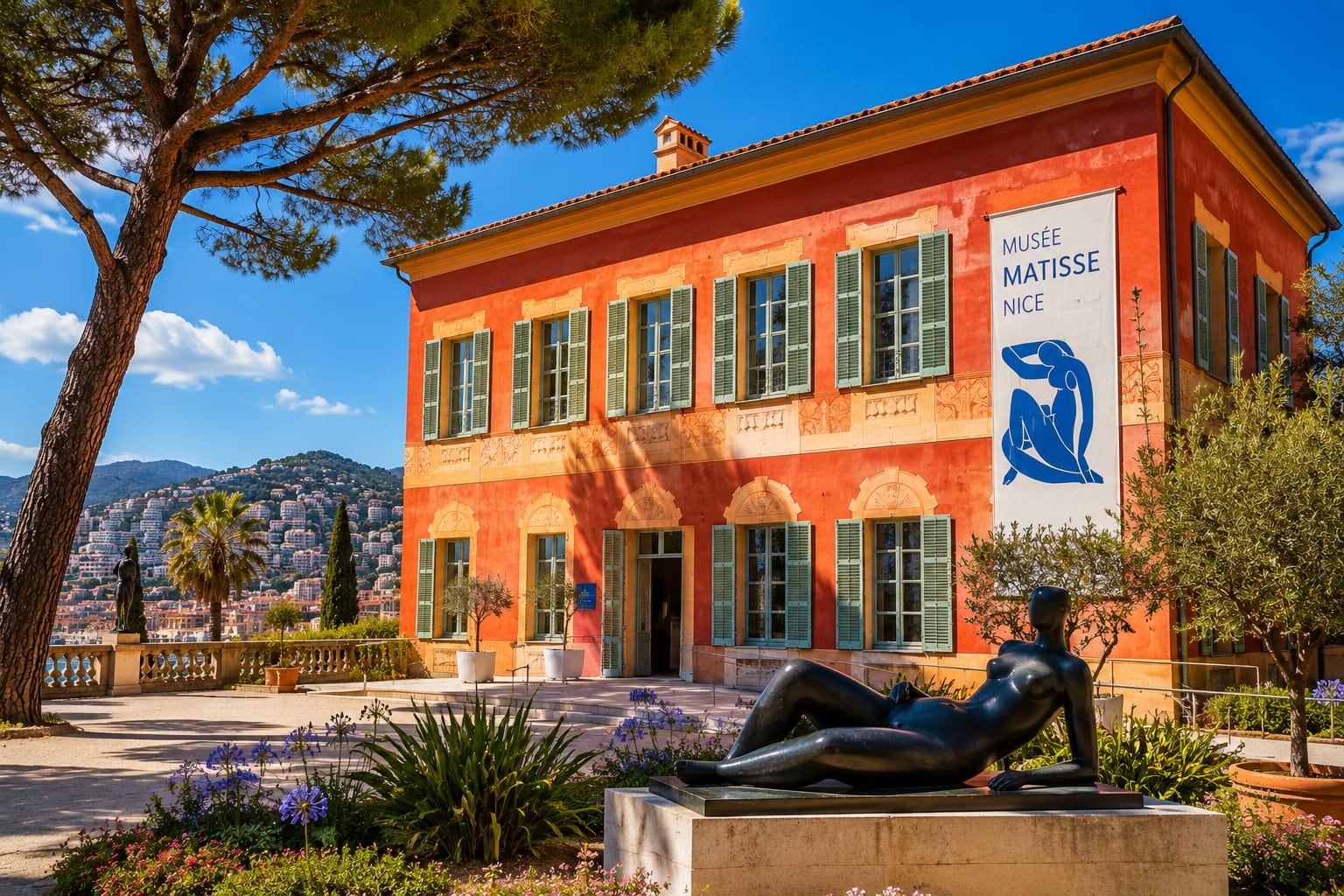
A key Nice museum for Matisse, Mediterranean light and a calm Cimiez cultural day.
164 Avenue des Arènes de Cimiez, 06000 Nice
Check current hours before visiting
12. If you only have one day, which route should you choose?
For a single day from Menton, we recommend concentrating on Le Régina in Nice and Jardin Exotique in Monaco, provided the garden is open.
These two locations illustrate the film's use of architecture particularly clearly.
One shows how a former luxury hotel can represent another hotel in a different city.
The other offers a publicly accessible garden used in the Riviera sequence.
A practical day
Morning: Train from Menton to Nice, then local transport to Cimiez. Explore Le Régina's exterior.
Lunch: Enjoy a break in Nice or return towards Monaco.
Afternoon: Visit Jardin Exotique de Monaco.
Evening: Return to Menton.
This is a planning framework, not a date-specific transport schedule.
Confirm the railway connections and garden opening hours before travelling.
What about Villa Eilenroc?
Save it for another day if a public visiting session is available.
Its location on Cap d'Antibes requires additional travel, and adding it to the Nice–Monaco itinerary would create an unnecessarily rushed day.
13. What can you actually enter?
A filming-location credit is not an admission ticket.
This is particularly important for historic private residences.
| Location | Realistic visitor plan |
|---|---|
| Le Régina | Exterior from public street; no residential interior access |
| Jardin Exotique | Ticketed public garden, reopened March 2026 |
| Villa Eilenroc | Only on confirmed public-opening dates |
| Argent Faux / Croupatassière | Check legal access, coastal conditions and terrain |
| Grande Corniche | Transport and viewpoint context, not a pedestrian reconstruction |
| Waddesdon Manor | Separate English heritage visit, not part of a Riviera itinerary |
14. How to compare the film with the real places
Compare Le Régina, Jardin Exotique and Villa Eilenroc as distinct real buildings and landscapes, not as a single continuous hotel.
Le Régina
Compare the monumental façades, entrances and architectural proportions.
Distinguish permanent features from temporary film decoration.
Jardin Exotique
Compare hillside paths, botanical planting and the relationship between the garden and panoramic views.
Keep in mind that the garden underwent renovation before reopening in 2026.
Villa Eilenroc
Compare architectural elements and the relationship between the villa and gardens.
Avoid labelling a precise terrace or doorway until a frame comparison establishes the match.
Record the film version
Timestamps can differ between releases or playback platforms.
A reliable photographic comparison should record the edition, timestamp and public camera viewpoint.
Use screenshots only where their reproduction is legally permitted.
15. Why the Riviera looks so different from Manderley
This contrast is one of the film's most important visual decisions.
The Riviera is full of sunlight, elegant clothes, scenic roads and open views.
Manderley is associated with corridors, shadows and the weight of the past.
The young heroine's perspective
In Monte Carlo, the narrator experiences a world of romance and possibility.
She is uncertain about her place in society, but the journey seems to offer a new identity.
The locations reflect that expectation.
A new environment
When the story moves to England, the architecture becomes more psychologically imposing.
The film's visual design reinforces the emotional transition.
The Riviera scenes aren't the main subject of the story.
They are the contrast that makes the later setting more powerful.
A production designer's challenge
Sarah Greenwood's team had to create two coherent worlds using multiple buildings.
The Monte Carlo hotel needed to look like one establishment despite its separate locations.
Manderley required the same technique on a much larger scale.
That's the real architectural story behind the film.
16. What is confirmed and what still needs checking?
This separation between verified production facts and literary interpretation is essential for an accurate filming-location guide.
| Claim | Verification |
|---|---|
| Rebecca was released on Netflix in October 2020 | Confirmed |
| Ben Wheatley directed the adaptation | Confirmed |
| Le Régina, Nice, was used in the Monte Carlo sequence | Confirmed by production accounts and Film France |
| Villa Eilenroc was used during filming | Confirmed by Film France |
| Monaco was a production location | Confirmed by Film France |
| Jardin Exotique was used for the Riviera scenes | Reported by contemporary coverage; the Film France entry confirms Monaco, not this precise garden |
| Waddesdon Manor provided parts of the Monte Carlo hotel interiors | Confirmed by National Trust |
| Le Régina is still a working hotel | False; it is residential |
| Jardin Exotique is still closed for renovation | False; it reopened on 30 March 2026 |
| Every scene set at the Monte Carlo hotel was filmed in Nice | False |
| Exact camera positions at all Riviera sites | Not independently verified |
| The novel's fictional Hôtel Côte d'Azur is Le Régina | Not established |
Frequently asked questions
Was Rebecca (2020) filmed in Monaco?
Yes. The production filmed in Monaco, including locations associated with the Exotic Garden.
Was the Monte Carlo hotel filmed in Nice?
Yes. Le Régina in Cimiez was used for the hotel environment, while some interiors were filmed at Waddesdon Manor in England.
Is Le Régina still a hotel?
No. The former Excelsior Hôtel Régina is now a private residential building.
Can you visit Villa Eilenroc?
Public access depends on the City of Antibes' current visiting programme. Confirm dates before travelling.
Is Jardin Exotique de Monaco open?
Yes. It reopened on 30 March 2026, with published seasonal hours and ticket prices.
How much does the Exotic Garden cost?
The published 2026 adult admission is €12 for the garden alone, with other combined tickets available.
Where was Manderley filmed?
Several English country houses and estates were used, including Cranborne Manor, Hatfield House and Osterley House.
Is the Hôtel Côte d'Azur in the novel a real hotel?
It's fictional. Neither Le Régina nor Waddesdon Manor has been established as its direct historical inspiration.
Can you visit all three main Riviera locations in one day?
It's theoretically possible with extensive travel, but more practical to separate Monaco and Nice from the Antibes excursion.
Is this a route about the book or the film?
This guide focuses on the 2020 screen adaptation. The companion literary guide explores du Maurier's original Monte Carlo setting.
Does the guide contain spoilers?
It discusses the premise and production geography without revealing the central mystery or the ending.
Final thoughts: Monte Carlo was made in several places
The Riviera opening of Rebecca appears to take place in one glamorous world.
A grand hotel.
Beautiful gardens.
Mediterranean roads.
Elegant people.
The beginning of an unexpected romance.
But the world we see on screen was assembled from several real places.
A former hotel in Nice.
A historic villa in Antibes.
A botanical garden in Monaco.
And an English country house that supplied part of the hotel's interior.
The production created continuity through architecture, decoration, costume and editing.
For visitors staying in Menton, those choices offer a rewarding way to explore the region.
You can discover the real buildings, understand their histories and appreciate why the filmmakers selected them.
But the most interesting lesson is perhaps this:
A film location has two stories. The one that happened there, and the one the camera persuaded us to believe.
Official sources and further reading
Rebecca (2020), Film France-CNC
British Vogue: Rebecca Filming Locations
National Trust: Explore the Filming Locations of Rebecca
Condé Nast Traveler: On Location with Rebecca
The Observer: Rebecca Production Design
French National Heritage Register: Le Régina
Musée Matisse: The Historic Cimiez Neighbourhood
Jardin Exotique de Monaco: Official Visitor Information
Villa Eilenroc: municipal visitor information
Villa Eilenroc: tourist-office dates and admission
Research reviewed on 4 November 2026. Film-location information was checked against Film France-CNC, National Trust and contemporary production interviews. This is documentary research, not a claim of full viewing or a site inspection. Some exact shots remain to be verified. Opening hours, admissions and visitor access may change. Private buildings must be respected. Supplied illustrations are artistic, not film stills or documentary evidence of exact locations.