Beautiful houses, extraordinary lives

Beautiful houses. Extraordinary lives. Stories that outlasted them both. The French Riviera is full of remarkable houses. Some stand behind elaborate garden gates. Others overlook the Mediterranean from rocky cliffs. A few are former luxury hotels, transformed into private apartments long after their famous residents departed. It's easy to admire the buildings. But what happened inside them? Who chose to live there, and why? Who worked, struggled, collected art, designed furniture or planted gardens? What happened when those people could no longer maintain the lives they had created?
These questions are at the heart of The Houses That Remember: Eight True Stories of Remarkable Lives on the French Riviera, the new book by Anton Biletskyi-Volokh, published in 2026 as part of the AzurBooks series. Beginning in Menton and continuing west towards Nice, the book explores eight real places through the lives of the people associated with them. Among its subjects are Katherine Mansfield, Eileen Gray, Ferdinand Bac, Béatrice Ephrussi de Rothschild, Théodore Reinach and Henri Matisse. But the stories are about more than famous names.
They're about friendships, illness, money, artistic ambition, domestic life and the complicated question of what it means to preserve a home after its inhabitants are gone. This companion guide takes you to the places behind the book. Some can be visited inside. Others offer beautiful gardens or guided tours. A few remain private, making their history more accessible than their interiors. You don't have to read the book before following these routes. And if you have read it, this guide won't reveal the most important discoveries of each chapter.
Instead, it offers a new way to explore the French Riviera: one house, one life and one question at a time.
Read The Houses That Remember
The Houses That Remember: Eight True Stories of Remarkable Lives on the French Riviera By Anton Biletskyi-Volokh An AzurBooks publication, 2026. Eight stories based on historical correspondence, archives, photographs and published research. The book distinguishes documented events from later traditions and uncertain accounts. It also examines the people whose contributions to famous lives have sometimes been overlooked.
Available on Amazon:
Read The Houses That Remember on Kindle
The eight houses: which can you visit?
Not every historic house is a public museum. The distinction is particularly important on the French Riviera, where some of the most celebrated buildings remain privately owned or have restricted access.
Access note: These are the arrangements identified during the October 2026 review. Some guided programmes are seasonal, and a place being historically significant doesn't create a right of entry.
| Place | Location | Visitor access | Time to allow |
|---|---|---|---|
| Villa Isola Bella | Menton, Garavan | Private/restricted; no ordinary public interior visit verified | Exterior context only where publicly visible |
| Val Rahmeh | Menton | Public botanical garden, ticketed | 1–1.5 hours |
| Fontana Rosa | Menton | Organised guided visits | Approximately 1.5 hours |
| E-1027 | Roquebrune-Cap-Martin | Guided tours, advance booking required | Approximately 2–2.5 hours including approach |
| Les Colombières | Menton | Limited guided garden visits, advance booking | Approximately 1.5 hours |
| Villa Ephrussi de Rothschild | Saint-Jean-Cap-Ferrat | Public museum and gardens, ticketed | 2–3 hours |
| Villa Kérylos | Beaulieu-sur-Mer | Public historic villa, ticketed | 1–1.5 hours |
| Former Hôtel Régina | Nice, Cimiez | Private residential building; exterior viewing | 10–20 minutes, plus nearby museum |
1. Villa Isola Bella, Menton: the room that wasn't hers
The person: Katherine Mansfield
The story: A Room at Isola Bella
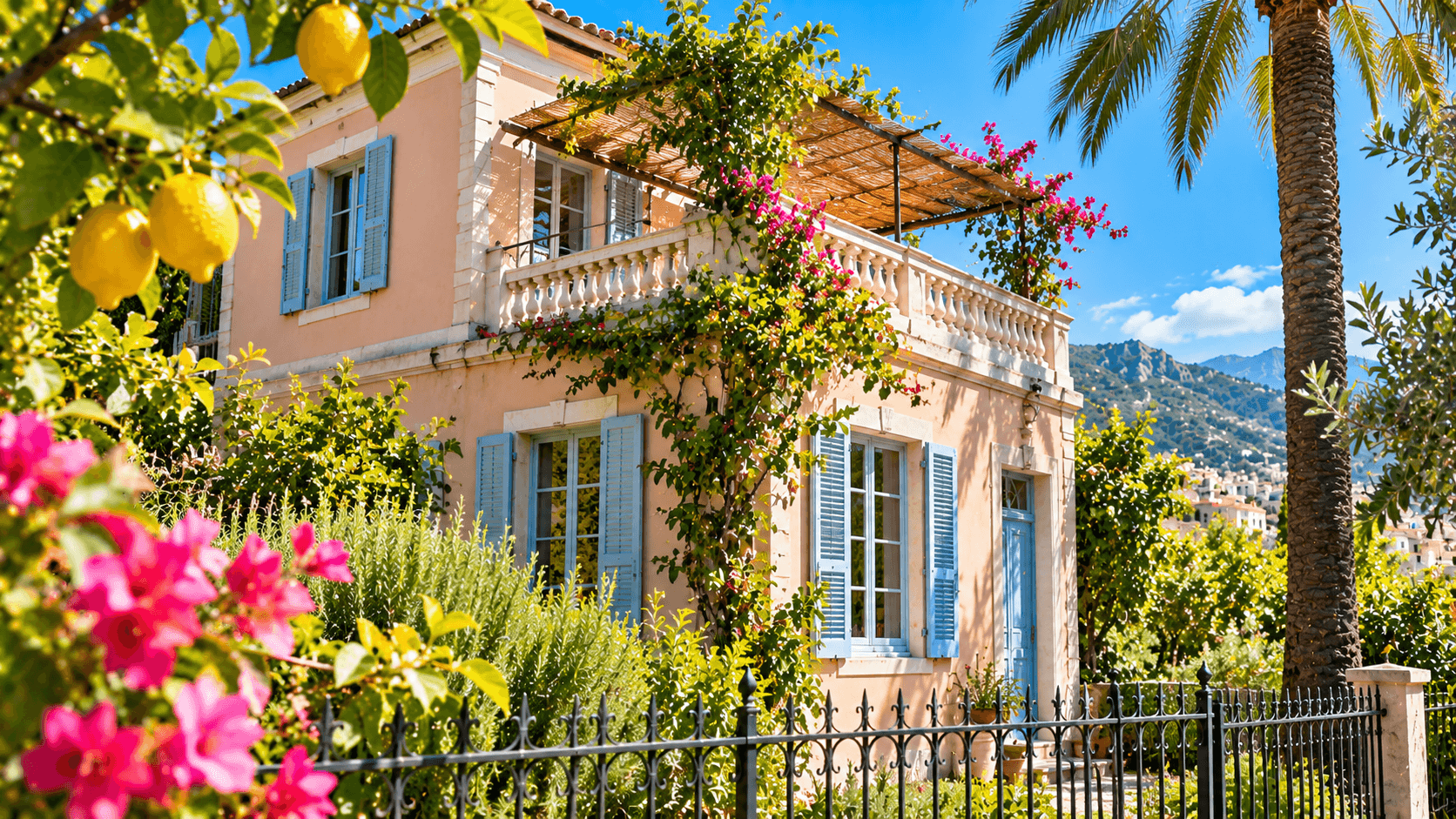
In September 1920, Katherine Mansfield returned to Menton. She was thirty-one, seriously ill with tuberculosis and searching for conditions that would allow her to continue writing. At Villa Isola Bella, in the Garavan district, she found a place surrounded by the subtropical vegetation and Mediterranean light that made Menton such an attractive winter destination. But the most interesting part of the story isn't simply that a famous writer stayed here. It's the question of what later generations choose to preserve.
A room associated with Mansfield eventually became a memorial and a working space for visiting New Zealand writers. Yet that memorial room wasn't the room in which Mansfield had written. The original evidence takes us elsewhere: to surviving letters, manuscripts, photographs and the people who shared her daily life. One of them was Ida Baker, whose practical and personal support forms an important part of the book's account.
Why visit this area?
Garavan offers an opportunity to understand Menton's history as an international winter retreat. Its villas, gardens, hillside setting and relationship with the sea help explain why writers and other visitors came here long before modern beach tourism.
Can you visit the house?
Villa Isola Bella should not be treated as an ordinary walk-in museum. The historic address is associated with private and restricted premises. We couldn't establish a dependable current public visiting programme for independent tourists. Don't enter the grounds, approach residential doors or assume a commemorative association permits access.
A good alternative
Explore the public streets of Garavan and visit another garden connected with the book, Val Rahmeh, when open.
What the book adds: The distinction between a place as it was lived in and the memorial created afterwards.
viewpoint
viewpoint
Villa Isola Bella
Katherine Mansfield's Garavan home is literary heritage, not a confirmed walk-in museum. View only from public spaces; respect residential doors and grounds.
Garavan, Menton; public-street context only
Check current hours before visiting
2. Val Rahmeh: the garden that outgrew the house
Location: Avenue Saint-Jacques, Menton
The person: Maybud Sherwood Campbell
The story: The Garden That Outgrew the House
Val Rahmeh is one of Menton's most remarkable botanical gardens. Today, it's managed by France's National Museum of Natural History and contains an extraordinary collection of tropical, subtropical and Mediterranean plants. But its existence is closely connected with a woman whose ambitions eventually exceeded her financial resources. Maybud Sherwood Campbell acquired the property in 1957. A former opera singer with serious botanical interests, she enlarged the plant collection and transformed the garden. She became associated with the spectacular Brugmansia flowers, sometimes called angel's trumpets, earning the nickname La Dame aux daturas.
Yet by 1966, the property had become financially impossible for her to retain. The garden survived through its transfer into public stewardship.
What to discover on your visit
Walk through the palm-lined areas, explore the botanical collections and notice how different climates seem to meet within a small space. Consider the practical work required to maintain such a garden. Plants need irrigation, protection, specialist care and constant attention. The garden's beauty conceals an enormous amount of labour.
Visiting information
Val Rahmeh is ordinarily open every day except Tuesday. Published hours are generally 10 a.m.–6 p.m. from April to October and 10 a.m.–5 p.m. from November to March.
Temporary closure: The National Museum of Natural History announces closure from 2 to 27 November 2026 inclusive, with reopening expected on 28 November. Verify the final reopening notice before travelling. Official works notice
The garden has sloping and uneven paths and is described by its operator as difficult for visitors with significant mobility limitations.
Official information: Official website
What the book adds: The human story behind a garden that survived after its owner was forced to leave it.
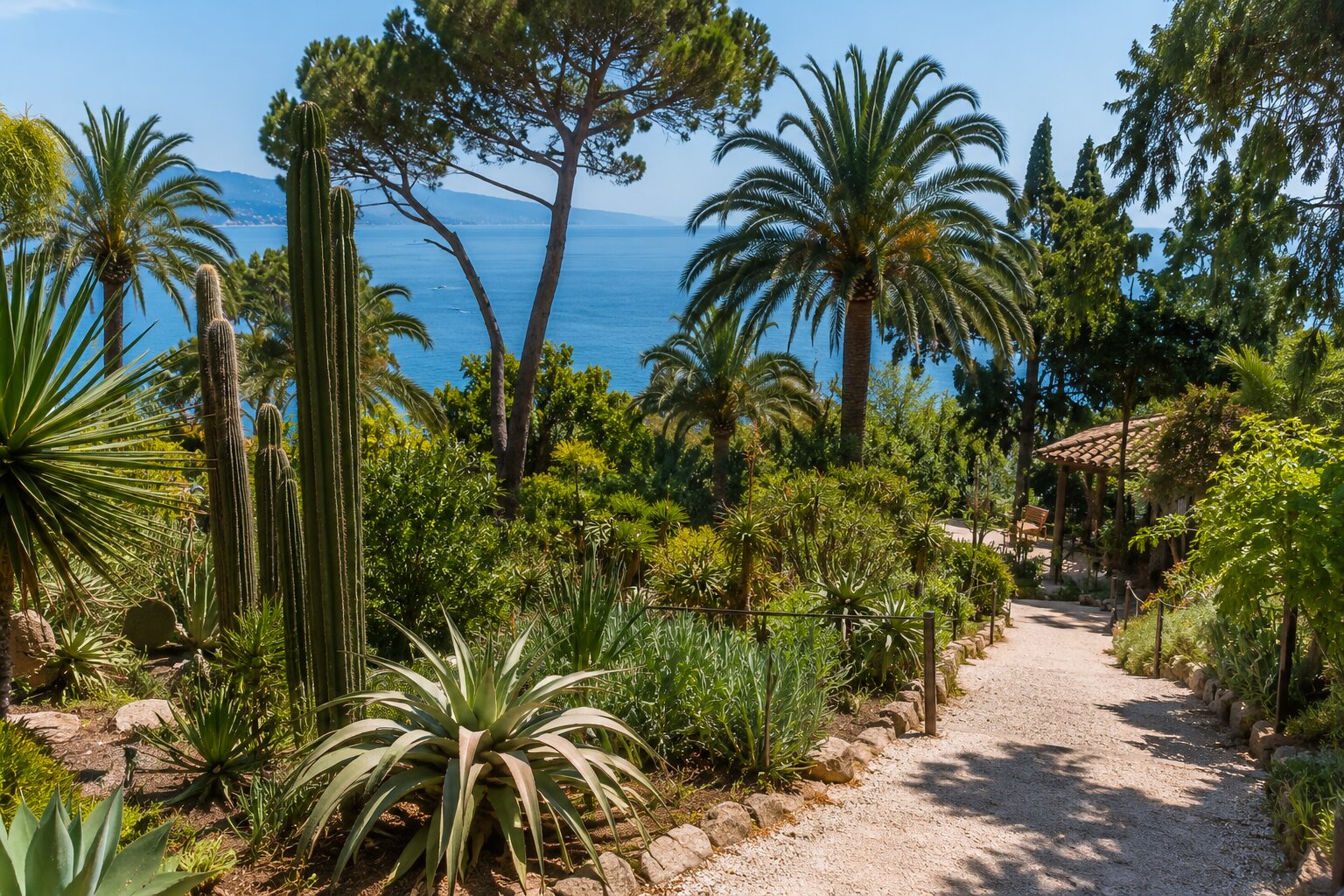
garden
garden
Jardin Botanique Val Rahmeh
A botanical stop to consider for garden lovers and slower itineraries.
Avenue Saint-Jacques, 06500 Menton
Check current hours before visiting
3. Fontana Rosa: the novelist who built a garden for other writers
Location: Avenue Blasco Ibáñez, Menton
The person: Vicente Blasco Ibáñez
The story: The Garden of the Novelists
Fontana Rosa is unlike Menton's other historic gardens. Its creator, Spanish novelist Vicente Blasco Ibáñez, wanted a place where architecture, literature and Mediterranean gardening could coexist. He filled the property with colourful ceramics, decorative structures and tributes to writers he admired. The garden became known as El Jardín de los Novelistas, the Garden of the Novelists. One particularly charming detail in the book comes from a real letter written in April 1924. Inviting a fellow writer to visit, Blasco Ibáñez explained that his guest should not get off the train at central Menton.
He should continue to Menton-Garavan. The garden lay almost beside the railway. That practical travel instruction reveals something easy to overlook when admiring an elaborate historic estate. Fontana Rosa wasn't just a monument to literature. It was a working home where people wrote letters, received visitors, made plans and continued ordinary life.
What should you look for?
The colourful ceramic work, literary monuments, garden structures and Mediterranean architectural influences. Rather than treating the garden as a series of decorative objects, think about the kind of private world its creator wanted to build.
Visiting information
Fontana Rosa is normally visited through organised guided tours. The tourist office has published Monday morning visits, generally 10–11:30 a.m., with an adult ticket of €8 during the current programme. Meet the guide at the entrance on Avenue Blasco Ibáñez. The published tour language is French.
Official visit information: Official website
What the book adds: The man behind the extravagant decorations, and the difference between a writer's working home and the monument it later became.
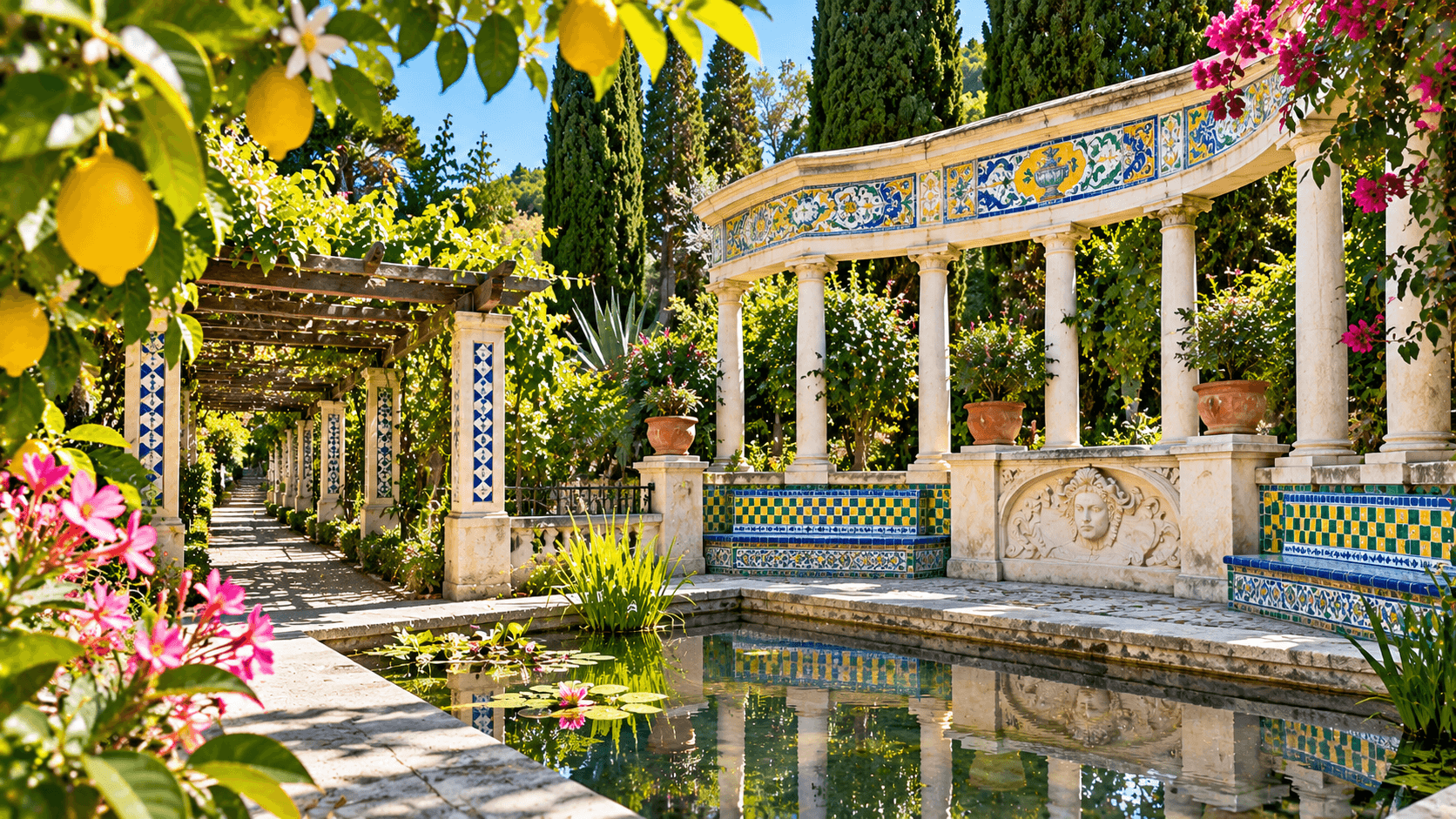
garden
garden
Jardin Fontana Rosa
Vicente Blasco Ibáñez's Garden of the Novelists, with ceramics and literary monuments. Organised guided visits, not unrestricted garden admission; confirm the booked session and language.
Avenue Blasco Ibáñez, 06500 Menton
Check current hours before visiting
4. E-1027: a modern house that raises difficult questions
Location: Roquebrune-Cap-Martin
The people: Eileen Gray and Jean Badovici
The story: A House of One's Own Design
On a rocky stretch of coastline west of Menton stands a small white modernist villa. Its name is E-1027. Designed by Eileen Gray in collaboration with Jean Badovici, the house is one of the most important examples of early modernist domestic architecture. It looks deceptively simple. White walls, slender supports, large openings and terraces overlooking the sea. But almost every detail was carefully considered. Windows, shutters, furniture and room arrangements were intended to respond to the needs of the people living inside.
The book begins with something particularly revealing: a window mechanism designed to manage light, ventilation and privacy. What sounds like a minor architectural detail becomes an introduction to much larger questions. Who designs a home? Who gets credit for it? And what happens when later interventions change the character of a carefully conceived interior?
Why is this place worth visiting?
E-1027 is more than a beautiful house. It's an opportunity to understand architecture as a collection of decisions about daily life. A window isn't merely a decorative opening. A chair isn't simply furniture. The entire space is designed around movement, comfort and relationships between people and their surroundings.
Visiting information
E-1027 forms part of the Cap Moderne heritage site. For the published 2026 season, visits operate from April through October, with guided tours and mandatory online reservations. The standard individual ticket is listed at €18. The published season ends on 31 October 2026; later visits require a newly confirmed programme. The meeting point is associated with Roquebrune-Cap-Martin railway station. Access includes a pedestrian approach and uneven ground with stairs. Some sections may be restricted because of conservation work.
Official information: Official website
What the book adds: A closer look at the design, personal relationships and later changes that make this small building historically complicated.
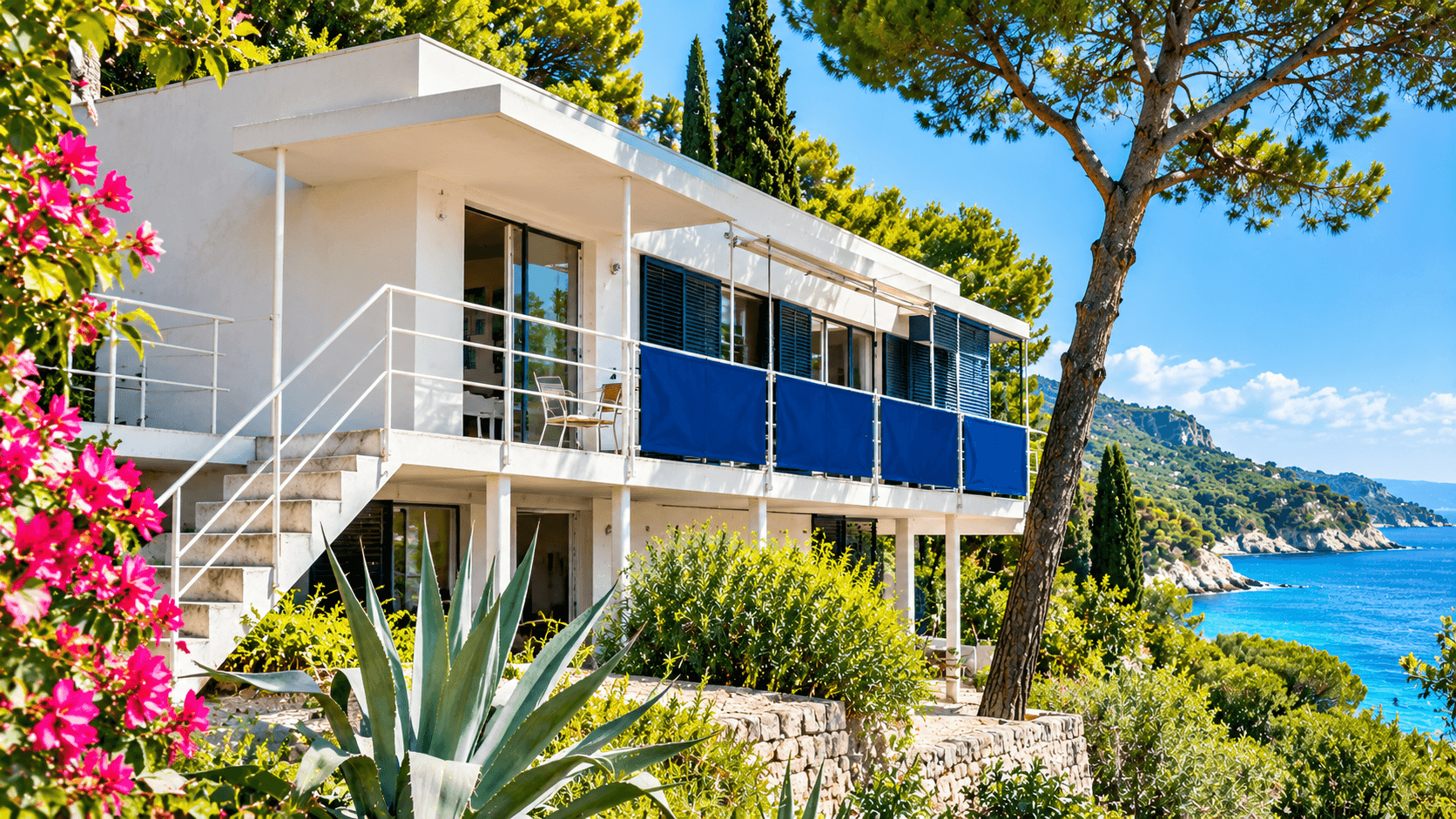
museum
museum
Villa E-1027 / Cap Moderne
Eileen Gray's modernist villa, visited with a booked Cap Moderne tour. Published 2026 season ends 31 October; later visits need a new confirmed programme. Walking approach, uneven ground and steps.
Roquebrune-Cap-Martin; tour meeting point at the railway station
Check current hours before visiting
5. Les Colombières: a house built for three
Location: 312 Route de Super Garavan, Menton
The people: Ferdinand Bac, Émile and Jeanne Ladan-Bockairy
The story: The House Built for Three
Les Colombières is one of the Riviera's most extraordinary private historic estates. Its architecture and gardens were transformed by Ferdinand Bac, an artist, writer and designer whose imagination drew heavily on Mediterranean history and mythology. But Bac didn't create the property alone. Émile and Jeanne Ladan-Bockairy owned the estate and supported the work that turned it into such an unusual artistic environment. Their relationship lies at the centre of the book's fifth chapter. Letters, photographs and surviving historical accounts reveal a long association between the three.
The estate became a shared creative project, shaped by friendship, resources and an ambitious vision of Mediterranean life.
What can you see?
The estate is known for its terraced gardens, architectural structures and visual references to the ancient Mediterranean world. The gardens were designed as a journey through landscapes, mythology and historical imagination.
Is it open?
Les Colombières remains a private property. Public access is limited to specifically organised guided visits. The tourist-office listing reviewed here advertises a July–September programme at around €20. Those dates have passed; do not assume an autumn or winter session is available without a fresh booking confirmation. The visitor entrance is the upper gate at 312 Route de Super Garavan, not a lower garden entrance. The approach is steep, parking is limited and the gardens are unsuitable for visitors who cannot manage uneven ground and steps. Future sessions require confirmation.
Official visit information: Official website
What the book adds: The relationships behind the estate, including the people whose financial and personal contributions made Bac's artistic project possible.
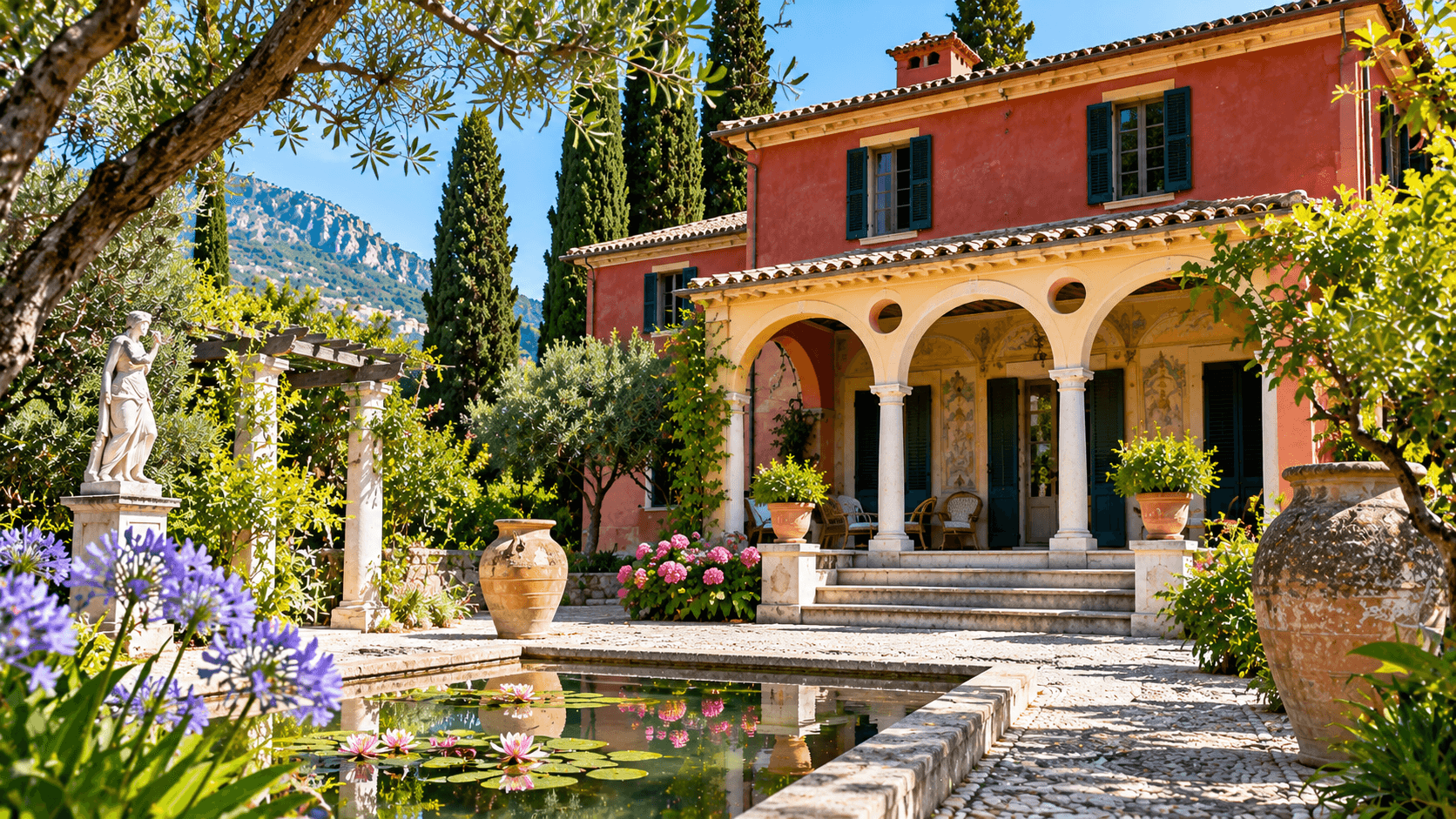
garden
garden
Les Colombières
Private estate shaped by Ferdinand Bac and the Ladan-Bockairys. Enter only for a confirmed guided visit via the upper gate. Published July–September dates have passed; steep approach and steps.
312 Route de Super Garavan, 06500 Menton
Check current hours before visiting
6. Villa Ephrussi de Rothschild: the woman who built a world
Location: Saint-Jean-Cap-Ferrat
The person: Béatrice Ephrussi de Rothschild
The story: The Woman Who Built a World
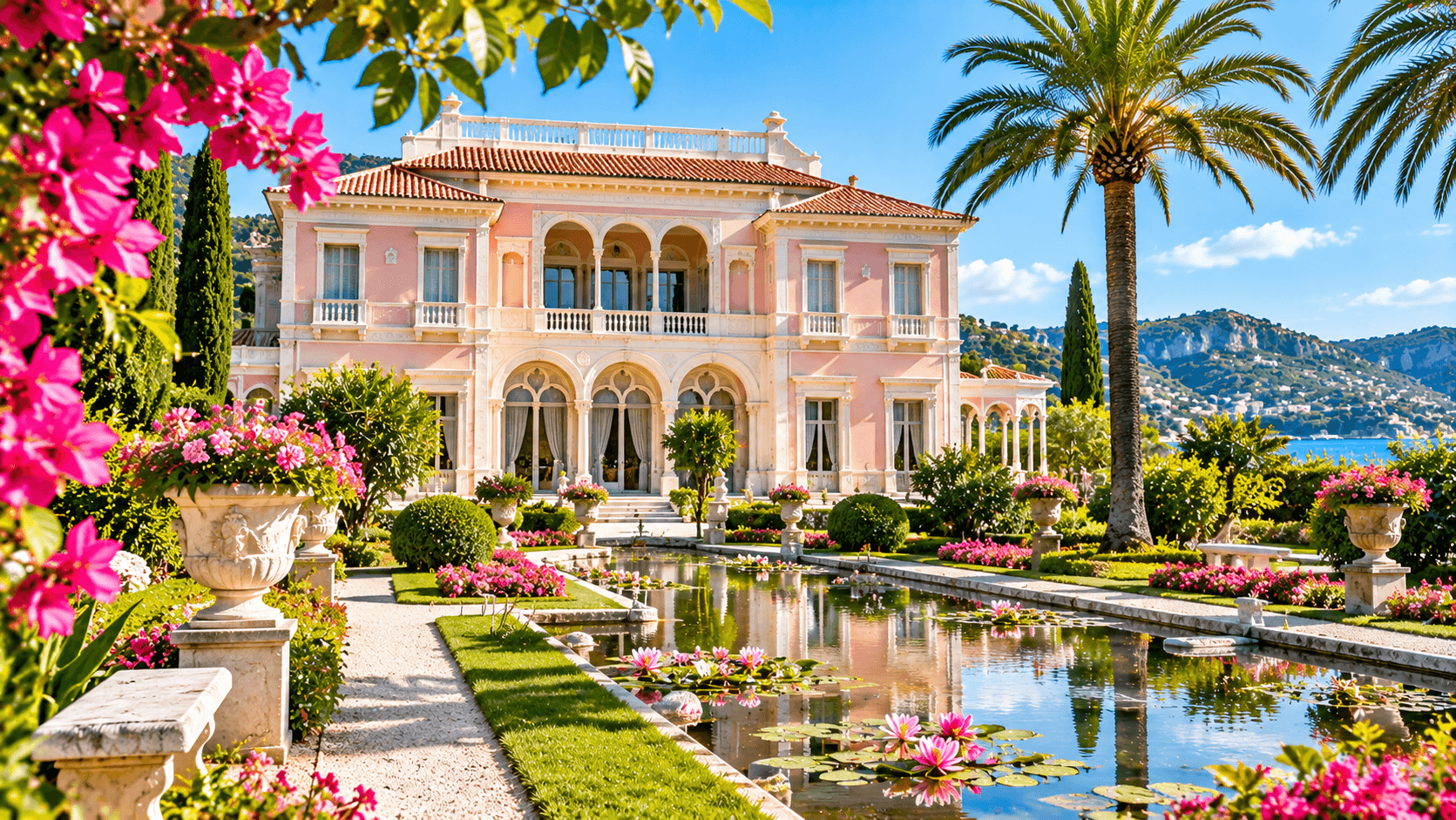
Few houses on the French Riviera are as visually spectacular as Villa Ephrussi de Rothschild. Its elegant pink façades, richly decorated rooms and elaborate gardens seem almost designed for a dream of aristocratic Riviera life. The villa was created for Béatrice Ephrussi de Rothschild, a collector with extraordinary resources and very definite ideas about how her surroundings should look. One story associated with the garden's creation describes employees moving cardboard representations of trees so that Béatrice could judge the appearance of different arrangements.
The book treats this as a historical anecdote rather than presenting every detail as independently documented. The larger story, however, is unmistakable. Béatrice created an environment in which architecture, decoration, gardens and collections were brought together according to her personal tastes.
What should you see?
The interiors offer a glimpse of the world she assembled. Outside, the themed gardens provide a journey through different landscape traditions. The formal French garden, exotic planting and other carefully composed spaces are attractions in their own right.
Visiting information
Villa Ephrussi de Rothschild is a public museum and garden. It operates year-round under published seasonal hours, with occasional exceptional closures. During the winter period from November 2026 to January 2027, the official schedule lists shorter weekday hours and longer opening on weekends and school holidays. The villa's official website should be checked for current ticket prices, special events and visitor access conditions. It also announces an exceptional closure on 14 December 2026.
Official website: Official website
What the book adds: The decisions, personal ambition and eventual legacy behind one of the Riviera's most impressive private collections.
museum
museum
Villa Ephrussi de Rothschild
Béatrice Ephrussi de Rothschild's collections and themed gardens. Public ticketed visit with seasonal hours; exceptional closure announced for 14 December 2026.
Saint-Jean-Cap-Ferrat
Check current hours before visiting
7. Villa Kérylos: an ancient dream with modern plumbing
Location: Rue Gustave Eiffel, Beaulieu-sur-Mer
The people: Théodore and Fanny Reinach, architect Emmanuel Pontremoli
The story: An Ancient Dream with Modern Plumbing
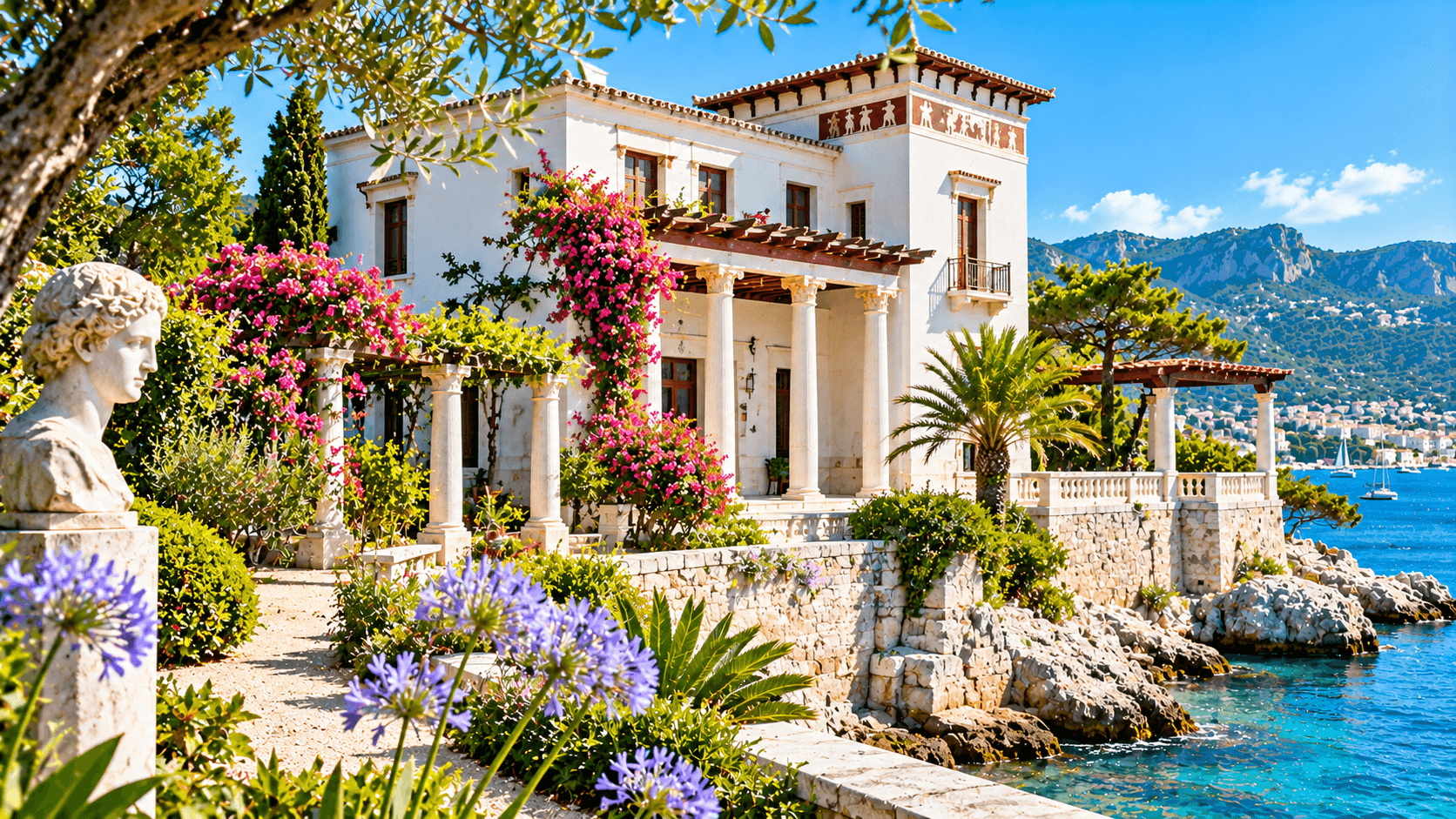
What happens when someone decides to build an ancient Greek house in the twentieth century? At Villa Kérylos, the answer is fascinating. Théodore Reinach was a scholar with a deep interest in classical Greece. With architect Emmanuel Pontremoli, he created a villa inspired by the architecture, decorative arts and domestic life of antiquity. Yet the family was living in the modern world. They needed functioning bathrooms, comfortable rooms and contemporary conveniences. One particularly delightful example concerns Fanny Reinach's piano. An ordinary piano hardly belonged in a carefully constructed ancient Greek interior.
So the instrument was concealed within a specially designed cabinet, allowing modern music-making to coexist with the historical concept of the house.
What makes Kérylos special?
Unlike a museum displaying ancient objects in ordinary rooms, Kérylos attempts to recreate an entire domestic environment. You can explore architectural details, mosaics, painted decoration, furniture and the relationship between the villa and its coastal setting. It's a wonderful place to consider how people imagine the past.
Visiting information
Villa Kérylos is normally open to the public. The current official schedule lists 10 a.m.–5 p.m. from October to March and 10 a.m.–6 p.m. from April to September. Standard adult admission is listed at €15. The villa's website states that regular tickets are sold on site rather than through external online ticket platforms.
Important: Due to works, Rue Gustave Eiffel has pedestrian-only access. Check the approach if you have mobility limitations.
The site also has specific restrictions concerning pushchairs and pets.
Official website: Official website
What the book adds: The tension between historical authenticity and the needs of a family living in the twentieth century.
museum
museum
Villa Kérylos
Greek-inspired home of Théodore and Fanny Reinach, designed with Emmanuel Pontremoli. Regular tickets sold on site. Rue Gustave Eiffel has pedestrian-only access during works; confirm mobility arrangements.
Rue Gustave Eiffel, 06310 Beaulieu-sur-Mer
Check current hours before visiting
8. Le Régina: the hotel that became Matisse's studio
Location: 71 Boulevard de Cimiez, Nice
The person: Henri Matisse
The story: The Hotel That Became a Studio
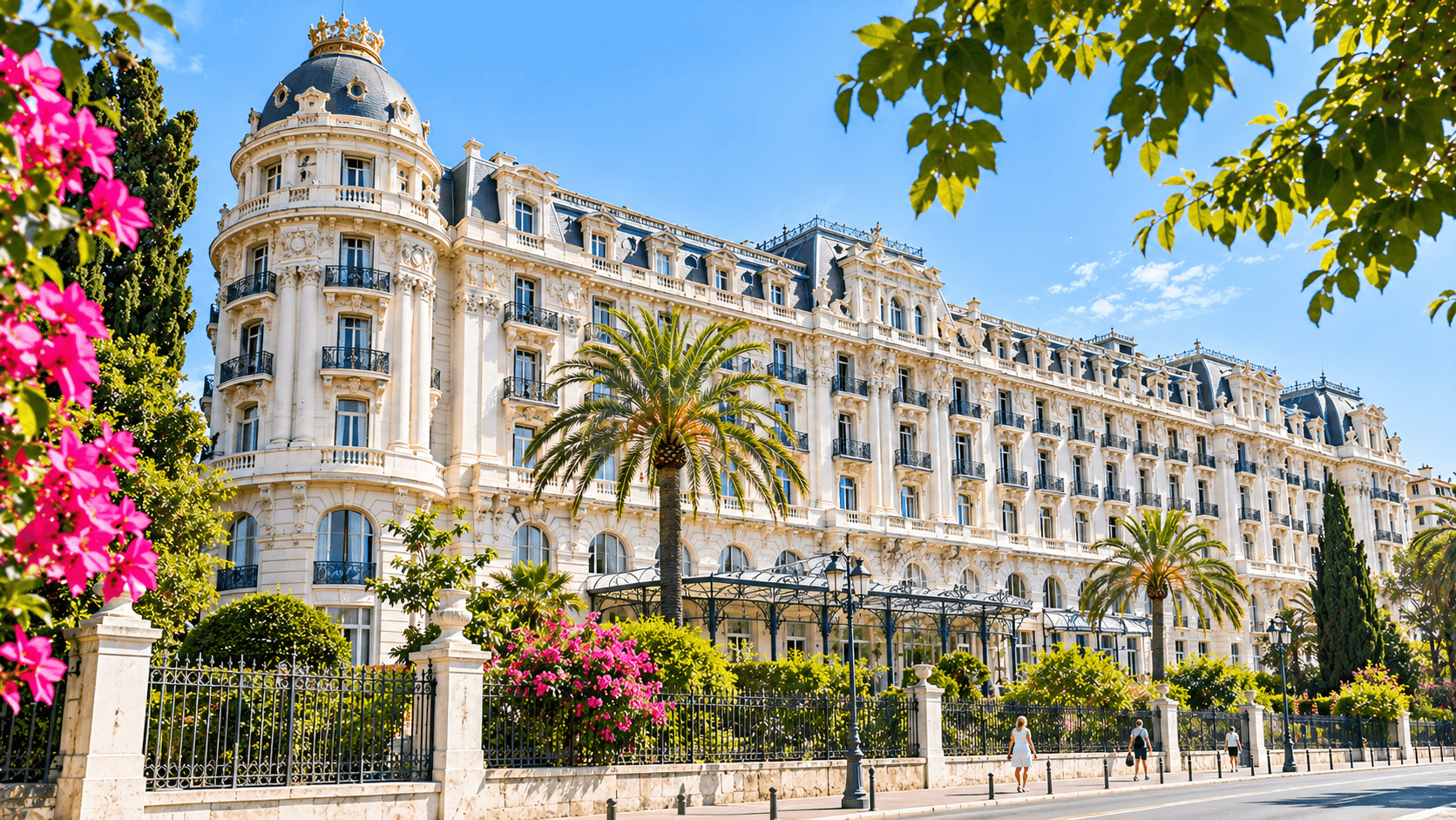
The final chapter of The Houses That Remember takes us to Nice. Here, in the former Hôtel Régina, Henri Matisse lived and worked during an extraordinary period of his artistic life. The building had once been a grand hotel associated with the fashionable Belle Époque resort of Nice. By the time Matisse lived there, it had become a residential building. Its spacious rooms gave the artist an environment in which he could develop some of his most ambitious later compositions. One especially memorable work was The Swimming Pool, created in 1952.
Using shapes cut from painted paper, Matisse transformed the walls of a room into a world of swimmers, divers and sea creatures. The work was connected to the specific room in which it was made. Yet preserving it would eventually require separating the composition from that original setting.
Can you visit Matisse's apartment?
No ordinary public interior access is available. Le Régina is a residential property, not the Musée Matisse. Its façade can be appreciated from public areas, but the building's private entrances, gardens and apartments must be respected.
Where should you go instead?
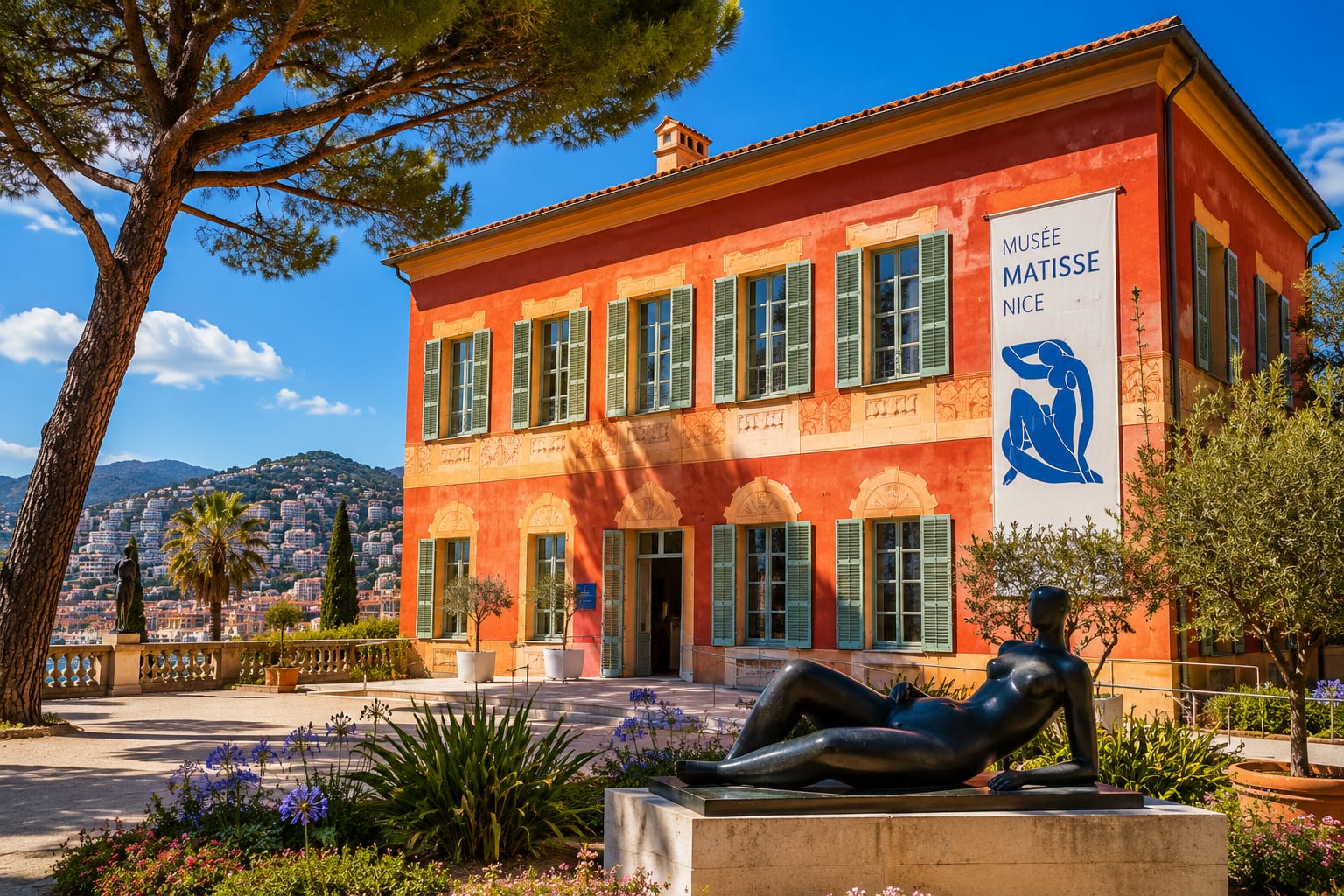
Visit the Musée Matisse Nice, also in Cimiez. The museum explores Matisse's artistic development and his long relationship with Nice. The surrounding Cimiez district is also worth exploring for its Belle Époque architecture, gardens and cultural heritage. The museum is a separate institution rather than Matisse's preserved private apartment.
Official museum: Official website
What the book adds: The relationship between an artist's working space, the work created there and the difficult decisions involved in preservation.
viewpoint
viewpoint
Le Régina / Ancien Excelsior Régina Palace
Former grand hotel where Matisse lived and worked. Not the Musée Matisse and no ordinary public apartment tour. Respect private entrances and gardens; combine public-street viewing with the separate museum.
71 Boulevard de Cimiez, 06000 Nice
Check current hours before visiting
museum
museum
Musée Matisse
A key Nice museum for Matisse, Mediterranean light and a calm Cimiez cultural day.
164 Avenue des Arènes de Cimiez, 06000 Nice
Check current hours before visiting
Three ways to explore the houses from Menton
Trying to visit all eight properties in one day would turn a fascinating cultural journey into a rushed transport exercise. A better approach is to choose the route that suits your interests and the time available.
Route A. A day in Menton: writers, gardens and extraordinary lives
Begin with a visit to Val Rahmeh, when the garden is open. Explore Garavan's historic surroundings, remembering that Villa Isola Bella is not a confirmed public museum. If you have arranged a guided visit to Fontana Rosa, plan the day's timing around its reservation. Les Colombières is a further possibility for a separate, confirmed guided tour. However, its uphill location and restricted access make it unsuitable as a spontaneous addition.
Recommended approach: Choose Val Rahmeh plus one organised historic garden, rather than attempting all four sites.
Allow: A full day with breaks, or two half-days if you prefer a slower pace.
Route B. Modernism and Mediterranean architecture
Choose a date when E-1027 has a confirmed guided tour. Travel from Menton to Roquebrune-Cap-Martin and follow the operator's instructions for reaching Cap Moderne. Allow time for the guided visit, including the pedestrian approach. Afterwards, enjoy the coastline or return to Menton. You could add another nearby location on a different day, but the E-1027 tour deserves time on its own.
Allow: Approximately half a day, including transport.
Route C. The collectors and artists: a longer Riviera experience
Visit Villa Ephrussi de Rothschild in Saint-Jean-Cap-Ferrat. On a separate excursion, discover Villa Kérylos in Beaulieu-sur-Mer. Continue to Nice on another day for the Matisse Museum and an exterior view of Le Régina in Cimiez. This provides an opportunity to explore three very different interpretations of what a house can become: a collector's world, a reconstruction of antiquity and an artist's working environment.
Allow: Two relaxed days for the three main cultural visits, or longer if you enjoy gardens and museums.
Which house should you choose if you can visit only one?
The best visit isn't necessarily the most famous building. It's the one whose story makes you want to look more closely.
| Your main interest | Our recommendation |
|---|---|
| Plants and botanical history | Val Rahmeh |
| Literature and unusual garden architecture | Fontana Rosa |
| Modernist design | E-1027 |
| Mediterranean garden design | Les Colombières |
| Art collections and elaborate gardens | Villa Ephrussi de Rothschild |
| Classical Greece and historic interiors | Villa Kérylos |
| Matisse's work | Musée Matisse Nice, with Le Régina as exterior heritage context |
| Katherine Mansfield | Read the Isola Bella chapter and explore the history of Garavan without expecting entry to the villa |
What the houses can't tell us
A beautifully restored house can create a powerful illusion. It may seem as though the people who lived there have only just stepped outside. Their furniture is arranged. Their books are displayed. Their gardens are maintained. Yet the past is never quite that easy to reconstruct. The book examines the difference between documented history and the stories later generations tell about it. A memorial room may not be the room where someone worked. A garden can survive while changing so dramatically that its creator would barely recognise it.
A building's restoration may preserve some aspects of its history while altering others. And the people who supported a celebrated writer or artist may be almost invisible in the surviving public story. This is why the eight houses are worth visiting, even if you've never opened the book. They encourage a different kind of attention. Rather than asking only, “Who lived here?”, you might ask, “Who made it possible for them to live and work here?”
And rather than seeing restoration as the end of the story, you may begin to see it as another chapter.
Practical questions before visiting
Do I need to book every house?
No. Some, such as Villa Kérylos and Villa Ephrussi de Rothschild, offer ordinary public admission. Others, including E-1027, Fontana Rosa and Les Colombières, require advance arrangements or guided visits. Villa Isola Bella and Le Régina shouldn't be treated as ordinary public attractions.
Can I visit all eight houses without a car?
Several locations can be reached using regional trains and local transport, but not every final approach is convenient. Some properties are uphill, have limited bus service or require substantial walking. For Les Colombières and other restricted estates, organise the visit and access separately.
Is the route suitable for wheelchair users?
Not as one continuous accessible itinerary. Several historic gardens and villas contain stairs, uneven paths or steep approaches. Check accessibility directly with each operator before booking.
Is this guide a substitute for the book?
No. The guide introduces the people and places and provides contemporary visitor information. The book tells their stories in depth, drawing on historical evidence, correspondence and published research. You can enjoy either independently.
Is the book fiction?
No. The Houses That Remember is narrative nonfiction. It examines eight real historical places and the lives of people associated with them, while acknowledging uncertainty where sources are incomplete or contradictory.
Read the stories, then visit the places
A house can preserve a view, a staircase, a garden or a room. It cannot preserve an entire life. That's what makes the stories behind these eight places so fascinating. Katherine Mansfield, Maybud Campbell, Vicente Blasco Ibáñez, Eileen Gray, Ferdinand Bac, Béatrice Ephrussi de Rothschild, Théodore Reinach and Henri Matisse all wanted something from the places they inhabited. Some wanted somewhere to work. Some wanted to create an ideal home. Some wanted to gather objects, preserve beauty or experiment with new ways of living. The buildings remain, but their meanings have changed.
The Houses That Remember invites you to explore those changes through the people who experienced them. And this guide offers a way to visit the places yourself, without confusing the beauty of a building with the full complexity of its history. Whether you visit one garden in Menton or spend several days travelling west towards Nice, you may find yourself looking at the Riviera differently. Not just admiring its houses. Wondering what they remember.
Discover the book and the AzurBooks series
The Houses That Remember: Eight True Stories of Remarkable Lives on the French Riviera By Anton Biletskyi-Volokh.
For another literary journey through Menton, discover A Week in Menton: A Novella by the Sea, also published as part of the AzurBooks project. The author introduces the book. Explore more local history, architecture, gardens and walking routes through the AzurMenton Guide. Historical subjects and chapter themes are based on The Houses That Remember, first edition, 2026. Visitor information reviewed on 31 October 2026 against official museum, monument and tourism resources. Opening hours, seasonal closures and private-property restrictions may change. A place mentioned in the book is not necessarily open to visitors.