Hitchcock's Riviera and the real town
Few films have made the French Riviera look quite as irresistible as Alfred Hitchcock’s To Catch a Thief.
There are spectacular coastal roads, glamorous hotels, expensive jewellery, beautiful villas and the sort of Mediterranean sunshine that seems to make everyone look more elegant.
Cary Grant plays John Robie, a retired jewel thief known as “The Cat”, who has settled into a quiet life on the Riviera.
When a series of new robberies begins, suspicion falls on him.
To establish his innocence, Robie must identify the person imitating his former methods.
Then he meets Frances Stevens, played by Grace Kelly, a wealthy young American holidaying on the coast with her mother.
Their relationship unfolds against some of the most recognisable landscapes in southern France.
But the Riviera we see on screen is not one continuous, easily followed itinerary.
Hitchcock and his production team filmed across Cannes, Nice, Monaco, Èze and several inland villages. Studios and other locations supplied additional material.
Villefranche-sur-Mer is also identified in regional filming-location sources, although the precise shots filmed there remain less securely documented than several of the film’s famous scenes elsewhere.
That makes the town an interesting destination for a different kind of film-inspired journey.
Rather than promising an exact recreation of a scene that has not yet been independently identified, this guide combines a day in Villefranche-sur-Mer with the real history of Hitchcock’s Riviera.
You can enjoy the old town, discover its remarkable natural harbour, walk beside the Mediterranean and understand how filmmakers turned separate locations into one glamorous cinematic world.
And you can do all of that during an easy excursion from Menton.
1. Discover To Catch a Thief
Film: To Catch a Thief
Director: Alfred Hitchcock
Release: 1955
Starring: Cary Grant, Grace Kelly, Jessie Royce Landis, John Williams, Charles Vanel and Brigitte Auber
Screenplay: John Michael Hayes
Based on: The 1952 novel by David Dodge
Cinematography: Robert Burks
Music: Lyn Murray
Genre: Romantic thriller / Mystery
Running time: Approximately 106 minutes
The film is one of Hitchcock’s most visually celebrated productions.
It combines romantic comedy, suspense and the director’s fascination with characters who are not always what they appear to be.
John Robie has a criminal past but claims to have abandoned it.
Frances Stevens is fascinated by him, although his background makes their relationship unusually complicated.
Around them is a social world built on wealth, luxury hotels and the constant possibility that appearances may be deceptive.
The Riviera as part of the story
The location is essential to the film.
Jewellery theft requires wealthy victims.
Wealthy victims gather in exclusive hotels and private villas.
The mountainous coastline provides dramatic roads and spectacular viewpoints.
And the mixture of French villages, elegant seaside resorts and Monaco’s luxury culture creates an environment that feels almost too beautiful to be dangerous.
Hitchcock uses that beauty deliberately.
The Riviera is not merely scenery.
It helps explain the characters’ behaviour, their opportunities and the risks they take.
Where to find the film
To Catch a Thief is available through different rental, streaming and physical-media services depending on the country.
For reliable production history, consult theAmerican Film Institute catalogue andThe Alfred Hitchcock Wiki.
2. Was To Catch a Thief actually filmed in Villefranche-sur-Mer?
An archived Côte d'Azur tourism cinema press kit hosted by France.fr includes Villefranche-sur-Mer in the film's geography. It even names Villa Agnelli in its town filmography. This is a historical tourism attribution, not our independent identification of a surviving scene, a verified address or permission to visit a private villa.
However, the evidence deserves careful treatment.
The American Film Institute provides a detailed list based on Paramount production files, identifying places such as Cannes, Nice, La Turbie, Èze, Gourdon, Cagnes-sur-Mer and Monte Carlo.
Its summary does not specifically name Villefranche-sur-Mer.
The specialist Hitchcock Wiki is useful for further research, but could not be retrieved during this check. IMDb is a supplementary listing, not the basis for identifying a particular street. Neither is treated here as independently verified scene evidence.
What can we say confidently?
The film was extensively shot on the French Riviera.
Villefranche-sur-Mer appears in published regional and film-location listings.
Its particular contribution to the completed film has not yet been established through a verified scene-and-camera-position comparison.
What should we avoid claiming?
We should not label a particular staircase, waterfront café, church or harbour wall as a confirmed To Catch a Thief scene merely because the film is associated with Villefranche.
The distinction matters for visitors.
A beautiful building may fit the film’s atmosphere without ever having appeared in a frame.
And a location listed in a filming database may have been used for a short insert, a background shot or footage subsequently removed during editing.
For now, this is best described as a Hitchcock-inspired Villefranche visit with a reported historical filming association, rather than a complete shot-by-shot location tour. The public walk below does not include Villa Agnelli or claim that any of its stops appears in the film. See the archived tourism press kit, printed page 25.
3. Why Villefranche-sur-Mer belongs in a Hitchcock Riviera itinerary
Villefranche is one of the most visually distinctive towns between Menton and Nice.
Its colourful buildings rise around a deep natural bay.
The waterfront curves below steep historic streets, with boats and coastal hills providing an extraordinary Mediterranean backdrop.
The town has a long history associated with maritime activity and its strategic position on the coast.
In the twentieth century, its scenery also attracted filmmakers.
A town that already looks cinematic
There are several reasons Villefranche works so well as a film destination.
The old buildings create strong architectural perspectives.
The natural harbour offers wide views that can establish an entire location in a single shot.
Narrow streets contrast with bright, open waterfront spaces.
And the coastline provides a visual connection to Monaco, Nice and the wider Riviera.
These qualities help explain the town’s cinematic appeal without requiring us to invent a specific Hitchcock scene.
The real geography
Villefranche-sur-Mer is a separate French municipality east of Nice.
It is not a district of Monaco.
It is also not the same place as nearby Beaulieu-sur-Mer or Saint-Jean-Cap-Ferrat.
The distinction is particularly important in film-location research.
On screen, separate coastal places may be joined by editing into one apparently continuous journey.
In reality, each has its own geography and history.
4. Stop one: arriving in Villefranche by train
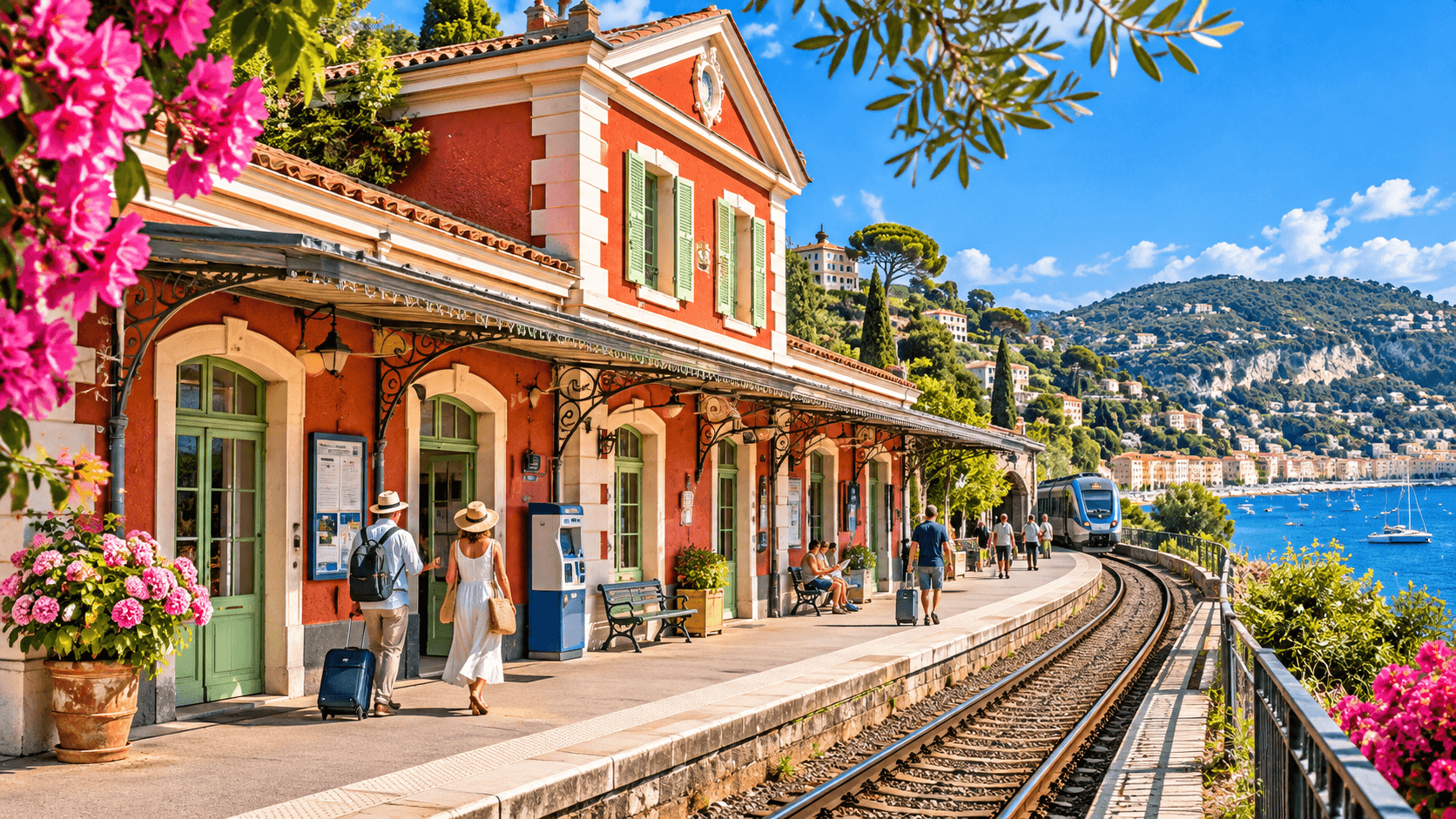
Starting point: Gare de Villefranche-sur-Mer.
The simplest way to arrive from Menton is by coastal regional train.
The line travels past Monaco, Èze and Beaulieu-sur-Mer before reaching Villefranche.
Even before leaving the station, you can appreciate why the coastline became such an important part of Riviera cinema.
The railway runs above the sea, with the town and bay spread out below.
What to do
Leave the station using the designated pedestrian exit.
Take a moment to orient yourself towards the waterfront and old town.
Then follow public streets and paths downhill towards the historic centre.
Film connection
The station is a practical starting point, not an independently confirmed filming location for To Catch a Thief.
The journey nevertheless provides a good introduction to the landscape represented in the film.
Time to allow
Approximately 10–20 minutes to reach the lower town at a relaxed pace, depending on your route and stops.
Remember that the return journey to the station involves an uphill section.
station
station
Gare de Villefranche-sur-Mer
Practical start for the Villefranche walk, not a confirmed Hitchcock scene. Check the actual train, station access and uphill return; no step-free route guarantee.
Avenue Georges Clemenceau, 06230 Villefranche-sur-Mer
5. Stop two: the old town, a world of narrow streets and changing light
Location: Vieille Ville de Villefranche-sur-Mer.
Villefranche’s historic streets are among its most attractive features.
Buildings in warm shades of ochre, yellow and pink rise above narrow passages and small stairways.
Shutters, balconies and shopfronts add detail to the architecture.
What makes it interesting?
A historic Mediterranean town offers a completely different visual environment from the grand hotels of Cannes or Monaco.
Its streets are narrower.
The façades stand closer together.
Light changes dramatically as you move between open squares and shaded passages.
These are qualities filmmakers can use to create atmosphere.
But the history of the town is interesting independently of cinema.
What should you look for?
The relationship between street width and building height.
Architectural details that survived successive renovations.
Passages connecting different levels of the settlement.
And the way the Mediterranean suddenly appears between buildings.
An important filming distinction
The old town is an original cultural stop in this guide.
No particular street here is currently presented as a verified To Catch a Thief camera position.
Suggested time: 30–45 minutes.
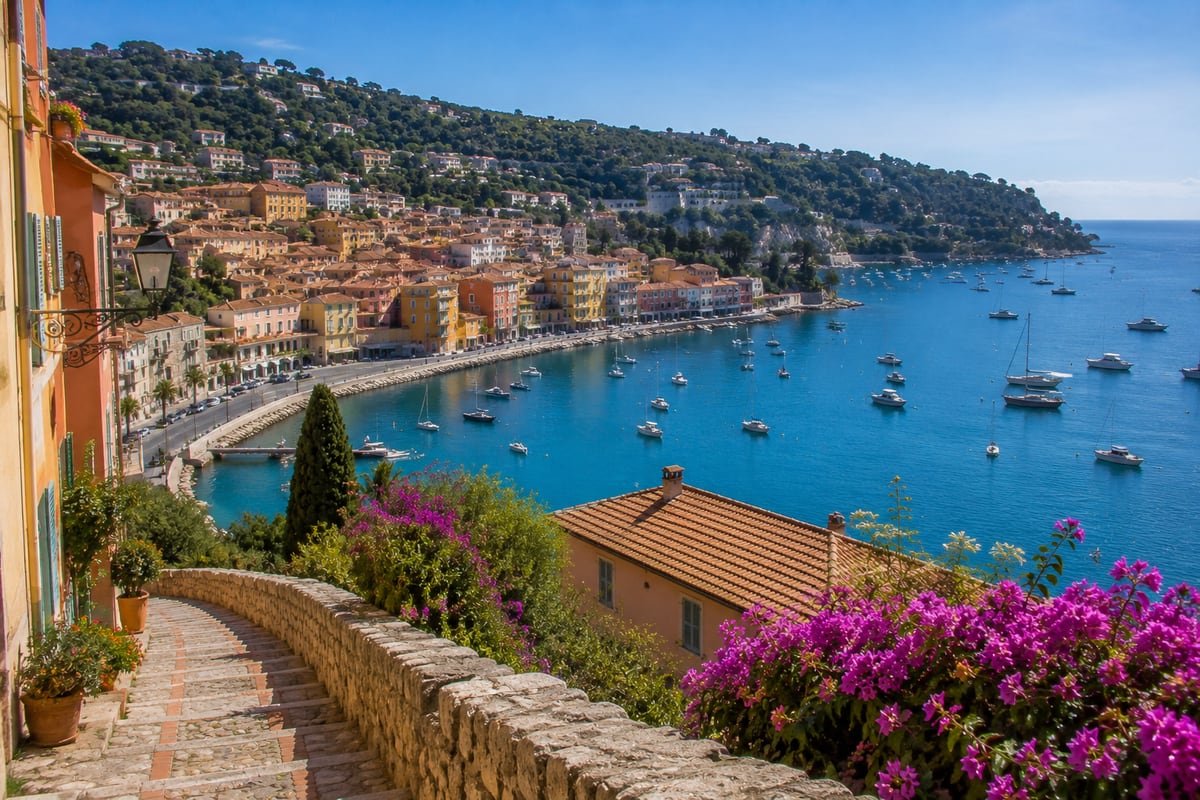
port
port
Villefranche-sur-Mer
A slower coastal stop for a sheltered bay, old streets and a softer Riviera pace outside peak season.
between Monaco and Nice
6. Stop three: Rue Obscure, the passage beneath the town
Location: Rue Obscure, Villefranche-sur-Mer.
One of Villefranche’s most unusual architectural features is Rue Obscure.
This covered passage runs for approximately 130 metres through the historic town.
Its origins lie in a fourteenth-century defensive route along the town’s first fortifications.
Sections were progressively covered between the sixteenth and eighteenth centuries.
Today, it offers an extraordinary contrast with the sunshine outside.
What makes it worth seeing?
The architecture is both functional and atmospheric.
Arched passages and enclosed sections reveal how the old town developed over centuries.
It's a reminder that Villefranche was a defended maritime settlement long before the modern Riviera tourist economy.
Is it a Hitchcock filming location?
The passage is not independently confirmed as a filming site for To Catch a Thief.
It's included because it is one of Villefranche’s most distinctive public historic spaces.
Presenting it as a confirmed Hitchcock location without a corresponding scene would be misleading.
Practical information
The tourist office lists Rue Obscure as open daily throughout 2026, with free public access.
The passage can usually be explored in around ten minutes.
Check current conditions and any temporary restrictions before entering.
Official information:Rue Obscure, Nice Côte d’Azur Tourist Office
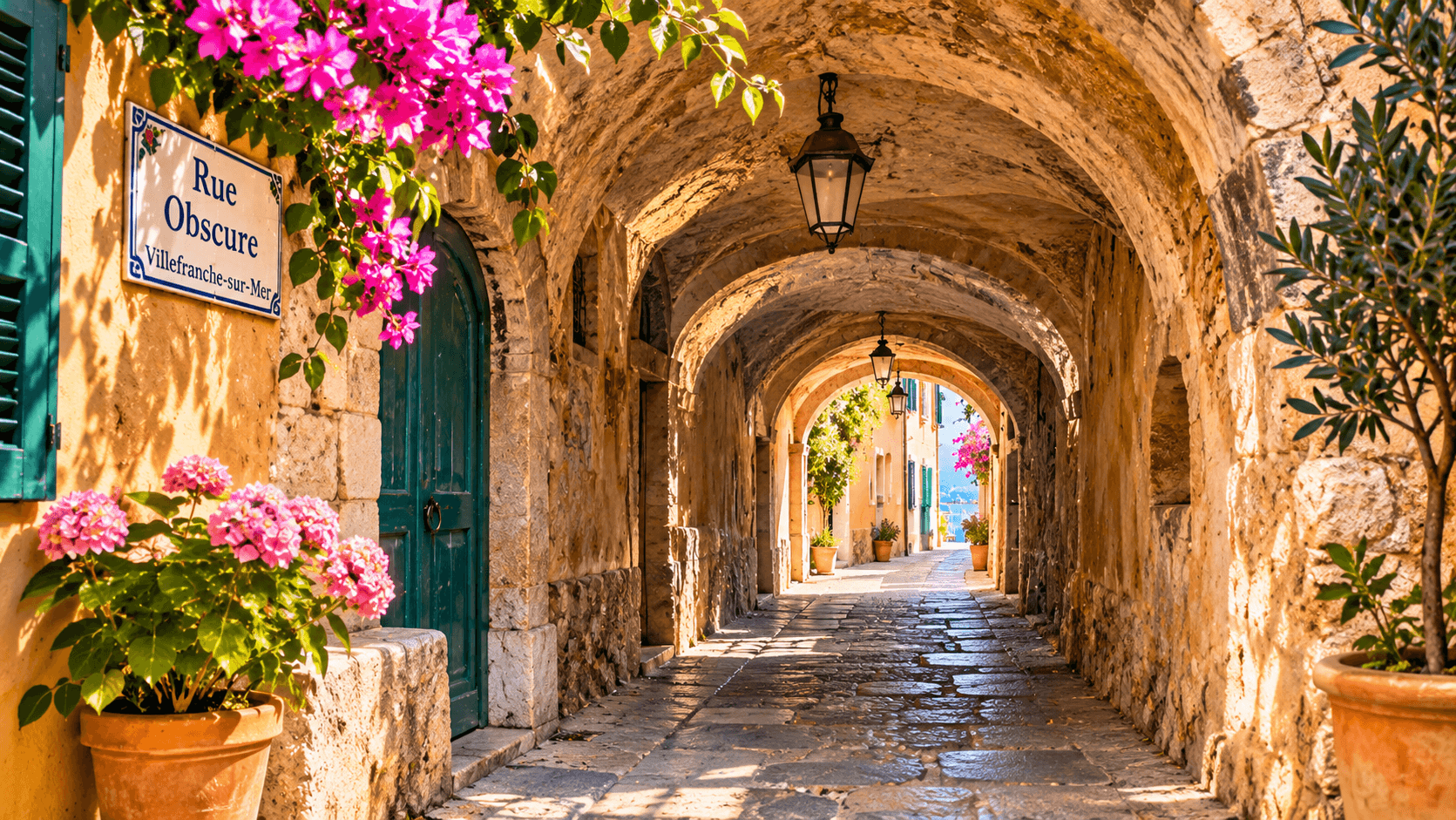
walk
walk
Rue Obscure
Covered historic passage beside the first rampart. Official 2026 listing gives free daily access, subject to temporary restrictions; not a confirmed To Catch a Thief scene or a step-free audit.
Rue Obscure, 06230 Villefranche-sur-Mer
7. Stop four: Quai de l’Amiral Courbet, the postcard Riviera
Location: Quai de l’Amiral Courbet.
This is one of the best places to appreciate Villefranche’s waterfront.
Colourful buildings face the harbour.
Cafés and restaurants line the pedestrian areas.
Small boats sit against the backdrop of the Mediterranean.
From here, the town looks almost impossibly picturesque.
Why it fits the film’s atmosphere
To Catch a Thief is famous for turning the landscape into part of its romance.
The Mediterranean offers beauty and freedom, while the characters' actions introduce uncertainty.
Villefranche’s waterfront creates a similar contrast.
It's an open, welcoming place, but the old town behind it contains an entirely different network of passages and enclosed spaces.
A useful cinematic exercise
Choose a public place overlooking the harbour.
Imagine three different camera frames.
A wide view that shows the entire bay.
A medium view concentrating on café terraces and waterfront buildings.
A close view of a doorway or balcony.
The same place can tell very different stories depending on how the camera presents it.
This is a way to understand location filmmaking without asserting that Hitchcock filmed a specific shot from your chosen position.
Lunch by the waterfront
The quai is a convenient area for a meal.
A restaurant reservation can be helpful in busier months, but a simpler café or takeaway lunch may suit the visit equally well.
Suggested time: 30–60 minutes, or longer with lunch.
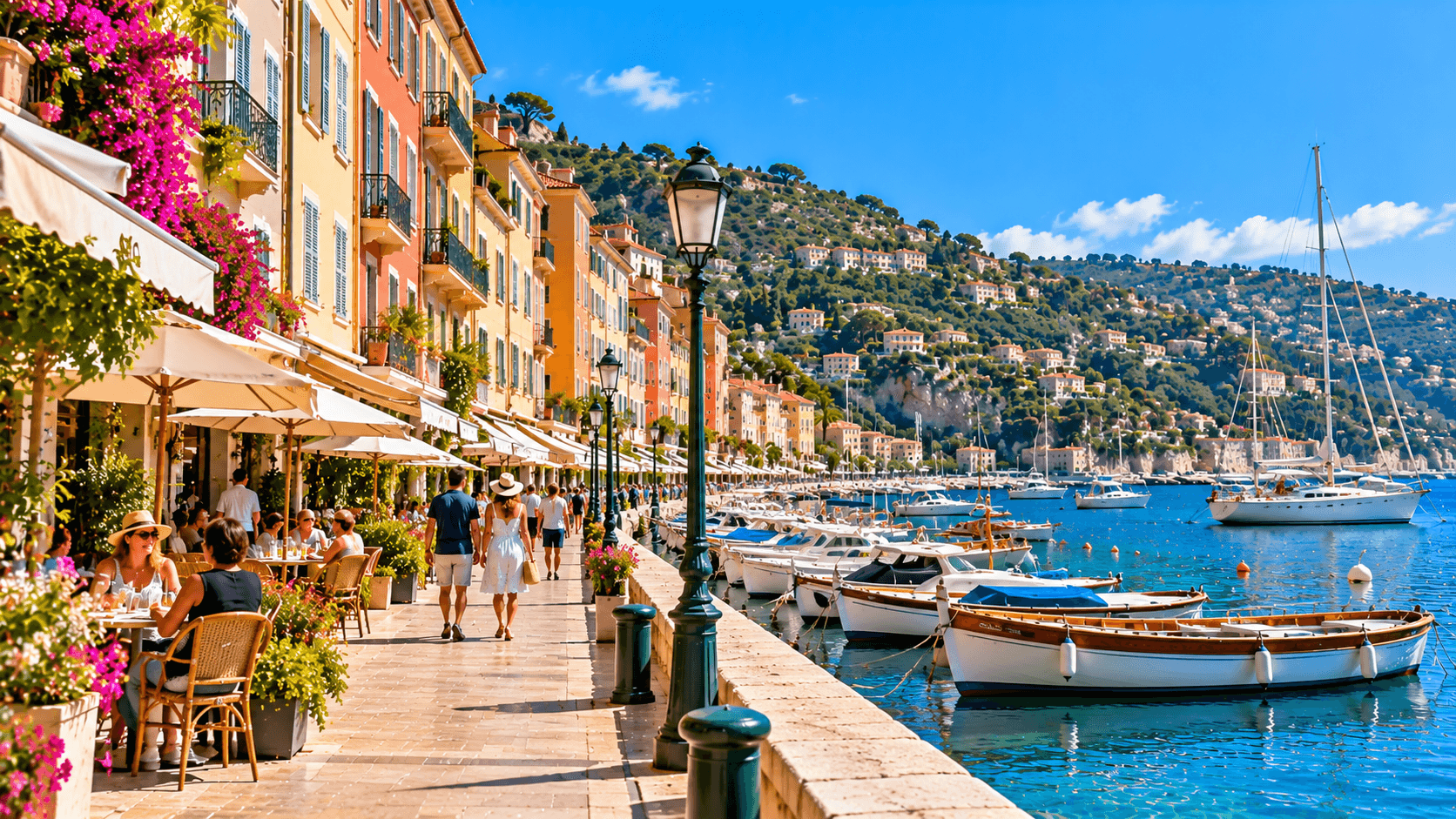
walk
walk
Quai de l'Amiral Courbet
Villefranche waterfront identified by regional tourism for Largo's yacht scenes in Never Say Never Again. A different film setting from the Darse warehouse; public-quay context, not yacht or interior access.
Quai de l'Amiral Courbet, 06230 Villefranche-sur-Mer
8. Stop five: Chapelle Saint-Pierre and Jean Cocteau’s Riviera
Location: 4 Quai de l’Amiral Courbet.
The small Chapel of Saint Peter is one of Villefranche’s most important cultural landmarks.
Jean Cocteau decorated its interior in the 1950s, transforming the historic fishermen’s chapel into a distinctive artistic environment.
His work belongs to another major chapter in the Riviera’s relationship with the arts.
Why include it in a Hitchcock guide?
Because Villefranche’s cultural history extends far beyond a single production.
Cocteau and Hitchcock represent different forms of twentieth-century visual storytelling.
Both worked with images, symbolism and the relationship between real spaces and imagined worlds.
The chapel provides a rewarding additional cultural visit, especially for travellers who enjoy art as well as cinema.
Is it in To Catch a Thief?
The chapel is not presented as a verified filming location for the film.
Its connection is cultural and geographical.
Visiting
The interior is ticketed. The Nice Côte d'Azur Tourist Office lists Wednesday–Sunday visiting and an annual closure from mid-November to mid-December. Exact closure dates must be confirmed before travel; the listing is not a live opening guarantee. It also describes the chapel as not wheelchair accessible.
Check the current official information before planning an indoor visit.
For a shorter outing, appreciating the exterior and waterfront setting may be enough.
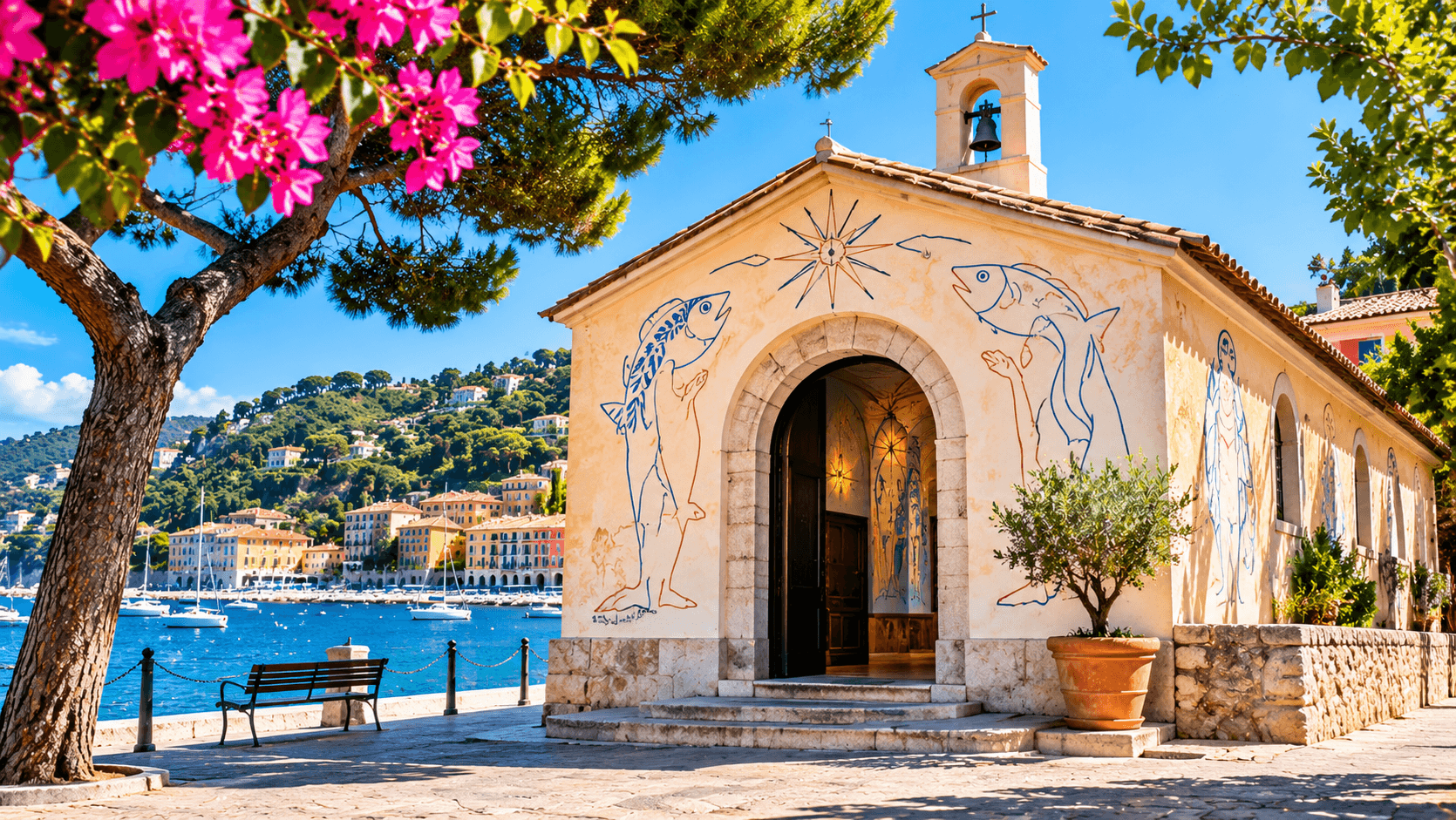
museum
museum
Chapelle Saint-Pierre / Jean Cocteau
Cocteau-decorated fishermen's chapel, a cultural stop not a confirmed Hitchcock scene. Ticketed interior; official listing states mid-November–mid-December closure and no wheelchair access. Confirm exact dates.
4 Quai Courbet, 06230 Villefranche-sur-Mer
9. Stop six: the Citadel of Saint-Elme and the wider bay
Location: Citadelle Saint-Elme, Villefranche-sur-Mer.
The citadel dates from the sixteenth century and reflects the strategic importance of Villefranche’s natural harbour.
Its fortifications were constructed under the authority of the Duke of Savoy.
The site offers a useful perspective on the region’s history before it became part of modern France.
Why finish here?
The harbour makes more sense when viewed through its military and commercial history.
Villefranche was not originally built to serve filmmakers or luxury tourists.
Its deep bay and protected position made it important to maritime powers.
The citadel and its surroundings tell that earlier story.
What to see
Explore the authorised public areas.
Look towards the harbour and surrounding coastline.
Notice how the town’s position between sea and hills shaped its development.
The Citadel's own website states that the permanent museum route has been closed since January 2022 for renovation, while temporary exhibitions continue. A first reopening phase is planned for 2028, not guaranteed. Do not plan a visit around seeing all permanent collections. Gardens, authorised public areas and any current temporary exhibition have separate access conditions; check holidays and works before leaving. The summer 2026 exhibition advertised on the homepage ended on 31 October and is not presented here as current.
Film connection
The citadel is a contextual historical stop, not a verified specific To Catch a Thief scene.
Suggested time: 30–45 minutes, with extra time for any open exhibitions.
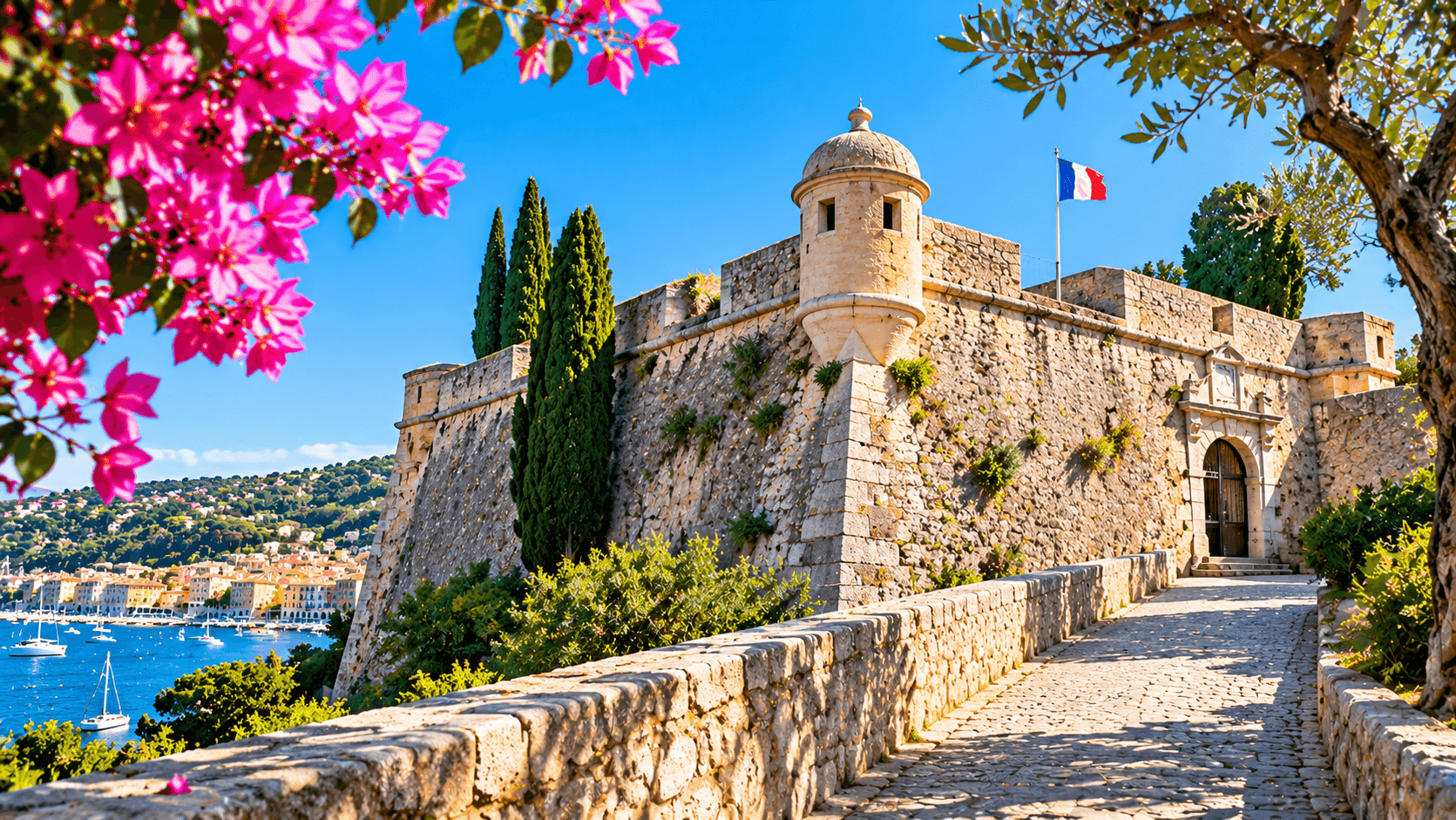
museum
museum
Citadelle Saint-Elme
Historic fortress and permitted public areas; not a confirmed Hitchcock scene. Permanent museum route closed since January 2022; temporary exhibitions continue. Check works, current exhibitions, gardens and holiday access separately.
La Citadelle, 06230 Villefranche-sur-Mer
10. The better-documented Hitchcock locations elsewhere on the Riviera
Villefranche is a good base for understanding the film’s Mediterranean atmosphere.
But some of its most famous locations lie elsewhere.
Production research also identifies footage shot outside France.
The American Film Institute documents, for example, that footage associated with the fireworks was staged in Long Beach, California.
That is a particularly good illustration of how cinema creates an apparently continuous fictional place from separate physical locations.
Why not turn all of them into one itinerary?
Because the geography is too scattered.
A visitor based in Menton would spend much of the day travelling between towns, roads and private estates.
It would also be misleading to suggest that every location is freely accessible.
A more useful approach is to choose one destination per day.
Villefranche for a relaxed coastal visit.
Nice for the market and urban sequences.
Cannes for the grand-hotel atmosphere.
And an inland excursion for the dramatic mountain scenery.
| Real place | Film connection | Visitor consideration |
|---|---|---|
| Hôtel Carlton, Cannes | Major hotel setting used in the production | Operating luxury hotel; access depends on reservations and policies |
| Saint-Jeannet | Area of John Robie’s fictional villa | Identified residence is private property |
| Nice, flower-market setting | Nice is documented by AFI; an exact current market camera position is not verified here | Public market areas change; do not infer a scene marker from a market name |
| Èze and La Turbie | Coastal road and driving sequences | Roads are for normal transport, not pedestrian stunt recreation |
| Gourdon and Tourrettes-sur-Loup | Village and mountain-road scenery | Separate inland excursion |
| Monte Carlo, Monaco | Luxury resort and hotel setting | Public architectural areas; private venues have separate rules |
| Cannes, La Croix des Gardes | Exterior setting associated with the masquerade-ball sequence | Private-property boundaries must be respected |
11. The famous driving scenes: not a walking route
To Catch a Thief contains some of the most celebrated driving sequences in classic Riviera cinema.
The blue convertible, mountain roads and coastal views have become an essential part of the film’s visual identity.
But reproducing those scenes today requires common sense.
Historical film geography versus modern roads
The road network has changed since filming in 1954.
Traffic is heavier.
Intersections and safety arrangements have been altered.
Some famous viewpoints may have restricted stopping or parking.
And the camera positions used by the production may have been located in areas that are not suitable for public access.
A safer way to experience the landscape
Use regular public transport to reach a viewpoint or village.
If travelling by car, stop only in authorised parking areas.
Do not stop in tunnels, on narrow bends or beside live traffic lanes to recreate a film frame.
For Villefranche specifically, there's no need to drive at all.
The train and pedestrian waterfront provide the most practical visit.
12. How Hitchcock constructed his Riviera
One reason the film remains so memorable is that the landscape feels coherent even though the production used many separate locations.
This is the art of cinematic geography.
Establishing shots
A wide view of a harbour, mountain or elegant hotel tells the audience where a scene is supposed to take place.
The following scene may have been recorded somewhere else.
Architectural continuity
Similar façades, terraces and gardens can make different locations appear to belong to the same environment.
The audience usually notices style before geography.
Editing
A car leaves one town.
The next shot shows it on a road several kilometres away.
Another cut places it near a different village.
The viewer experiences one journey because the sequence has been edited to feel continuous.
Studio footage
Interiors, close-ups or technically difficult sequences may be filmed away from the location shown on screen.
The finished film combines these fragments into a convincing story.
Why Villefranche is an interesting place to think about this
From its waterfront, you can see how a single stretch of coastline contains several visual worlds.
Historic streets.
A natural harbour.
Large private villas on surrounding hills.
Open sea.
And the neighbouring peninsulas.
Each can provide a different kind of setting without requiring the viewer to know the precise geography.
13. A realistic Hitchcock-inspired day from Menton
For most visitors, the best option is a half-day or full-day trip by train.
Suggested itinerary
This is a flexible example rather than a date-specific confirmed itinerary.
Short version: two to three hours
Visit the old town, Rue Obscure and the waterfront.
Have a coffee and return to Menton.
Relaxed version: half a day
Add the chapel and citadel, with time for lunch.
Full-day version
Include a longer waterfront break or time by the beach, subject to weather and facilities.
There is no reason to pack the day with additional towns merely because the film contains locations throughout the Riviera.
| Stage | Activity | Planning time |
|---|---|---|
| Morning | TER from Menton to Villefranche-sur-Mer | Around 30 minutes |
| Stop 1 | Walk from the station towards the old town | 15–20 minutes |
| Stop 2 | Explore the historic streets and Rue Obscure | 45–60 minutes |
| Stop 3 | Waterfront and lunch | 60–90 minutes |
| Stop 4 | Chapelle Saint-Pierre, if open | 20–40 minutes |
| Stop 5 | Citadel and harbour views | 30–45 minutes |
| Return | Walk to station and take TER to Menton | Allow uphill approach plus around 30 minutes on train |
14. Getting to Villefranche-sur-Mer from Menton
The regional TER runs directly between Menton and Villefranche-sur-Mer on many services.
The SNCF Connect route page checked on 3 November 2026 shows journeys around 27–30 minutes. This is a planning example, not a date-specific departure or last-train guarantee.
You do not need to change trains at Monaco or Nice for these direct services.
However, service patterns can change.
What to check before leaving
The actual train departure.
Whether your preferred service stops at Villefranche-sur-Mer.
The ticket price for your date and any eligible discount.
The return train.
And any engineering works or replacement buses. The current TER Nice–Ventimiglia works notice and the separate 10–11 November interruption notice must be checked against the actual outward and return journey. No replacement-coach seat or through journey is guaranteed.
Official timetable:SNCF Connect, Menton–Villefranche-sur-Mer
Is the town walkable?
Yes, but Villefranche is built on a slope.
The railway station sits above parts of the waterfront.
Descending towards the sea is relatively straightforward for many visitors.
Returning uphill may feel more demanding, especially in summer heat or with limited mobility.
The historic streets include steps and uneven surfaces.
The full suggested route is not certified as step-free.
Menton to Nice
Good for museums, events, Jazz Fest, Carnival and airport access planning.
Useful links
15. What does the film tell us about 1950s Riviera society?
The film was released in 1955, when the Riviera’s international identity was changing rapidly.
The region had already attracted wealthy winter visitors for generations.
During the interwar period, American artists and expatriates helped popularise summer life.
After the Second World War, cinema, fashion and international celebrity made the coast even more recognisable.
To Catch a Thief captures this transformation.
Jewellery, wealth and social performance
The film’s central mystery depends on an environment where expensive jewellery and social display matter.
Hotels and parties bring wealthy guests together.
Reputation becomes important.
And a charming stranger may seem trustworthy simply because he knows how to behave in the right surroundings.
Hitchcock uses this world both romantically and ironically.
Grace Kelly and Monaco
There is an additional historical coincidence that makes the film particularly memorable today.
Grace Kelly filmed To Catch a Thief before becoming Princess of Monaco in 1956.
Her later marriage to Prince Rainier III gave the film an unexpected connection with the real Principality.
But it would be historically inaccurate to describe the film as a depiction of her royal life.
She was portraying the fictional Frances Stevens.
The monarchy connection came afterwards.
16. A note on the original novel
To Catch a Thief was adapted from a 1952 novel by American writer David Dodge.
The film and the original book belong to related but different creative works.
Hitchcock's location choices should not automatically be treated as an exact map of the novel.
For this AzurMenton guide, the emphasis is on the 1955 screen production and the real Riviera.
A separate literary analysis would require reading the original novel and distinguishing its fictional geography from the places used by the filmmakers.
17. What is verified and what needs further research?
How this guide can become more precise
The strongest next step is a frame-by-frame comparison of a licensed copy of the film with the regional location references.
A complete research record should include the scene timestamp, identifiable architecture, contemporary photograph, source and confidence level.
Only then should a specific public street or building be marked as a confirmed Hitchcock filming position.
Until that work is complete, the historic Villefranche route remains a thematic visitor itinerary with a documented town-level connection to the production.
| Claim | Verification status |
|---|---|
| To Catch a Thief was filmed extensively on the French Riviera | Confirmed |
| Cannes, Nice, La Turbie, Èze and several other destinations were used | Supported by Paramount production records |
| Villefranche-sur-Mer is listed among filming locations | Supported by regional tourism and location databases |
| A particular Villefranche street appears at a specified timestamp | Not independently established |
| Rue Obscure is a confirmed Hitchcock location | Not established |
| Chapelle Saint-Pierre is a confirmed Hitchcock location | Not established |
| The Villefranche citadel is a confirmed Hitchcock location | Not established |
| The famous Riviera driving scenes form a continuous real route | No; multiple locations and editing were involved |
| Every historic building used for filming is accessible to visitors | No |
Frequently asked questions
Was To Catch a Thief filmed in Villefranche-sur-Mer?
Villefranche-sur-Mer appears in regional tourism and filming-location records, although the exact scene has not yet been independently established through detailed frame matching.
Who directed To Catch a Thief?
Alfred Hitchcock. The film was released in 1955.
Who starred in the film?
Cary Grant and Grace Kelly played the leading characters, John Robie and Frances Stevens.
Is Villefranche-sur-Mer the principal setting of the film?
No. The film uses several destinations across the French Riviera, including Cannes, Nice, Monaco and inland villages.
Can I visit the exact Villefranche filming location?
A precise publicly accessible camera position has not yet been independently confirmed. This guide provides a cultural outing through the town rather than claiming an exact scene recreation or a safety-audited route.
Is Rue Obscure featured in the film?
Its appearance has not been confirmed by the filming research reviewed for this guide. It is included because it is an important historic attraction in Villefranche.
How long is the train journey from Menton?
Direct regional trains typically take around 27–30 minutes, depending on the service.
Can you visit without a car?
Yes. The train is a convenient option, and much of central Villefranche can be explored on foot.
Is the route suitable for wheelchair users?
The old town has slopes, steps and uneven passages. The complete itinerary should not be treated as step-free.
Where is John Robie's villa?
Specialist filming research identifies a private property near Saint-Jeannet. It is not a public museum or a stop in this Villefranche itinerary.
Was Grace Kelly already Princess of Monaco during filming?
No. She married Prince Rainier III in 1956, after the film's production and release.
Does this guide reveal the thief's identity?
No. The guide discusses locations and production history without revealing the mystery's solution.
Final thoughts: Hitchcock's Riviera beyond the famous scenes
To Catch a Thief helped turn the French Riviera into one of cinema's most glamorous landscapes.
Its beautiful roads, hotels, villas and Mediterranean views remain instantly recognisable.
But the film's geography is more complicated than it first appears.
Hitchcock assembled his screen world from numerous separate places.
Some are well documented.
Others, including the exact Villefranche-sur-Mer footage, still deserve closer research.
For visitors staying in Menton, that uncertainty doesn't prevent an enjoyable trip.
Villefranche is beautiful in its own right.
Its historic streets, remarkable harbour and waterfront offer an introduction to the Mediterranean landscape that made the Riviera so attractive to filmmakers.
Come for Hitchcock.
Explore the real town.
And enjoy the difference between a place as cinema imagines it and the place that exists beyond the frame.
Sources and further reading
American Film Institute: To Catch a Thief
The Alfred Hitchcock Wiki: To Catch a Thief Filming Locations
Reelstreets: To Catch a Thief, Scene Comparisons
IMDb: To Catch a Thief Filming Locations
Nice Côte d'Azur Tourist Office: Rue Obscure
Archived Côte d'Azur cinema tourism press kit, printed page 25
Chapelle Saint-Pierre: official tourism visiting information
La Citadelle: permanent museum renovation and temporary exhibitions
SNCF Connect: Menton to Villefranche-sur-Mer
Research checked on 3 November 2026. The archived tourism attribution does not independently authenticate a specific scene or timestamp. AFI's production-file summary supports the broader Riviera shoot but does not name Villefranche. The Film Commission's municipal page concerns permission to film today, not evidence of the 1955 shoot. The Hitchcock Wiki was unavailable during this pass; IMDb and specialist location pages are further-reading leads, not newly authenticated sources. Public visitor stops, private properties and production geography remain distinct. Confirm opening hours, works and rail services for your actual date.