Menton to Nice
Good for museums, events, Jazz Fest, Carnival and airport access planning.
Useful links
A villa on screen
The French Riviera has a complicated relationship with its glamorous image.
Behind the grand hotels, gardens and Mediterranean villas lie stories of ambition, money, family conflict and sometimes tragedy.
Few films explore that contrast as directly as In the Name of My Daughter, known in French as L'Homme qu'on aimait trop.
Directed by André Téchiné and released in 2014, the film stars Catherine Deneuve, Adèle Haenel and Guillaume Canet.
It revisits the disappearance of Agnès Le Roux, the daughter of a prominent Nice casino owner, during one of the most turbulent periods in the Riviera's gambling industry.
The story begins in the 1970s, when the Palais de la Méditerranée casino in Nice is at the centre of a struggle involving family interests, money and competing business ambitions.
But its emotional centre is a relationship between a mother and daughter, complicated by the daughter's involvement with an older lawyer.
To tell the story, the filmmakers used several real locations along the French Riviera.
One of them was Villa Maria Serena, a beautiful historic residence in Menton's Garavan district, near the Italian border.
The villa and its subtropical gardens became part of the film's representation of the Le Roux family's world.
The connection is now supported by regional tourism information and filming records independent of AzurMenton.
Maria Serena's garden is accessible only through authorised guided arrangements. No future dated session after 31 October was confirmed in this review.
Its real history is quite separate from the Le Roux case, and just as interesting.
This guide explores those two layers: the historic villa that visitors can discover and the fictionalised screen world that temporarily occupied it.
1. Discover the film
Original title: L'Homme qu'on aimait trop
International title: In the Name of My Daughter
Director: André Téchiné
Running time: 116 minutes
Principal cast: Catherine Deneuve, Adèle Haenel and Guillaume Canet
Genre: Biographical crime drama / Psychological drama
Historical setting: Primarily Nice in the 1970s, with later legal developments
Production: Fidélité Films
The film was presented out of competition at the 2014 Cannes Film Festival.
Catherine Deneuve plays Renée Le Roux, who manages the Palais de la Méditerranée casino.
Adèle Haenel plays her daughter Agnès.
Guillaume Canet plays Maurice Agnelet, a lawyer associated with the family who becomes romantically involved with Agnès.
The film explores the tensions surrounding that relationship, the financial pressures affecting the casino and the widening conflict between mother and daughter.
What makes the film distinctive?
Téchiné doesn't approach the story simply as a conventional detective mystery.
He is interested in relationships and the conflicting emotional demands placed on the characters.
Love, loyalty, money and independence become difficult to separate.
The Riviera provides a visually attractive setting, but the characters' lives are far from carefree.
Its luxurious homes and institutions make an effective contrast with the instability of their personal relationships.
Where to find official information
2. The real Agnès Le Roux case
The film takes its inspiration from a real disappearance that became one of the French Riviera's most extensively discussed criminal cases.
In the 1970s, Renée Le Roux managed the Palais de la Méditerranée casino in Nice.
Her daughter Agnès held a financial interest in the business.
The family's circumstances became entangled with a struggle for control of the casino and Agnès's relationship with Maurice Agnelet.
In late October 1977, Agnès disappeared at the age of twenty-nine.
Her body and vehicle were never recovered.
The investigation and subsequent court proceedings extended across decades.
Historical facts and film interpretation
The disappearance was real.
The financial and legal disputes were real.
The later trials and court decisions are documented.
But the private conversations, motives and emotional exchanges shown in the film are dramatic reconstructions.
A screenplay cannot provide independent proof of what individuals thought or said in private.
A careful note about the legal case
Maurice Agnelet was convicted of Agnès Le Roux's murder in 2007. The European Court of Human Rights subsequently found shortcomings in the reasoning of that conviction, and further French proceedings followed.
The case's complex legal history should not be compressed into the film's storyline.
For a complete account of the judicial decisions, consult court records and reliable historical reporting rather than treating the adaptation as a documentary.
The film is an interpretation of a real tragedy, not a replacement for the legal record.
3. Villa Maria Serena: the filming location in Menton
Address: 21 Promenade Reine Astrid, Menton.
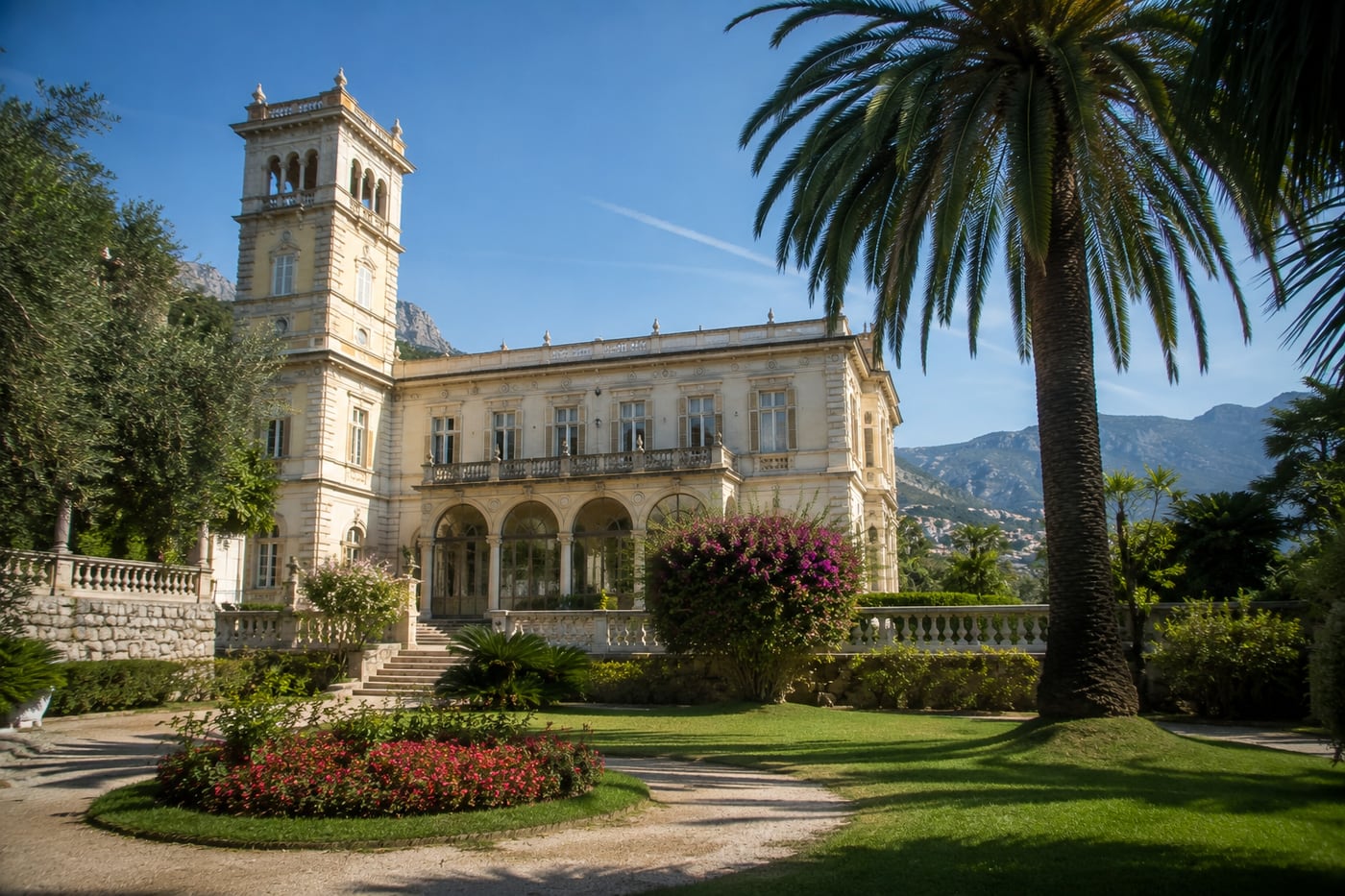
Villa Maria Serena is located in Garavan, at the eastern end of Menton, close to the Italian border.
The property stands below the surrounding hills, in a sheltered location renowned for its subtropical vegetation.
Its pale façades, elegant terraces, palms and views towards the Mediterranean make it one of Menton's most visually distinctive historic estates.
What is its connection with the film?
National filming records confirm that In the Name of My Daughter filmed in Menton.
The regional Provence-Alpes-Côte d'Azur tourism authority specifically identifies the gardens of Villa Maria Serena as a filming location.
The supplied research attributes the Le Roux residence identification to IMDb. That page required a robot check during this review, so this more specific identification is not independently reconfirmed here.
This combination of sources supports the location's inclusion in the AzurMenton Books & Films series.
What is not yet established?
The precise camera positions, individual interior scenes and exact timestamps haven't been independently verified against a complete copy of the film.
The regional source explicitly confirms the gardens; it doesn't by itself establish that every scene set inside the fictional Le Roux house was filmed in Maria Serena.
That distinction matters.
A production may use the garden or exterior of one property while filming interior scenes elsewhere.
Until detailed scene matching is complete, describe Maria Serena as a confirmed garden filming location, not as a verified match for every scene of the family's screen residence.
garden
garden
Villa Maria Serena
A historic Garavan villa and garden used as a filming location; access depends on municipal arrangements, tours or events.
21 Promenade Reine Astrid, 06500 Menton
Check current hours before visiting
4. The real history of Maria Serena
The villa's story began almost a century before Téchiné's film.
It was created in the late nineteenth century for the Foucher de Careil family.
The City of Menton dates its creation to 1886.
The municipality associates it with Charles Garnier, the architect famous for the Paris Opéra and the Monte Carlo Casino.
The supplied research cites the regional heritage inventory for Pierre Jansoulin and later alterations. Its page could not be retrieved beyond an access check during this review; that attribution is not independently reconfirmed here.
This means the building's history should be understood through multiple construction phases rather than attributing every surviving feature to one architect.
Henry Konig and the transformation of the estate
In 1922, British banker Henry Konig acquired the property.
The supplied research describes later alterations, but the detailed architectural inventory was inaccessible during this review.
The later works changed portions of the building while maintaining its identity as an elegant Riviera residence.
In 1947, Konig transferred the villa and its southern garden to the City of Menton.
The property subsequently became a venue for official receptions and public heritage activities.
A residence with several identities
Maria Serena has therefore served several purposes.
A private aristocratic villa.
A British-owned winter residence.
A municipal reception property.
A historic garden open on organised visits.
And, briefly, a filming location for a story set in the world of the Le Roux family.
The building's cinematic identity is only one chapter in its much longer history.
5. The garden: the real attraction visitors can explore
Maria Serena is particularly celebrated for its gardens.
Protected by the surrounding terrain, the property enjoys a remarkably mild microclimate.
Its collection includes palms, cycads and other subtropical plants.
The municipality describes the site as a petite Afrique, reflecting the distinctive vegetation and sheltered conditions.
What should you notice?
The relationship between the house and garden.
The layered terraces and changing ground levels.
The way palms and large foliage frame the building.
The contrast between enclosed planted areas and open Mediterranean views.
The site's proximity to the border with Italy.
These features give the property a very different identity from Menton's formal public gardens and historic old-town squares.
Why would a film crew choose it?
Maria Serena offers a coherent image of Riviera privilege.
A grand historic residence.
A secluded garden.
A setting associated with wealth, privacy and international society.
The architecture requires relatively little explanation on screen.
Its appearance immediately tells the viewer something about the social world of the characters.
But that visual role doesn't mean the real Le Roux family lived here.
It is a film location, not a verified biographical address.
6. How a real villa becomes somebody else's house on screen
This is the central cinematic interest of Maria Serena.
When a film represents a real historical family, audiences may naturally assume that the houses they see are the family's actual residences.
Often, they aren't.
A production chooses locations for their visual qualities, practical access and suitability for the period being reconstructed.
The exterior creates an identity
A few establishing shots can persuade viewers that a building belongs to a particular family.
The architecture, landscape and arrival sequences help create that impression.
Interiors may be assembled elsewhere
Films sometimes combine exterior footage from one building with interiors recorded in another property or on a purpose-built set.
The finished edit makes the spaces appear continuous.
Without production documentation or frame comparison, a viewer cannot assume that all these spaces physically belong together.
The real address stays the same
Villa Maria Serena remains in Menton, whatever place it represents in the film.
The story is primarily connected with Nice and the Palais de la Méditerranée.
The filming geography is wider.
That difference is not an error.
It's one of the ordinary techniques of cinematic storytelling.
7. Can you visit Villa Maria Serena?
Yes, but only under the published guided-visit arrangements.
Maria Serena is a municipal heritage property, not a garden with unrestricted daily access.
Current published visiting information
The tourist office's autumn 2026 programme listed guided visits on Tuesdays, Thursdays and Saturdays from 10:00 to 11:30, ending on 31 October 2026.
The advertised adult admission was €10, with a €7 rate for visitors aged six to eighteen.
Tours were described as available in French and English.
Important: These were the published autumn sessions. They should not be presented as guaranteed future dates after 31 October.
Checked 5 November 2026: the dated tour page still ends on 31 October. A separate year-round tourism listing repeats Tuesday, Thursday and Saturday hours, but explicitly says opening follows the programme; it is not proof of a bookable November session. Confirm a new dated session before travelling.
Arrival instructions
Meeting point: The main garden gate at 21 Promenade Reine Astrid.
Local Zest bus routes 1 and 8 serve the Garavan area, subject to current timetables.
Menton-Garavan railway station is also relatively close.
Accessibility
The garden has changes in elevation and some stairs.
Published accessibility information describes wheelchair access with assistance, but not full independent access to every area.
Check your particular requirements with the organiser before booking.
What about the villa interiors?
A garden ticket doesn't automatically include access to all rooms of the historic building.
Follow the guide's instructions and respect any closed sections.
Official resources:
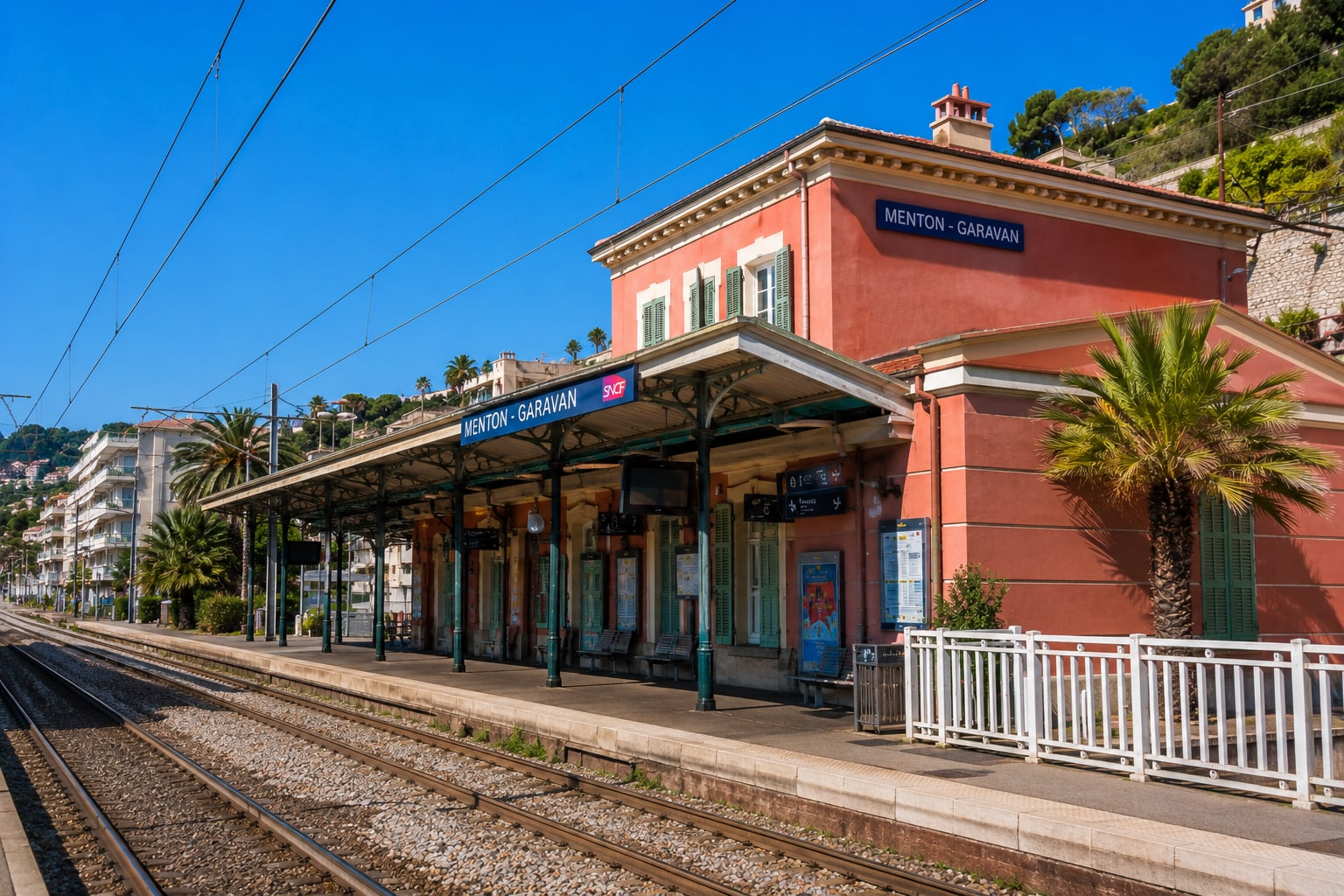
station
station
Menton Garavan Station
Eastern Menton station useful for Garavan, the port and some Italian Riviera train plans.
Garavan, 06500 Menton
Check current hours before visiting
8. A compact film-and-garden outing from Menton
This film doesn't require a long route with several unrelated stops.
Villa Maria Serena is the main location.
Plan around the opportunity to visit it.
Option A: On a confirmed guided-tour day
Arrive at the garden gate shortly before your scheduled visit.
Explore the historic planting and architecture with the guide.
Pay attention to the relationship between the house, terraces and surrounding vegetation.
After the tour, take a short walk along the public waterfront.
Return to your accommodation or continue exploring Garavan.
Recommended allowance: Approximately two to three hours including the tour and a relaxed walk.
Option B: When no garden tour is available
Explore the publicly accessible Garavan waterfront around Promenade Reine Astrid.
Enjoy the sea views and the historic residential atmosphere.
Do not enter the garden gates or attempt to photograph restricted areas.
The outing will provide coastal and architectural context, but it won't recreate the film's villa scenes.
Recommended allowance: Approximately 30–60 minutes.
A useful approach for film enthusiasts
Watch the film before visiting.
Pay attention to the exterior and garden sequences associated with the Le Roux residence.
Compare recognisable architectural shapes and vegetation, not temporary furniture or props.
If a particular shot remains uncertain, don't attribute it to a precise part of the villa without further evidence.
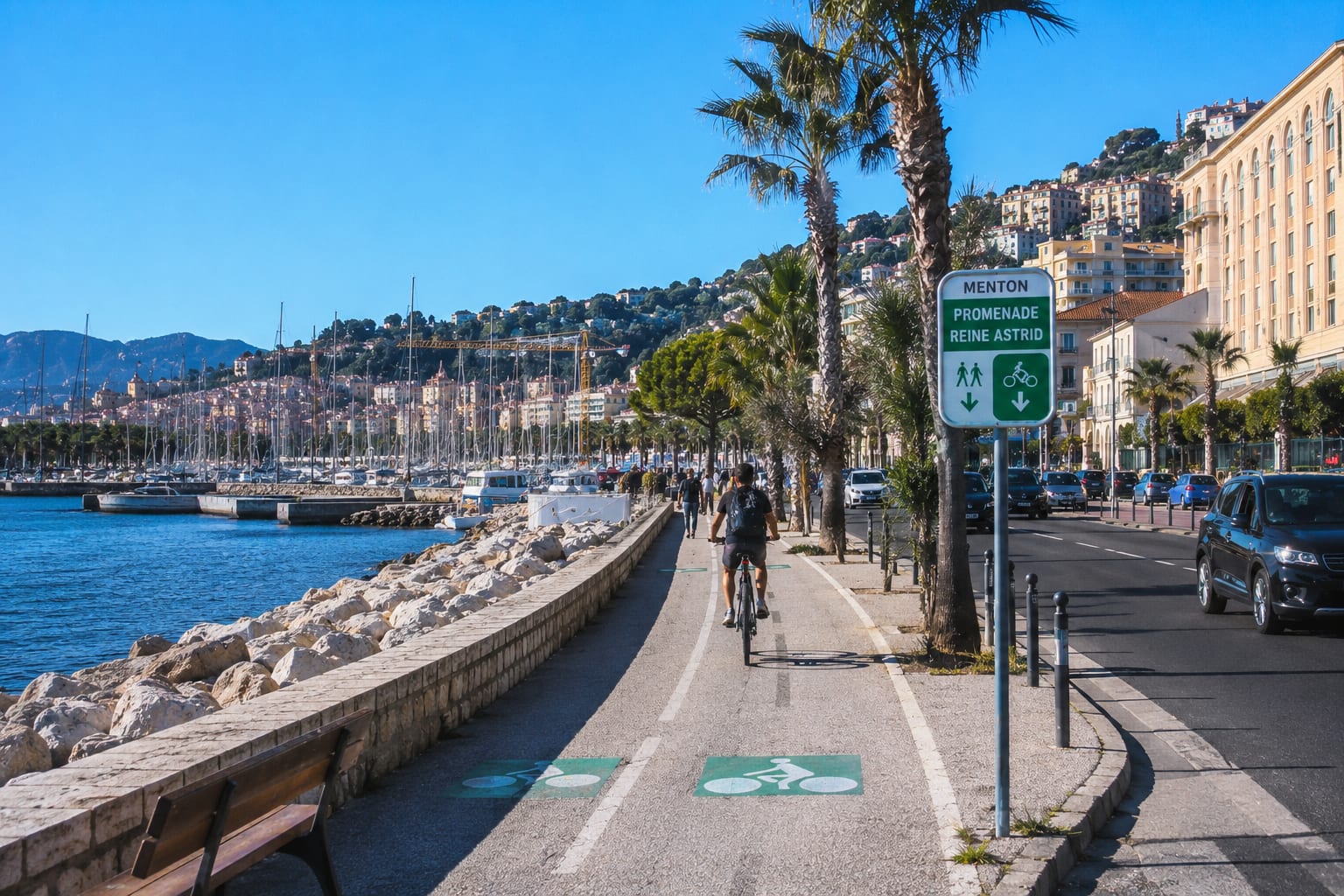
cycle route
cycle route
Promenade Reine Astrid
Scenic Garavan-side promenade used by the official local cycling route toward the border.
Garavan seafront
9. The real Palais de la Méditerranée is in Nice
To understand the film's historical context, there is another important real-world location.
The Palais de la Méditerranée, on Nice's Promenade des Anglais, was the casino associated with the Le Roux family.
Its dramatic history is central to the film.
The building was an important symbol of the Riviera's international gambling and hospitality economy.
But today's complex is not the unchanged casino of the 1970s.
Much of the original structure was demolished, while its historic façades were preserved as part of later redevelopment.
Why include it?
Because it helps separate the two geographies of the film.
Villa Maria Serena belongs to the production's choice of filming locations.
The Palais de la Méditerranée belongs to the actual history of the Le Roux family and their business.
They are different kinds of places, and they shouldn't be confused.
Should you combine them in one day?
You can, but there's no need to.
The villa is in eastern Menton.
The Palais de la Méditerranée is in central Nice.
For visitors staying in Menton, the two are better treated as separate outings.
The Nice trip offers a wider understanding of the real historical case; the Garavan visit is about the film's production and the history of Maria Serena.
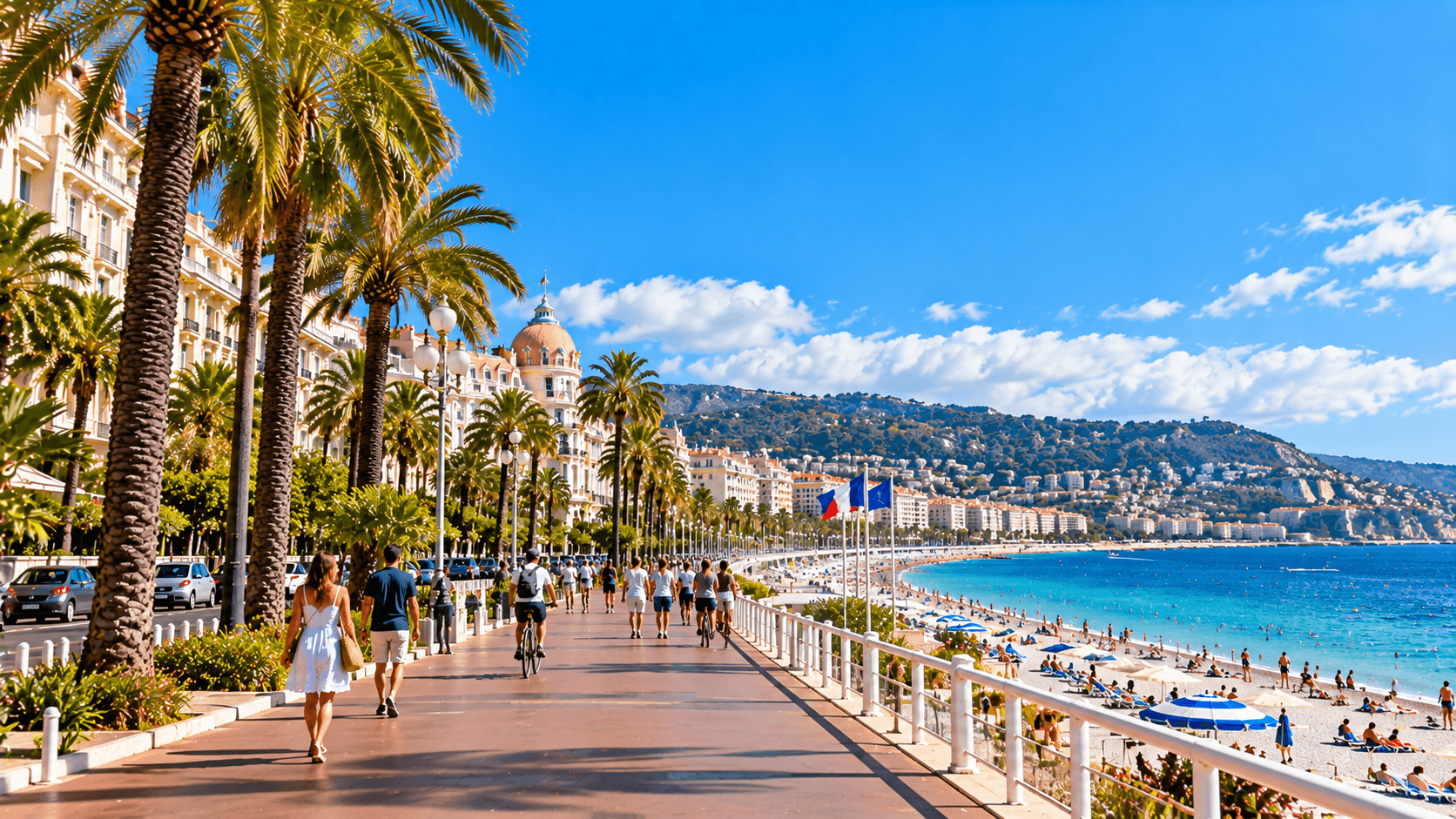
walk
walk
Promenade des Anglais
Nice's public seafront and a contextual finish for the Gary walk. Choose a manageable section; a seaside route is not a certification of uninterrupted step-free access or current conditions.
Promenade des Anglais, Nice
10. The Riviera beyond its glamorous image
One of the most interesting aspects of In the Name of My Daughter is its use of beautiful settings for a story of conflict.
The Mediterranean is sunny.
The villas are elegant.
The clothes, interiors and social environments suggest prosperity.
But the people living within this world are dealing with serious questions about trust, power and independence.
The Riviera's glamour doesn't resolve those problems.
It can make the contradiction more pronounced.
A different kind of location guide
For some films, visiting the location means recognising a famous staircase or matching the angle of an action sequence.
Here, the more interesting question is what the building represents.
Why does the Le Roux family need to be shown in a grand villa?
What does the house communicate about wealth and social position?
How does the garden contribute to the impression of privacy?
And why does the director place emotionally difficult scenes within such attractive surroundings?
These are questions that can make even a single confirmed filming location rewarding.
11. What is confirmed and what still needs checking?
This distinction between source reliability and editorial interpretation should remain visible even after a future update.
| Claim | Current evidence | Editorial status |
|---|---|---|
| The film was produced in 2014 | Festival de Cannes, CNC | Confirmed |
| André Téchiné directed it | Festival de Cannes | Confirmed |
| Catherine Deneuve, Adèle Haenel and Guillaume Canet star | Festival de Cannes | Confirmed |
| Filming took place in Menton | Film France-CNC | Confirmed |
| Villa Maria Serena gardens hosted the film crew | Regional tourism authority | Confirmed |
| Villa Maria Serena portrays a Le Roux family residence | Supplied research cites IMDb; access check prevented reconfirmation | Not independently reconfirmed; frame comparison required |
| Specific interior scenes were shot inside the villa | Insufficiently established | Not verified |
| Exact timestamps and camera positions | No independent shot-by-shot comparison | Not verified |
| The real Le Roux family lived at Maria Serena | No supporting evidence established | Do not claim |
| Garden is freely open every day | Contradicted by official visiting conditions | Incorrect |
12. What to compare on screen and in reality
For a later Then & Now section, three visual elements would be particularly useful.
The villa's principal façade. Compare its architectural composition with any exterior establishing shots.
The garden terraces. Check the relationship between planting, paths and views.
The transition between house and garden. Look for doorways, steps or terraces that could establish continuity between scenes.
These are research targets, not claims that specific shots have already been verified.
If suitable film stills can be legally reproduced, add the exact timestamp and edition used for each comparison.
If not, modern photographs and written descriptions can still explain the production's use of the property.
Frequently asked questions
Was In the Name of My Daughter filmed in Menton?
Yes. Film France-CNC identifies Menton among the locations used by the production.
Was Villa Maria Serena used in the film?
Yes. The Provence-Alpes-Côte d'Azur tourism authority specifically confirms filming in the villa's gardens.
What does Villa Maria Serena represent in the film?
The supplied research cites IMDb for this identification, but its page was not accessible for reconfirmation. The regional source confirms the gardens, not a complete scene-by-scene residence match.
Is the film based on a true story?
Yes. It is inspired by the circumstances surrounding Agnès Le Roux's disappearance and the related family, financial and legal events.
Did the real Le Roux family live in Villa Maria Serena?
There is no established evidence for that claim. The villa is identified as a filming location, not a documented family residence.
Who plays Renée Le Roux?
Catherine Deneuve.
Who plays Agnès Le Roux?
Adèle Haenel.
Who plays Maurice Agnelet?
Guillaume Canet.
Can you visit Villa Maria Serena?
The garden is accessible through scheduled guided visits. It is not generally open for unrestricted entry.
How much does a visit cost?
The autumn 2026 programme listed €10 for adults and €7 for ages six to eighteen. Confirm the price of any new session.
Is the villa wheelchair-accessible?
Published information describes assisted wheelchair access to portions of the site. Some slopes and steps restrict access.
Where is the real Palais de la Méditerranée?
On the Promenade des Anglais in Nice. It belongs to the historical casino story, not the same physical property as Villa Maria Serena.
Does this guide reveal the film's ending?
No. It introduces the historical case and cinematic setting without recounting the film's final scenes.
Final thoughts: a real garden and a cinematic identity
Villa Maria Serena was built long before the events depicted in In the Name of My Daughter.
Its history belongs to the international residents who shaped Menton's winter-resort architecture and to the city that later inherited the property.
Its remarkable garden is a product of that long history.
For the 2014 film, a crew used the gardens and temporarily gave the property another cinematic identity.
For André Téchiné's drama, it became part of the world surrounding the Le Roux family, whose real story had unfolded decades earlier.
The film uses the beauty and privacy of a Riviera residence to frame a tragedy rooted in love, money and conflict.
But the house on screen and the history of the house itself are different things.
Visitors can appreciate both without confusing them.
Book an authorised garden tour when one is available.
Explore the public waterfront of Garavan.
Discover the real history of Maria Serena.
Then look again at the film and consider how a place can become part of a story that originally happened somewhere else.
That's what makes Villa Maria Serena worth visiting, even for viewers who know nothing about the film.
Official sources and further reading
Festival de Cannes: In the Name of My Daughter
Film France-CNC: Production and filming locations
Provence-Alpes-Côte d'Azur Tourism: Riviera filming locations
IMDb: In the Name of My Daughter filming locations
City of Menton: Villa Maria Serena
Regional Heritage Inventory: Villa Maria Serena
Menton Tourist Office: Guided garden visits
Festival de Cannes: Téchiné and the Le Roux case
Checked 5 November 2026. Film France-CNC confirms Menton; regional tourism confirms Maria Serena's gardens. IMDb and the regional architectural inventory required access checks and were not independently reconfirmed. Exact interiors, camera positions and future dated tours remain unverified. The film is a dramatisation, not a documentary or judicial record. The supplied cover is an artistic project illustration, not a verified film still or current access photograph.
European Court of Human Rights: Agnelet case, 10 January 2013
Ministry of Culture: Palais de la Méditerranée and preserved facades