A beautiful refuge and a dangerous game
The French Riviera has no shortage of spectacular villas.
Some were built for aristocrats. Others belonged to artists, wealthy expatriates or collectors who wanted to create a private world beside the Mediterranean.
Villa Torre Clementina, on Cap Martin, is one of the most unusual.
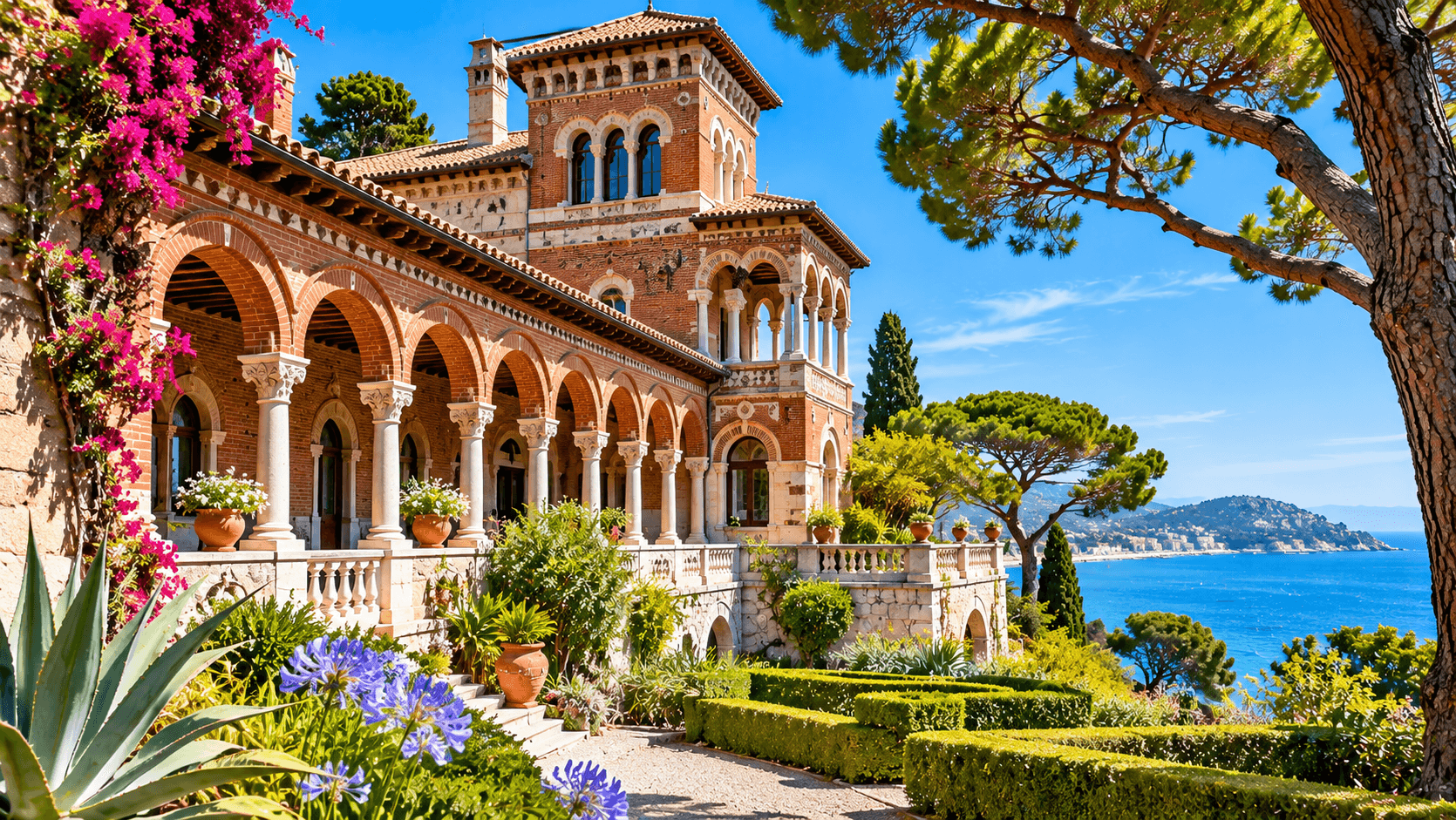
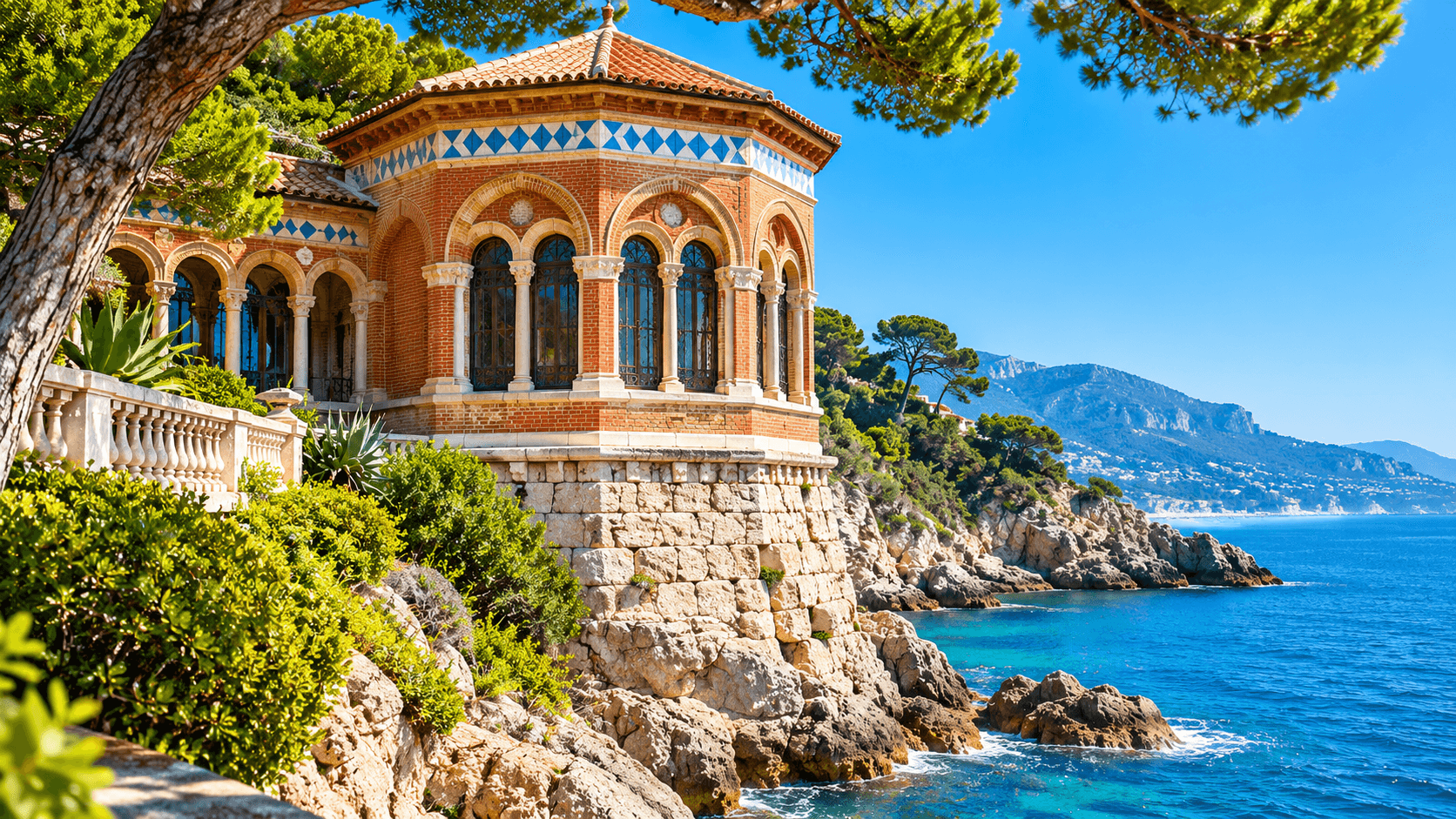
Hidden among Mediterranean pines, overlooking the sea, the estate combines decorative brickwork, elegant arcades, Venetian-inspired architecture and elaborate gardens.
It looks almost like a place invented for cinema.
And in 1963, a film crew arrived to make that idea a reality.
Director René Clément was preparing Les Félins, released internationally as Joy House, a psychological crime thriller starring Alain Delon, Jane Fonda and Lola Albright.
The story follows a charming fugitive who believes he has found safety in a magnificent Riviera villa.
But the beautiful house conceals a far more complicated situation.
For the production, Torre Clementina provided an extraordinary architectural setting.
More than sixty years later, the villa remains one of the French Riviera's most interesting connections between cinema, architecture and private garden history.
This guide explores the film, the real estate behind it and how to experience the surrounding Cap Martin landscape from Menton.
There is one important limitation.
Villa Torre Clementina is private property. Its appearance in a famous film does not mean visitors can enter the house, grounds or swimming-pool terraces.
The suggested outing focuses on authorised public coastal routes and the historical context of the building.
1. Discover the film: Les Félins / Joy House
Original title: Les Félins
International title: Joy House
Release: 1964
Director: René Clément
Starring: Alain Delon, Jane Fonda, Lola Albright
Music: Lalo Schifrin
Cinematography: Henri Decaë
Genre: Crime thriller / Psychological suspense
Format: Black-and-white widescreen
Running time: Approximately 97 minutes in the Gaumont edition; duration varies between catalogued versions.
The film centres on Marc, played by Alain Delon, a man pursued by criminals after an affair involving a gangster's wife.
Trying to escape danger, he finds employment with two wealthy American women living in an impressive Riviera villa.
Barbara, played by Lola Albright, and Melinda, played by Jane Fonda, appear to offer him protection and a comfortable place to stay.
But Marc gradually discovers that the household operates according to rules he doesn't understand.
And the villa that seemed like a refuge becomes increasingly unsettling.
Why is the film interesting?
René Clément had an exceptional talent for placing suspense within visually attractive environments.
The Riviera's magnificent houses and scenery create an atmosphere of luxury.
Yet the people living behind those elegant façades may be deceptive, manipulative or dangerous.
The contrast is central to Joy House.
The house isn't simply somewhere the characters happen to live.
Its enclosed spaces, dramatic architecture and sense of separation from the outside world contribute to the psychological tension.
A film adapted from a novel
Les Félins was adapted from the novel Joy House by American crime writer Day Keene.
The film's screenplay and dialogue involved René Clément, Pascal Jardin and Charles Williams.
This connection is worth noting for readers interested in noir fiction, but the original novel's literary geography should not automatically be treated as a record of the actual Riviera filming locations.
For this guide, the confirmed connection is with the 1964 screen production.
Where to find the film
Les Félins — Gaumont official film page
Les Félins — Fondation René Clément
Availability of streaming and physical editions depends on country and licensing.
2. Villa Torre Clementina: the real house behind the screen
Location: Avenue de l'Impératrice-Eugénie, Roquebrune-Cap-Martin
Torre Clementina stands within the historic private estate of Cap Martin, on the wooded peninsula between Menton and Monaco.
It was constructed in the early twentieth century for writer Ernesta Stern.
Her project belonged to an age when wealthy international residents commissioned highly individual villas along the Mediterranean.
But Torre Clementina wasn't designed as a conventional classical mansion.
Its architecture drew heavily on Venetian and Byzantine-inspired decorative traditions.
The result was theatrical long before cinema discovered it.
What makes it distinctive?
Brick and pale stone.
Decorative columns and arcades.
A prominent tower.
Loggias overlooking the surrounding landscape.
Terraced gardens and carefully arranged architectural features.
The relationship between the building, its grounds and the Mediterranean is especially important.
This is an estate designed to create an entire private environment, rather than merely a house with a pleasant garden.
Is this the real location from the film?
Yes.
The Provence-Alpes-Côte d'Azur regional tourism authority explicitly identifies Villa Torre Clementina as a filming location for Les Félins, starring Alain Delon and Jane Fonda.
The French heritage inventory independently records the same association.
A particularly valuable historical source is a Paris Match photographic feature, reproduced in a 2023 exhibition publication by Hôtel du Cap-Eden-Roc.
It documents Delon and Fonda exploring the villa shortly before filming began on 2 October 1963.
This makes the connection substantially stronger than an unverified filming-location listing.
civic
civic
Villa Torre Clementina
Private historic estate, documented Les Félins / Joy House filming property. No regular public visit or clear public viewpoint verified. Do not enter gates, gardens, driveways or terraces. The map search identifies the estate, not a visitor entrance. Exact film shots and unchanged interiors remain unverified.
Avenue Impératrice-Eugénie, 06190 Roquebrune-Cap-Martin, France
3. Before the film: Ernesta Stern and her imaginary Venice
The villa's first major story belongs not to cinema but to literature.
Its commissioner, Ernesta Stern, was a writer associated with European literary and artistic society.
She published works under the pseudonym Maria Star, including Venetian-themed stories.
In the years following 1904, she commissioned architect Lucien Hesse to build a residence on Cap Martin.
The villa's interiors and gardens were developed with the involvement of Raffaële Maïnella, an Italian painter and landscape designer brought from Venice.
Architecture inspired by another place
The villa uses a mixture of decorative traditions, with strong Venetian references.
Its arcades and ornamental stonework suggest historic Italian buildings, while the surrounding landscape is unmistakably Mediterranean Riviera.
This gives Torre Clementina an unusual double identity.
It stands in France, but its architecture evokes cultural influences from elsewhere.
Long before filmmakers used the property to represent a fictional world, its original owner had already created one through architecture.
A writer's house becomes a film location
This is one of the most interesting connections for the AzurMenton Books & Films collection.
Torre Clementina was commissioned by a novelist.
Its visual identity came partly from literary imagination and historicist design.
Decades later, another storyteller used those same architectural qualities to create suspense on screen.
The villa therefore connects two different kinds of artistic production.
The world imagined by its original owner.
And the world invented by René Clément.
4. The gardens: a private landscape designed as an experience
The French Ministry of Culture describes the gardens as an important part of Torre Clementina's heritage.
Raffaële Maïnella designed a sequence of geometrically organised garden spaces within the pine forest.
The grounds included paths, ornamental structures, fountains, water features and sculptures.
The official heritage record identifies roughly ten garden structures or decorative architectural features.
Why do the gardens matter?
A large historic estate is often designed around movement.
A visitor passes through an entrance.
Follows a path.
Encounters an arcade, fountain or terrace.
Then arrives at a carefully framed view.
This sequence creates a feeling of discovery.
At Torre Clementina, the relationship between gardens and architecture was an intentional part of the design.
Why is that useful for cinema?
A film director can use those same spaces to control what the audience sees.
An arcade can frame a character.
A garden path can create anticipation.
A terrace can establish distance between people.
A staircase can suggest a transition between private and public worlds.
These are general principles of cinematic space, not claims that every feature described above appears in a particular shot of Les Félins.
For a precise screen-location study, individual scenes still need to be compared with the surviving architecture.
5. Alain Delon, Jane Fonda and the filming of 1963
The film was released in 1964, but production activity on the Riviera began the previous year.
A photograph taken by François Pagès for Paris Match shows Alain Delon and Jane Fonda exploring the Torre Clementina property before the start of filming.
The archival caption identifies the estate and dates the upcoming start of production to 2 October 1963.
The caption also describes the actors sitting on decorative elements presented as artificial Byzantine remains.
Why this photograph matters
It establishes a direct production connection between the two leading actors and the estate.
The villa wasn't merely associated with the film in later tourist storytelling.
It was documented as part of the production environment at the time.
A changing moment in French cinema
By 1963, Alain Delon was already one of the most recognisable actors in European cinema.
René Clément had previously directed him in Plein Soleil (Purple Noon, 1960), another stylish thriller in which Mediterranean beauty contrasts with deception and danger.
Jane Fonda was an emerging American film star.
Les Félins became her first French film, as noted in the contemporary photographic material.
The international cast reflects the wider Riviera culture in which French, American and other artistic worlds regularly intersected.
6. Why Torre Clementina works as a thriller location
Some buildings look reassuring.
Others look mysterious.
Torre Clementina manages to do both.
Its Mediterranean setting, gardens and decorative architecture communicate wealth, beauty and privacy.
Yet the same qualities can create a feeling of enclosure.
High walls keep the outside world away.
Elaborate internal spaces make it difficult for outsiders to understand how the property works.
Terraces and gardens can be places of leisure, but also spaces where characters observe one another from a distance.
A beautiful refuge
For Marc, the prospect of staying in a magnificent villa appears attractive.
He's trying to escape danger.
The house seems to offer security.
But the private environment gradually reveals its own complications.
The architecture becomes part of the suspense
René Clément uses the contrast between outward elegance and hidden intentions to give the film much of its atmosphere.
The villa's actual design helps make that contrast visually convincing.
This is what distinguishes Torre Clementina from an ordinary location chosen simply because it looks attractive.
The architecture has enough character to become part of the drama.
7. What does the camera show, and what belongs to the real building?
A filming-location guide should distinguish three different things.
This distinction protects the historical integrity of the site.
The film may show spaces that have changed since 1963.
Some scenes may involve studio work, specially arranged props or changes made for production.
Without a shot-by-shot comparison, visitors shouldn't assume that every room or garden feature visible on screen remains exactly as it appeared.
What should film enthusiasts compare?
Start with the most stable architectural elements.
The tower silhouette.
The arched openings.
The arrangement of columns.
The relationship between the building and its terraces.
The overall geometry of garden structures.
These are more useful identifiers than furniture, temporary decoration or camera lighting.
| Element | What we know |
|---|---|
| Real building | Villa Torre Clementina, Roquebrune-Cap-Martin |
| Production connection | Independently confirmed as a location for René Clément's Les Félins |
| Screen identity | The luxury villa in the fictional thriller |
| Original architecture | Designed by Lucien Hesse for Ernesta Stern |
| Historic interiors and gardens | Created with Raffaële Maïnella |
| Exact shot locations | Not independently mapped frame by frame for this guide |
| Current public access | No ordinary public visiting programme established |
8. Can you visit Villa Torre Clementina?
Villa Torre Clementina is private property.
It is protected as a French historic monument, but heritage protection doesn't automatically give the public access to its interiors or grounds.
As of the November 2026 review, no regular public ticketing or guided-tour programme has been verified.
What does that mean in practice?
You cannot assume access to the house, gardens, loggias or swimming-pool areas.
You should not enter gates, private driveways or paths serving the estate.
Don't use drones over the property without the relevant permissions and compliance with aviation and privacy rules.
Avoid photographing residents through windows or over walls.
If an authorised special opening is announced in the future, its terms should be confirmed with the organiser.
Can you see the villa from outside?
Some architectural details may be visible from lawful public viewpoints around Cap Martin.
However, vegetation, terrain and the private estate's boundaries can restrict the view.
We have not verified a particular public viewpoint that guarantees an unobstructed photograph of the building.
The coastal walk is worth doing independently of whether the villa is visible.
9. A safe coastal outing inspired by Joy House
Rather than trying to recreate the characters' movements inside a private estate, explore the surrounding Cap Martin coastline.
This is one of the Riviera's most attractive areas for a walk.
The peninsula combines pines, rocky coves, sea views and historic villas partly concealed among the trees.
The official coastal path, commonly known as Sentier Le Corbusier or Sentier du Littoral, follows approximately five kilometres of coastline between the Cap Martin area and the western side towards Monaco.
It is a public walking route, subject to weather and temporary restrictions.
Suggested experience
Begin on an authorised section of the coastal path.
Walk through the pine-lined landscape.
Look towards the sea and notice the relationship between the natural terrain and the large private estates.
Enjoy the mixture of rugged coast and architectural history.
Turn back after a manageable distance, or continue towards a confirmed transport connection if you're prepared for the full route.
Why this works for the film
The coastline helps explain the estate's appeal as a setting.
A secluded villa on a wooded peninsula feels separate from busy coastal towns.
The surrounding Mediterranean landscape provides beauty and isolation in equal measure.
You can appreciate those qualities without entering the property or inventing a public entrance.
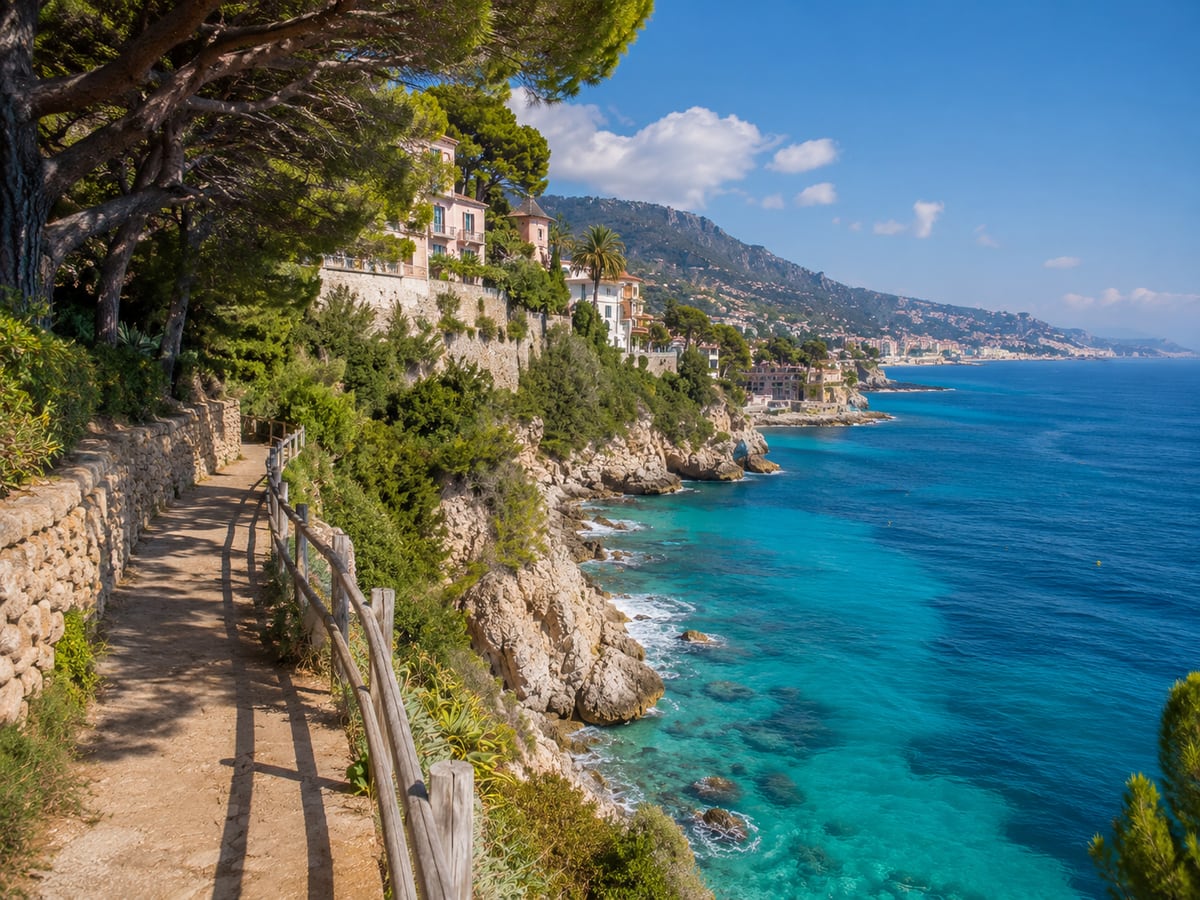
walk
walk
Roquebrune-Cap-Martin Coastal Walk
A classic Riviera coastal route linking beaches, cliffs, pine trees, villas and train access back to Menton.
between Menton and Cap Martin
10. The short version: a Cap Martin cinema walk
Best for: Visitors who want a relaxed outing without committing to the full coastal trail.
Suggested time: Approximately 60–120 minutes, depending on your chosen section and return.
Travel from Menton towards Carnolès or another suitable public starting point.
Use the officially designated coastal path.
Walk for 20–40 minutes, allowing time for sea views and photographs.
Return along the same authorised path.
This out-and-back approach avoids depending on a distant return connection.
It also allows you to shorten the route if the weather changes.
What to look for
Mediterranean pines.
Rocky shorelines and changes in elevation.
Historic villa silhouettes where publicly visible.
The contrast between secluded private estates and the public coastal landscape.
What not to do
Don't try to locate a hidden access road into Torre Clementina.
Don't leave the marked public path to approach its terraces or gardens.
And don't treat the fictional villa's screen entrance as a real visitor entrance.
11. The longer option: the Cap Martin coastal path
Best for: Visitors comfortable with uneven coastal paths who want to spend more time exploring the peninsula.
Distance: Approximately 4.7–5 km for the published coastal route.
Suggested duration: Allow at least 1.5–2.5 hours of walking, plus transport and breaks. These are planning estimates, not verified personal walking times.
The route connects the coastal neighbourhoods around Carnolès and Cabbé, with views towards Monaco and the surrounding cliffs.
Tourist-office descriptions classify it as relatively manageable, but the path is not continuously flat or step-free.
There are rocky sections, stairs and exposure to weather.
Getting there without a car
Carnolès and Roquebrune-Cap-Martin have regional railway stations that can be useful for the respective ends of the broader coastal walk.
Check the current access points and train departures before setting off.
Don't assume the coastal trail is fully open simply because the tourist office lists it as a year-round activity.
An important late-2026 consideration
The municipality has been carrying out a substantial improvement project around the Winston Churchill seafront.
The published works programme extends towards the end of 2026.
Temporary changes to pedestrian access and the surrounding roads may apply.
Before visiting, consult local notices and follow any on-site diversions.
If a section is closed, turn back rather than attempting to bypass barriers.
12. A different architectural perspective: Cap Moderne
Roquebrune-Cap-Martin is also home to another extraordinary architectural story.
On the western side of the peninsula stands E-1027, designed by Eileen Gray in collaboration with Jean Badovici, close to the Cabanon of Le Corbusier.
These properties belong to a very different architectural tradition from Torre Clementina.
Two ways of imagining a Mediterranean home
Torre Clementina embraces historicist decoration, elaborate arches and carefully designed gardens.
E-1027 explores modernist simplicity, flexible interiors and the relationship between domestic comfort and the Mediterranean climate.
Both demonstrate how strongly architecture can reflect the ideas of the people commissioning and designing a home.
Can you visit Cap Moderne?
The Cap Moderne heritage site offers guided tours during published seasons.
Booking is required.
For 2026, the operator lists a season from April through October, with ordinary individual admission of €19.
Check the next season's programme before planning a visit.
The published 2026 season ended on 31 October. At this review on 5 November 2026, do not plan a November visit using that expired calendar; the next season and available slots remain unconfirmed.
Is Cap Moderne connected with Les Félins?
Not as a confirmed filming location in the evidence reviewed for this guide.
It's an optional architectural extension, not another stop from the film.
The distinction is worth maintaining.
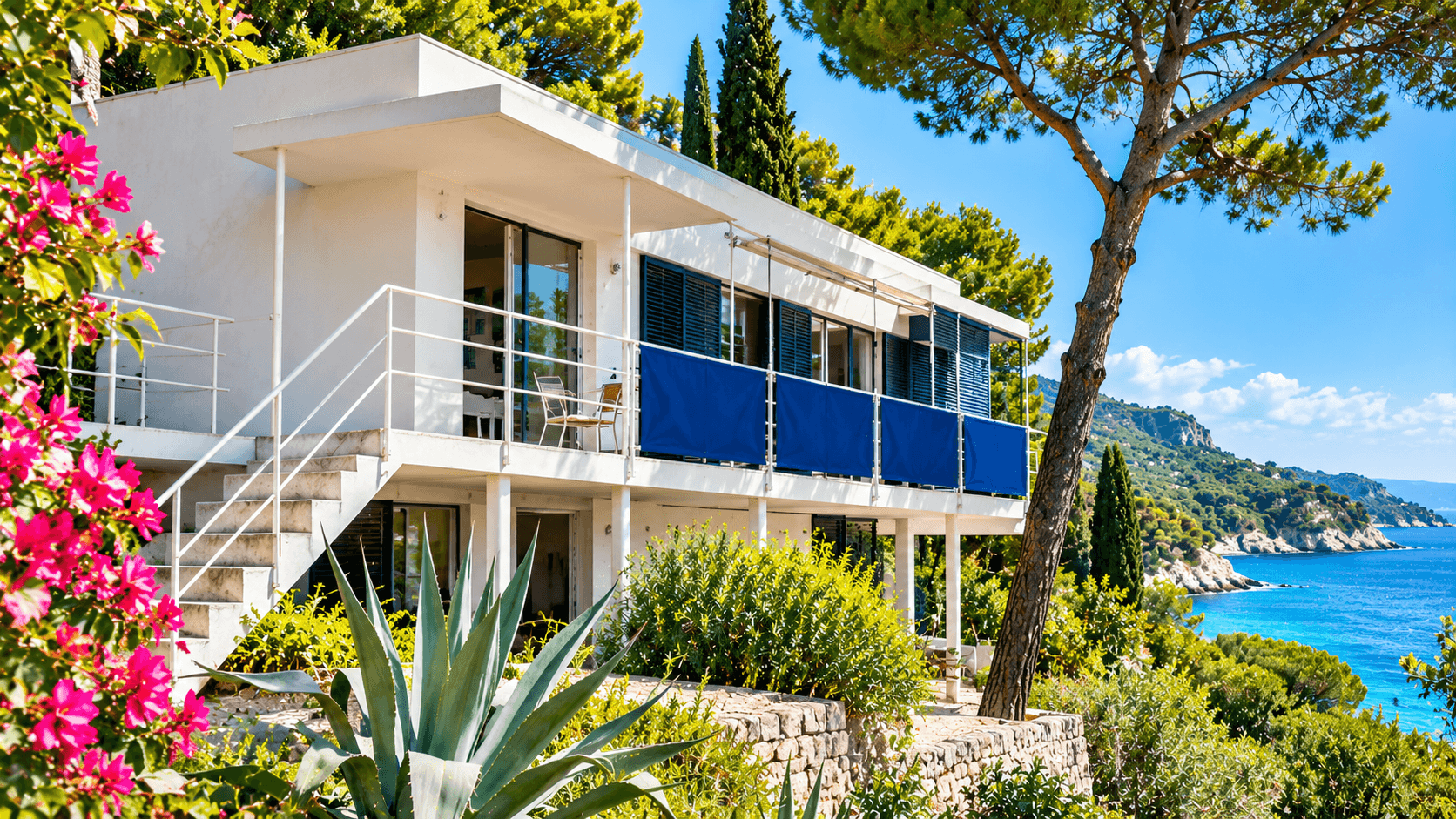
museum
museum
Villa E-1027 / Cap Moderne
Eileen Gray's modernist villa, visited with a booked Cap Moderne tour. Published 2026 season ends 31 October; later visits need a new confirmed programme. Walking approach, uneven ground and steps.
Roquebrune-Cap-Martin; tour meeting point at the railway station
Check current hours before visiting
13. A day on the Riviera: film and architecture from Menton
If you're spending several days in Menton, consider making Cap Martin the focus of a half-day or full-day outing.
A relaxed half-day
Travel towards Carnolès.
Explore a safe public section of the coastal path.
Enjoy the views and imagine the Riviera landscape in which Les Félins was filmed.
Have a café or lunch break in a suitable nearby neighbourhood.
Return to Menton.
A fuller cultural day
Walk a longer section of the Cap Martin coast.
If visiting during a season with confirmed Cap Moderne guided tours, arrange an appropriate reservation separately.
Explore another architectural location without rushing.
Return to Menton using a verified regional train or other suitable transport.
What about Torre Clementina itself?
Its historical significance is part of the outing, but it is not a scheduled stop requiring entry.
Even if the villa cannot be seen clearly from the public path, the visit still offers a meaningful connection with the coastal landscape and the architecture of the period.
14. The house as a character: what Joy House reveals about Riviera cinema
Les Félins belongs to a tradition of films in which beautiful surroundings conceal disturbing relationships.
The French Riviera is particularly effective for this type of story.
Its villas can represent privacy and wealth.
Its gardens create spaces of intimacy.
Its coastlines suggest escape.
But the same features can be used to communicate isolation.
A private house can become a refuge.
Or a trap.
René Clément understood how to work with that contradiction.
The contrast between the seductive appearance of a villa and the uncertainties inside it is essential to the film's appeal.
Torre Clementina's distinctive architecture made it a particularly memorable setting.
Looking beyond the film
There is a broader question here that connects this guide with the historic villas of Menton and Cap Martin.
What happens when a house acquires a second identity through cinema?
Its original owner imagined one way of living.
Its architect designed a particular environment.
Its later residents adapted the estate.
Then a director arrived and turned it into the setting of an entirely fictional story.
The real building remained.
But audiences encountered it as something else.
This is one of the reasons filming locations can be so interesting even when they're not open to the public.
civic
civic
Villa Cypris
Private historic estate, not a public museum. Regional tourism confirms Mortelle Randonnée filming; exact shots remain unverified. Observe only from the authorised public coastal trail when open. The location search identifies the estate, not a visitor entrance. Do not enter gardens, driveways or gallery, or bypass barriers.
Avenue Douine, 06190 Roquebrune-Cap-Martin, France
15. What is confirmed and what still needs verification?
This separation between documentary evidence and additional interpretation is particularly important for private historic properties.
It prevents the film's fiction from being confused with the house's real history.
| Claim | Current status |
|---|---|
| Les Félins was released in 1964 | Confirmed by Gaumont and the film foundation |
| René Clément directed the film | Confirmed |
| Alain Delon, Jane Fonda and Lola Albright starred | Confirmed |
| Villa Torre Clementina was used for filming | Confirmed by regional tourism and historical photography |
| Filming preparation at the villa occurred in 1963 | Documented by Paris Match photographic material |
| Villa commissioned by Ernesta Stern | Confirmed by French heritage records |
| Architecture by Lucien Hesse | Confirmed |
| Gardens and interiors associated with Raffaële Maïnella | Confirmed |
| Historic-monument protection since 1991 | Confirmed |
| Villa has a regular public visiting programme | Not established |
| Every screen interior survives unchanged | Not established |
| Exact scene timestamps and camera angles | Further frame-by-frame comparison required |
Frequently asked questions
Where was Joy House filmed on the French Riviera?
Villa Torre Clementina in Roquebrune-Cap-Martin is a confirmed location. The production used the estate as part of the film's luxury-villa setting.
Is Joy House the same film as Les Félins?
Yes. Les Félins is the French title, while Joy House is the international English title.
When was the film released?
In 1964. Production activity at Torre Clementina is documented in 1963.
Who directed Les Félins?
René Clément, who also directed Plein Soleil and Jeux interdits.
Who stars in the film?
Alain Delon, Jane Fonda and Lola Albright play the principal characters.
Is Villa Torre Clementina a real building?
Yes. It's an early twentieth-century historic villa on Cap Martin, commissioned by writer Ernesta Stern.
Who designed Torre Clementina?
Architect Lucien Hesse designed the villa. Raffaële Maïnella worked on its interiors and gardens.
Can you visit the villa?
It is private property, and no regular public visitor programme has been verified. Do not enter the estate without authorisation.
Can you see it from the coastal path?
Some architecture around the Cap Martin estates may be visible from public routes, but a clear view of Torre Clementina from a particular point has not been independently guaranteed.
Is the coastal walk free?
The published Sentier Le Corbusier is a free public coastal trail, subject to weather conditions and possible temporary closures.
Is the route suitable for wheelchair users?
The full coastal trail is not a step-free accessible walk. It includes irregular terrain and steps.
Is E-1027 another Joy House filming location?
No confirmed connection has been established. It is suggested as a separate architectural visit.
Does this guide contain film spoilers?
No major plot developments or the ending are revealed.
Final thoughts: a private villa with a public cinematic history
Torre Clementina was created as a private world.
Its first owner imagined a residence inspired by Venetian architecture and surrounded by carefully designed gardens.
Its architect and landscape designer turned that idea into one of Cap Martin's most distinctive historic estates.
Then cinema gave the house another identity.
In Les Félins, its beauty becomes part of a story about attraction, secrecy and danger.
Alain Delon and Jane Fonda brought international attention to a building whose original history was already remarkable.
Today, Torre Clementina remains private.
But its role in the film, its architectural significance and the landscape around it can still enrich a visit to Cap Martin.
Walk the public coastal path.
Enjoy the pines, cliffs and Mediterranean views.
Think about the people who created the villas hidden among the trees, and the filmmakers who transformed those houses into fictional worlds.
You don't need to enter Torre Clementina to appreciate why its story is worth telling.
Sometimes the most fascinating Riviera houses are the ones whose doors remain closed.
Sources and further reading
Les Félins — Fondation René Clément
Provence-Alpes-Côte d'Azur Tourism — Riviera Filming Locations
French Ministry of Culture — Villa Torre Clementina
French National Heritage Register — Torre Clementina
Menton Riviera & Merveilles Tourist Office — Sentier Le Corbusier
Cap Moderne — Official Visitor Information
Paris Match exhibition catalogue — archival caption, pp. 8–9
Municipality — Churchill seafront project
Municipal council — planned works timeline, March 2025, p. 22
Sources checked 4–5 November 2026. Regional tourism confirms the filming property; heritage records establish its history. The 2023 exhibition catalogue reproduces an archival caption naming 2 October 1963 as the upcoming start of filming, not the date of the photograph. Archive images are linked, not reproduced. Gaumont and the foundation give different screenplay listings; the credits above follow the foundation's transcription of the original credits. No complete shot-by-shot film audit, verified public viewpoint or current whole-trail opening is claimed. The March 2025 works timeline is a plan, not proof of today's closures or completion. The supplied cover and villa image are artistic illustrations, not documentary photographs, exact film stills or proof of public access.