A literary day in Nice
A literary day trip from Menton through the real Nice behind Promise at Dawn: a mother and son, a former pension, a school and the Mediterranean. Allow 3–4 hours in Nice, or a full day with travel and breaks. Historical addresses, literary scenes and film locations are distinguished throughout.
The boy who arrived in Nice carrying his mother's dreams
In 1928, a fourteen-year-old boy arrived in Nice with his mother. His name was Roman Kacew. He had been born in Vilnius, spent part of his childhood in Poland and grown up listening to his mother's extraordinary predictions about his future. She was convinced that he would become someone important. A French writer. A diplomat. A decorated hero. Perhaps something even more remarkable. For a teenager trying to adapt to a new country, these expectations could be both inspiring and deeply embarrassing. His mother, Mina, had very little money but an enormous capacity for determination. She found ways to support them, persuaded people to help her and worked tirelessly to give her son opportunities she had never enjoyed herself.
Eventually, they established a life in Nice. The boy attended school, discovered the city, formed friendships and began writing. Years later, he would become Romain Gary, one of France's most extraordinary novelists, a wartime aviator, diplomat and the only writer to receive the Prix Goncourt twice under different names. He would also transform his childhood and relationship with his mother into one of the great works of modern French literature. Published in 1960, La Promesse de l'aube, known in English as Promise at Dawn, is a story of ambition, love, sacrifice and the extraordinary demands that can accompany being loved too much.
Nice is central to its remembered world. And unlike literary routes built around fictional hotels or invented villas, this one includes several identifiable places where Gary actually lived, studied and began shaping his future. This guide explores those places, explains the relationship between the book and the author's biography, and offers a literary walk through Nice that can easily be organised from Menton.
1. Discover Promise at Dawn
Original title: La Promesse de l'aube Author: Romain Gary (1914–1980) First published: 1960, Gallimard English title: Promise at Dawn Genre: Autobiographical novel / literary memoir Principal geographical settings: Eastern Europe, Nice and wartime locations beyond the Riviera Central relationship: Roman and his mother, Mina, called Nina in the novel Promise at Dawn is one of those books that resist simple classification. It's a coming-of-age story, but also a portrait of an extraordinary mother. It's full of humour and wildly ambitious dreams, yet its emotional centre is often painful. It recounts events from Gary's life, but it also transforms them through storytelling.
The narrative follows the young Roman from Eastern Europe to France, through his education and early ambitions, and eventually into the extraordinary circumstances of the Second World War. Nice occupies a particularly important position. It's where he begins to feel that the French identity his mother imagines for him might become real. It's where he attends school, begins writing and experiences the everyday difficulties of a family trying to improve its circumstances.
Where to find the book
Promise at Dawn, New Directions The publisher offers a modern English-language edition, including paperback and eBook formats. French readers can look for La Promesse de l'aube in the Gallimard or Folio editions. For a literary visit to Nice, the sections dealing with Roman's adolescence and his mother's activities are especially rewarding. You don't need to read the entire novel before taking the walk.
2. An autobiographical novel, not a literal autobiography
This distinction is essential. Gary drew extensively on his own life, but he deliberately shaped the material into a literary work. The University Côte d'Azur's literary collection preserves the author's own explanation: the book is autobiographically inspired, but not an autobiography. That means real places and historical events coexist with narrative exaggeration, humour, invention and retrospective interpretation.
What can we treat as documented history?
Roman Kacew arrived in Nice with his mother in 1928. He studied at Lycée Masséna. His mother managed the Hôtel-Pension Mermonts. He began developing his literary ambitions while living in the city. He later served in the Free French forces during the Second World War and became a successful writer and diplomat. These facts can be checked independently of the novel.
What belongs to literary interpretation?
The precise dialogue between mother and son. The comic intensity of certain episodes. The narrator's descriptions of private feelings. The way separate events are arranged to create a coherent story of ambition and destiny. Gary's humour often depends on exaggeration, and he was unusually conscious of his ability to create and reinvent identities. The result is more than a record of childhood. It's the story of how a writer constructs the meaning of his own life.
3. Nice in 1928: a city of opportunity and inequality
By the time Roman and Mina arrived, Nice was already an internationally celebrated resort. The Promenade des Anglais, grand hotels and elegant façades reflected decades of tourism and foreign investment. But the city wasn't inhabited only by wealthy visitors. It was also a place of schools, modest apartments, markets, small businesses and working families. For a mother arriving with limited resources and very ambitious plans for her child, that mixture offered both opportunity and difficulty.
The dream of France
Mina regarded France as a place where her son could build an extraordinary future. Their arrival in Nice marked a major step towards that possibility. Roman had to learn to navigate a new educational and social environment while carrying the considerable weight of his mother's expectations. This is one of the book's central tensions. He loves her. He admires her courage. But her confidence in his destiny sometimes becomes almost impossible to bear.
A different Riviera story
Many famous books about the French Riviera concentrate on wealthy expatriates living in private villas. Promise at Dawn takes a different perspective. Its young protagonist isn't spending his days at luxurious beach parties. His mother is working to keep them financially secure. His schoolwork matters. His future is not guaranteed. The beautiful city around them doesn't remove the practical difficulties of their lives. That makes Gary's Nice particularly interesting for visitors who want to explore beyond the conventional tourist image.
4. Rue Shakespeare: the family's first Nice home
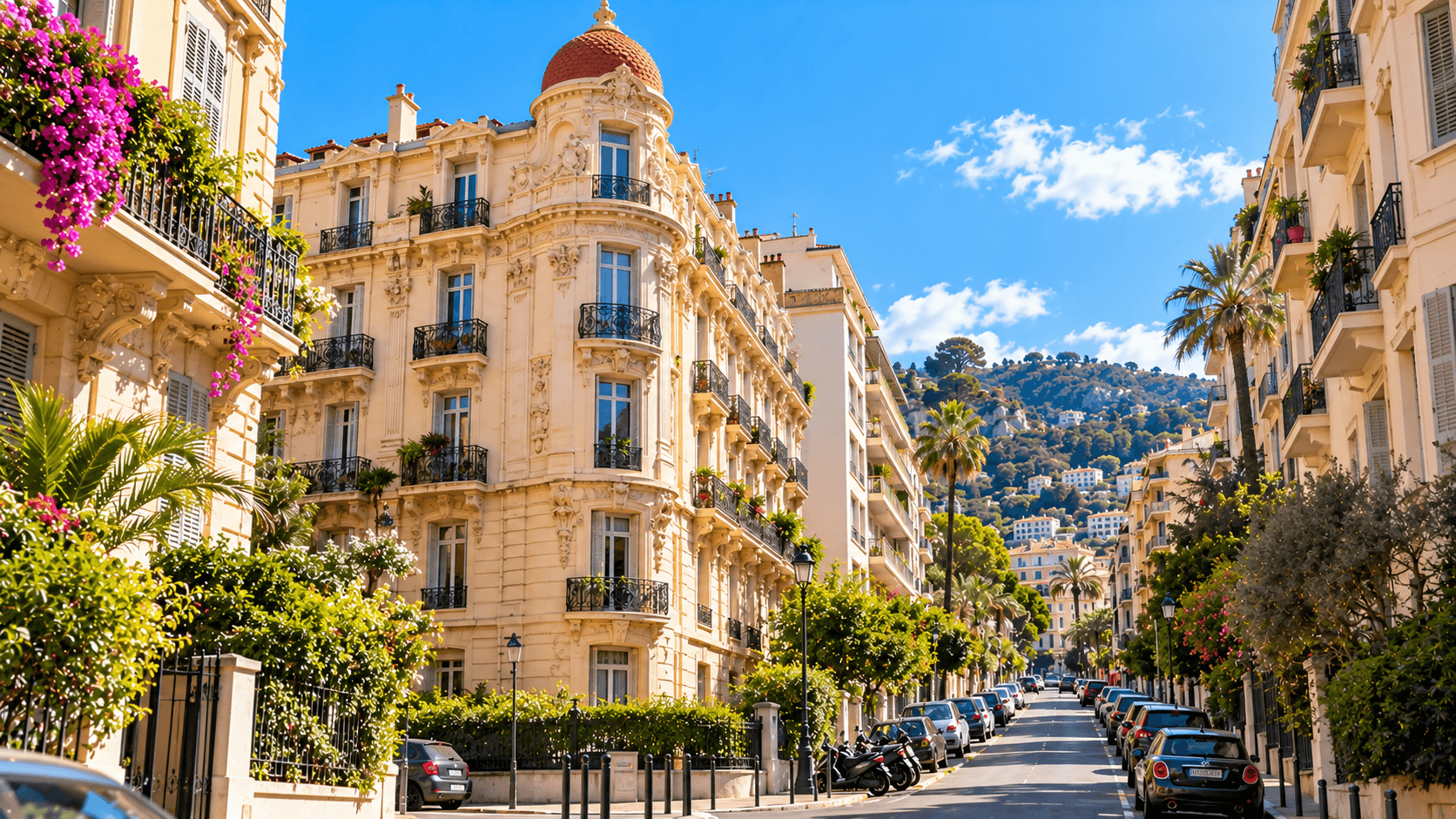
Location: Rue Shakespeare, Nice. Shortly after arriving in Nice, Roman and his mother lived in a small apartment on Rue Shakespeare. The address is identified in published biographical walking guides and literary research. It's an appropriate starting point for understanding the family's early circumstances.
Why is this place important?
Before the better-known Hôtel-Pension Mermonts, there was the task of establishing an ordinary household. Mina needed to earn money. Roman needed an education. They had to adapt to the city. The setting offers a useful contrast with the elegant public image of the Riviera.
Can you visit?
Rue Shakespeare is a residential street, not a dedicated literary museum. You can explore its public surroundings, but the original apartment's precise entrance and current access have not been independently established for this guide. Don't attempt to enter private buildings. The value of the stop lies in understanding the neighbourhood and the family's early situation.
walk
walk
Rue Shakespeare
Residential street associated with Roman Kacew and his mother's first Nice home. Public-street context only: the exact original apartment entrance is not independently established and homes are private.
Rue Shakespeare, Nice
5. Hôtel-Pension Mermonts: the most important surviving address
Historic address: 7 Boulevard Carlone. Current address: 7 Boulevard François-Grosso, Nice. This is the strongest directly identifiable stop on the route. The former Hôtel-Pension Mermonts became the centre of the family's life. Mina managed the establishment and turned it into a business that served an international clientele. Roman lived in the building during his adolescence.
A mother who refused to give up
In the novel, Mina's business activities are both comic and moving. She's endlessly resourceful. She finds opportunities where other people might see obstacles. She understands the importance of appearances, persuasion and determination. The pension becomes a tangible example of her effort to build a future for her son.
What survives today?
The building is now known as Les Pervenches. It is no longer operating as the family's historic hotel-pension. A memorial plaque identifies Gary's residence here from 1930 to 1933. This gives visitors something unusually concrete: an independently documented historical address rather than an invented literary landmark.
What should you look for?
Find the commemorative plaque from the public pavement. Look at the building's position near Rue Dante. Imagine an ordinary residential and commercial environment in which Mina was managing the pension while her son was developing his education and literary ambitions.
A connection with the book
The University Côte d'Azur's literary archive preserves an excerpt describing the pension and the route towards the Buffa market. It includes Roman's memory of watching his mother approach from his working table. That kind of detail makes the location especially rewarding. The building wasn't simply a place where a future celebrity once slept. It formed part of the daily work and family relationship at the heart of the book. Practical note: This is a residential building. The plaque can be viewed from public space; interiors and private entrances are not part of the itinerary.
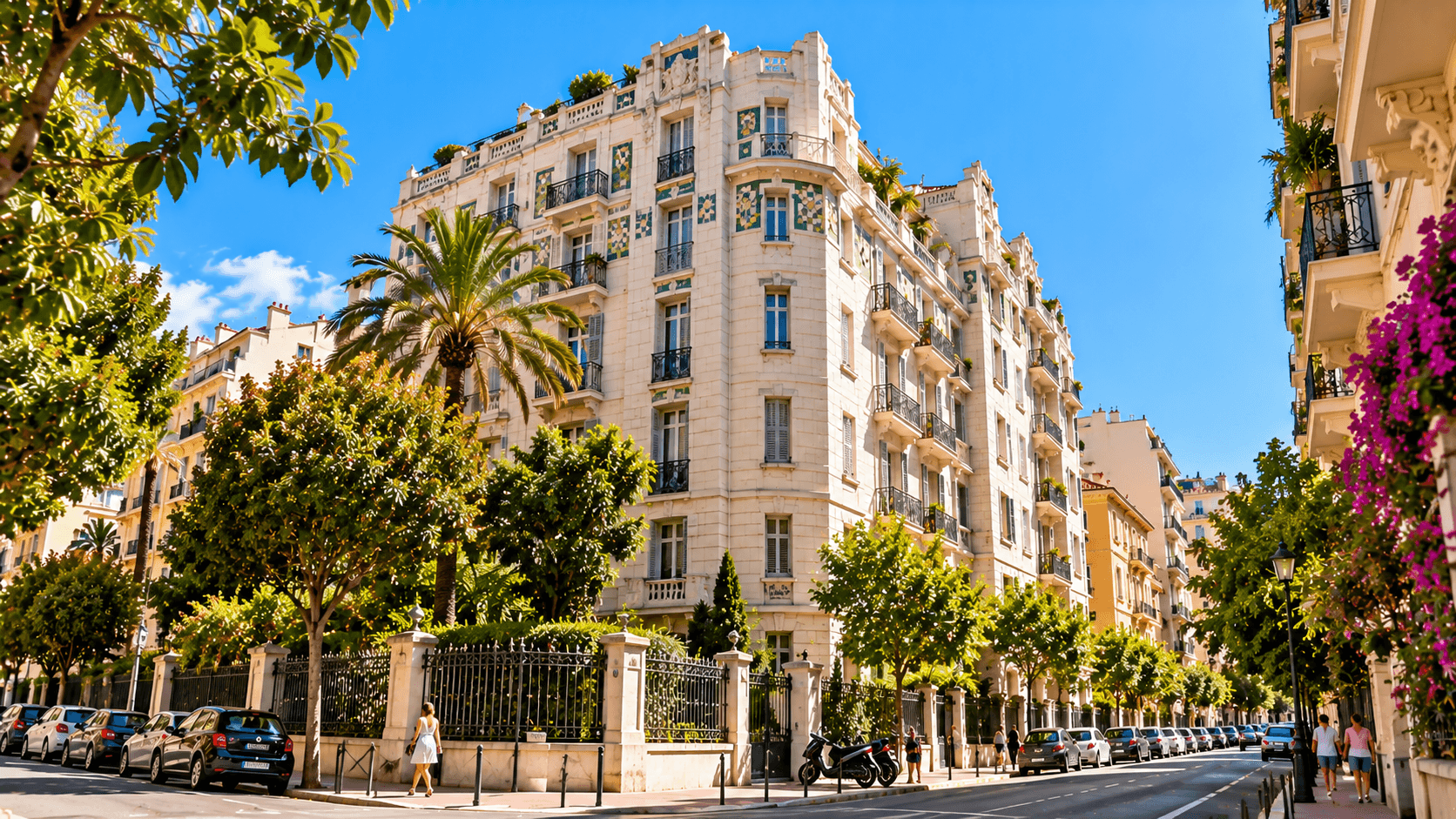
viewpoint
viewpoint
Former Hôtel-Pension Mermonts / Les Pervenches
Former pension managed by Gary's mother, now a residential building. View the commemorative plaque from the public pavement only; this is not a walk-in hotel or museum.
7 Boulevard François-Grosso, Nice
6. The Buffa neighbourhood: the everyday world beyond the pension
Area: Rue de la Buffa, Avenue Dante and surrounding streets. The market and commercial environment of the Buffa neighbourhood appear in descriptions of Gary's adolescence. Mina's work connected the family with the city's ordinary commercial life. For visitors, this is a useful place to think about the Nice of small businesses, groceries and everyday transactions.
What does the neighbourhood reveal?
The Riviera's luxury hotels were part of the local economy, but so were the people supplying, selling, cleaning and working around them. Mina's ambitions depended on understanding that economy. She wasn't simply enjoying the city. She was trying to earn a living in it.
What can you visit today?
Explore the public streets around Rue de la Buffa and Avenue Dante. The contemporary shops and buildings should not be presented as unchanged survivors of Gary's childhood. The purpose is to understand the geography of the family's daily life. A historic market reference also doesn't guarantee that the same stalls or arrangements still operate today.
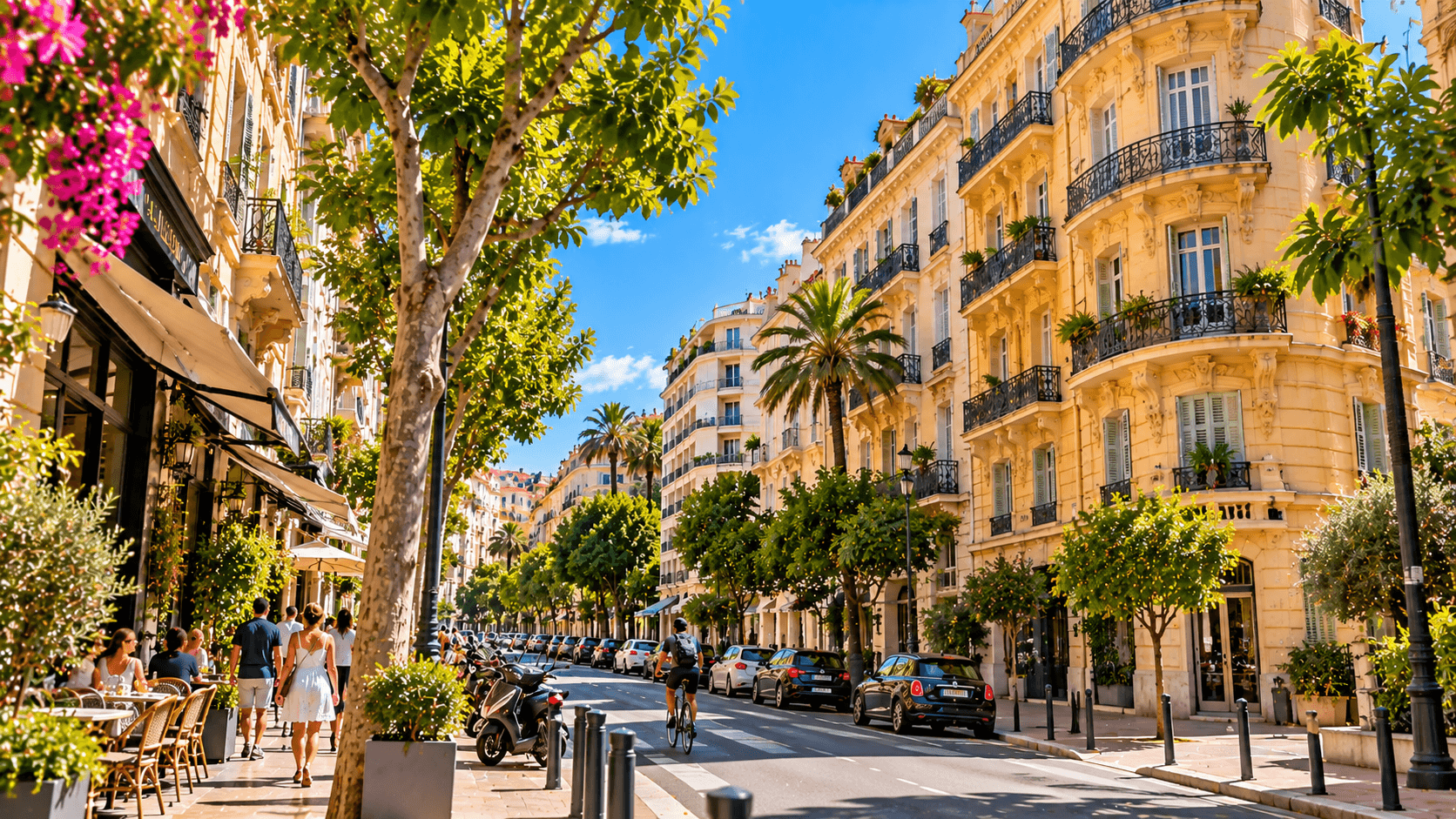
neighbourhood
neighbourhood
Buffa / Avenue Dante neighbourhood
Public streets evoking the everyday commercial world around Mermonts. The historical Buffa market reference is not a promise of the same market or stalls operating today.
Rue de la Buffa / Avenue Dante, Nice
7. Hôtel Negresco: luxury seen from the other side
Address: 37 Promenade des Anglais, Nice. Hôtel Negresco is one of the Riviera's most recognisable luxury hotels. Its famous dome and monumental architecture have become symbols of the city's international resort history. But its connection with Romain Gary is not a story of a wealthy family staying in an expensive suite. It's about his mother's work.
Mina and the hotel
Biographical walking guides describe how Mina arranged to use a display space in a corridor of the Negresco to sell luxury goods. It was another example of her determination to create opportunities. The detail is particularly striking because it brings the family's precarious financial circumstances into direct contact with the wealth of Nice's international visitors.
Why visit?
Look at the hotel exterior from the Promenade des Anglais. Consider two different ways of experiencing the same building. For a wealthy visitor, it might represent comfort, status and pleasure. For Mina, it represented a possible business opportunity. For Roman, it became part of the story of his mother's extraordinary efforts.
Access
Hôtel Negresco is an operating luxury hotel. Its private interiors aren't open for unrestricted literary sightseeing. You don't need to enter the building to appreciate its historical role. The exterior is sufficient for this stop.
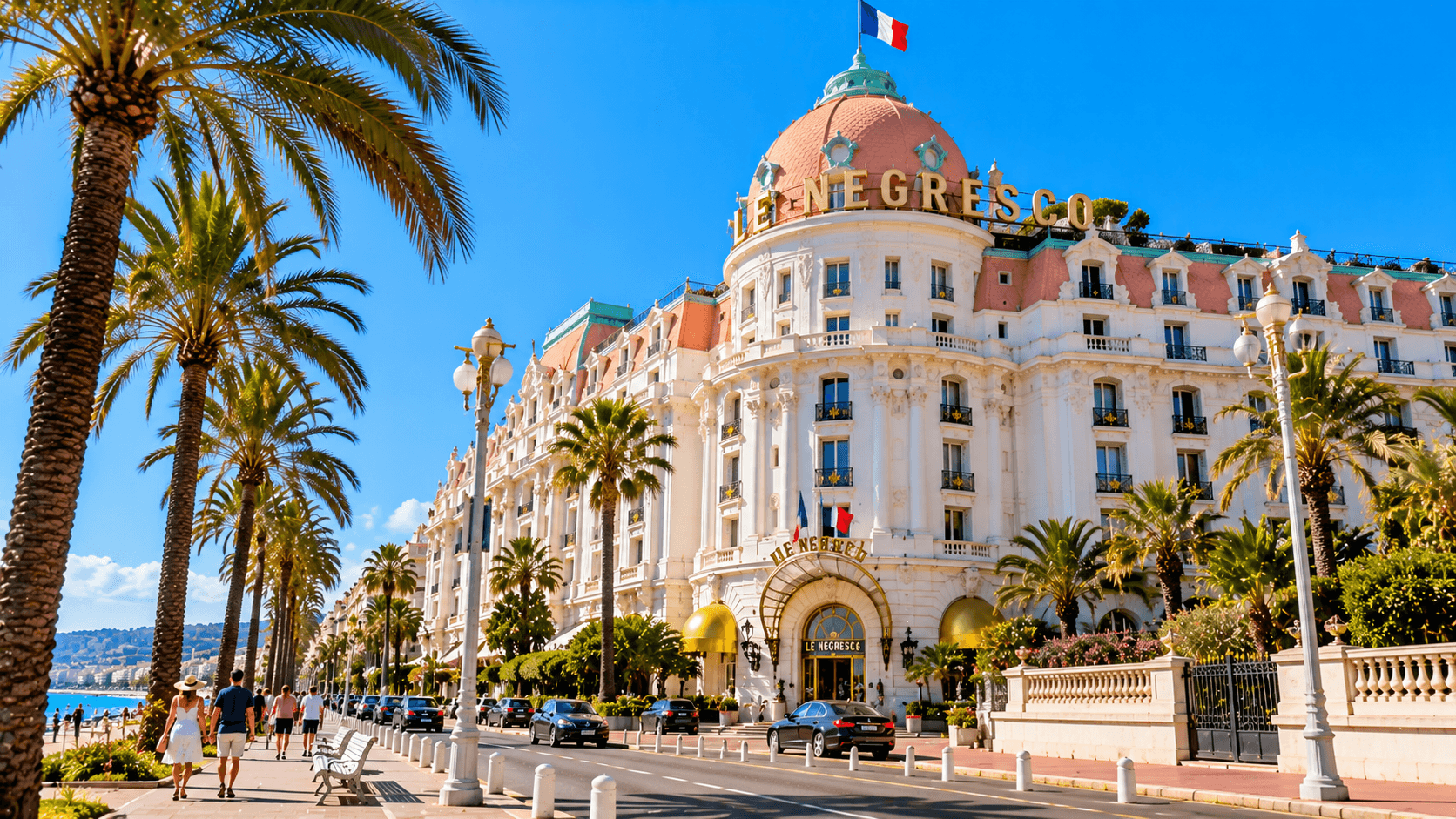
viewpoint
viewpoint
Hôtel Negresco
Landmark hotel associated in biographical walking research with Mina's luxury-goods trade. View the façade from the public promenade; literary interest does not grant access to private interiors.
37 Promenade des Anglais, Nice
8. Lycée Masséna: the place where Roman began becoming Romain
Address: 2 Avenue Félix-Faure, Nice. Roman attended Lycée Masséna after arriving in the city. He completed his baccalauréat in 1933. The school is a significant part of the story because Mina's ambitions for her son depended not only on imagination but also on education.
Learning to belong
Gary's future career would be extraordinarily French. He became a French military officer, diplomat and novelist. But those achievements were still distant possibilities when he arrived in Nice as a teenager. School was one of the institutions through which he began creating a place for himself in his adopted country.
Writing begins
Gary's early literary interests also developed during these years. The future author was already experimenting with language and imagining a career in literature. His mother's extraordinary confidence in him was matched by his growing awareness that he would have to produce work worthy of those expectations.
Visiting
Lycée Masséna remains an educational establishment. It isn't a public museum. Appreciate the building's exterior from public streets without entering school premises. Literary connection: A documented place of Gary's education and early development, not a fictional school invented for the novel.
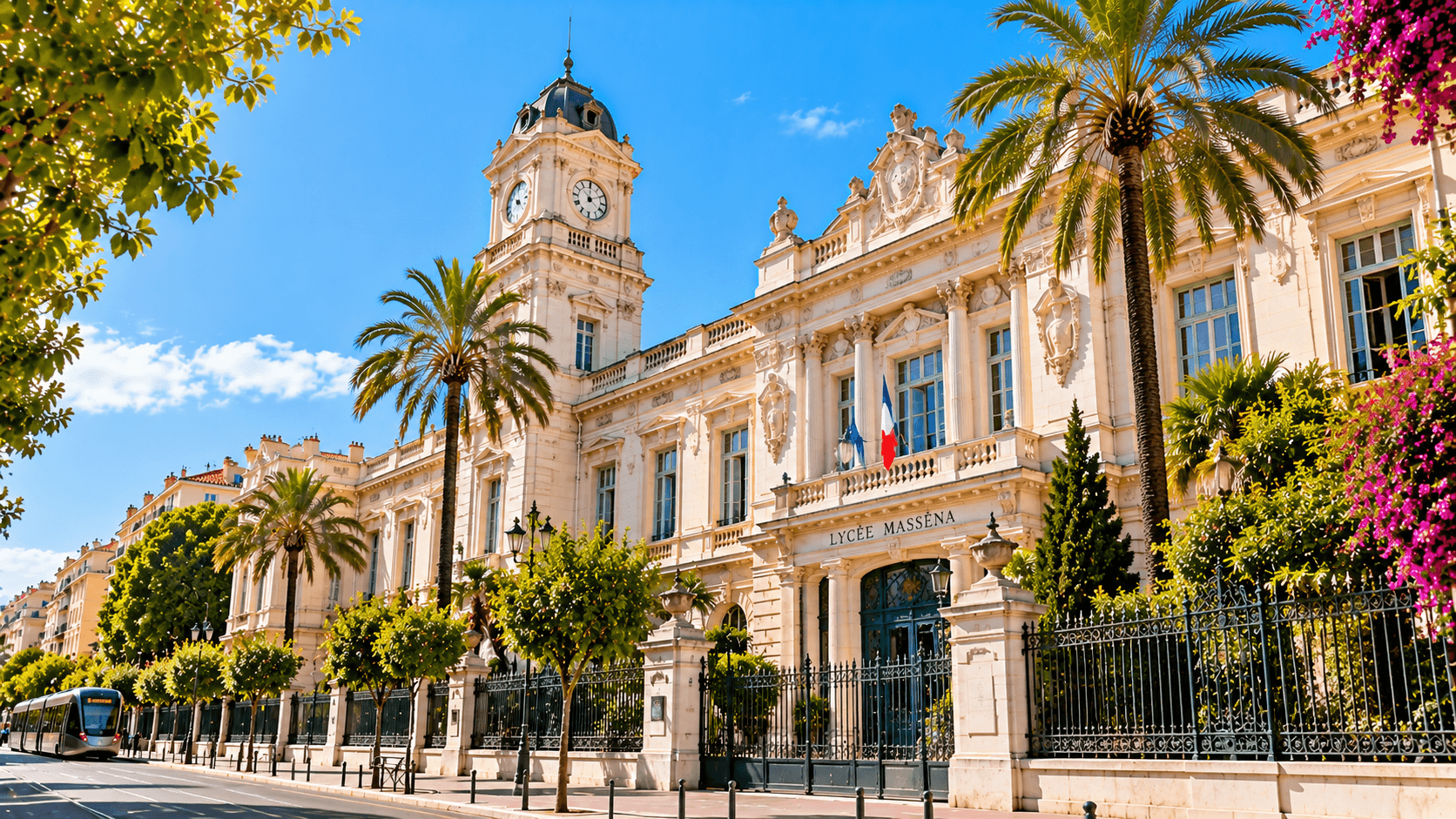
civic
civic
Lycée Masséna
Gary's Nice school, still an educational establishment. Appreciate the exterior from public streets, without entering school grounds or treating it as a public museum.
2 Avenue Félix-Faure, Nice
9. Cours Saleya: flowers for his mother
Location: Cours Saleya, Vieux Nice. Published biographical accounts describe how young Roman sometimes walked through the flower market and bought flowers for his mother. This is one of the gentler details associated with their relationship. The gesture may seem small compared with the extraordinary ambitions and later historical events described in the novel. But small acts matter in Promise at Dawn. The book constantly moves between extravagant hopes and ordinary expressions of affection.
What to experience
Visit Cours Saleya when the market is operating. Enjoy the colours, flowers and food stalls. The market's arrangements change by day and season, so check the current programme if you want to see particular traders. This is still an active public market, rather than a preserved reconstruction of the 1930s.
Why include it?
Because the novel is ultimately less about fame than about the relationship between mother and son. The market provides a way to remember that relationship through something ordinary. A teenager walking home with flowers. A mother trying to make a living. A city that gradually becomes familiar.
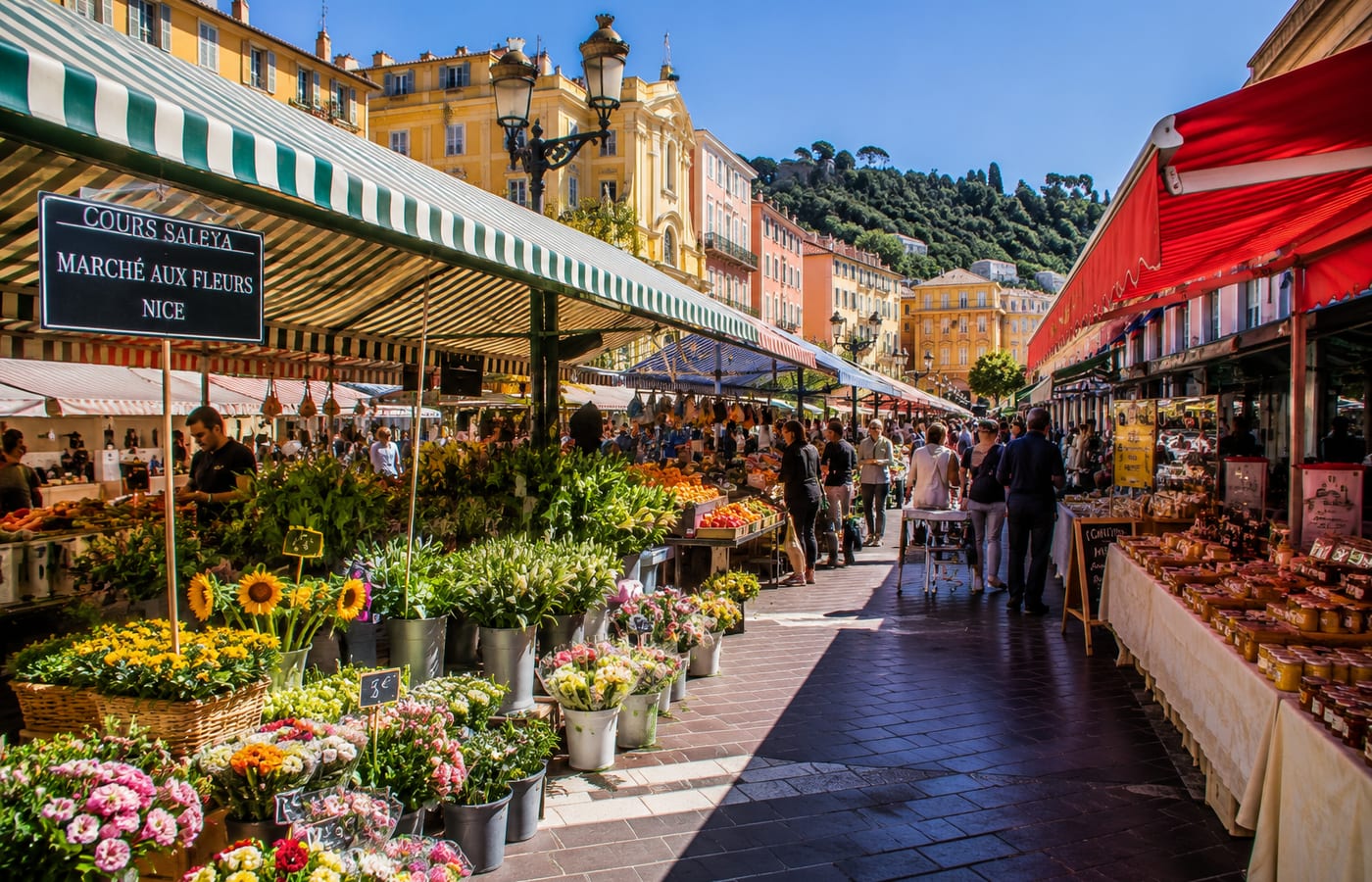
market
market
Cours Saleya Market
Nice's best-known market setting for flowers, local products, crafts and morning browsing in the old town.
Cours Saleya, 06300 Nice
Check current hours before visiting
10. Promenade des Anglais: the Mediterranean in Gary's memory
Location: Promenade des Anglais, Nice. Nice's famous waterfront is an important part of the geographical and emotional world associated with Gary's youth. For a family that had travelled across Europe, the Mediterranean represented a very different environment from their earlier lives. The sea also became a recurring presence in Gary's personal imagination.
The landscape and its meaning
The Promenade des Anglais is now one of the best-known tourist landmarks in France. But for the young Roman, Nice was not primarily a holiday destination. It was a place where the future might begin.
A good final stop
Finish your literary day beside the sea. Look towards the coastline and the horizon. Consider how many different lives coexist in a resort city. The affluent visitors in the great hotels. The families running businesses. The students heading home. The people who have come hoping that a different country will offer them another chance. Gary's story belongs particularly to that last group.
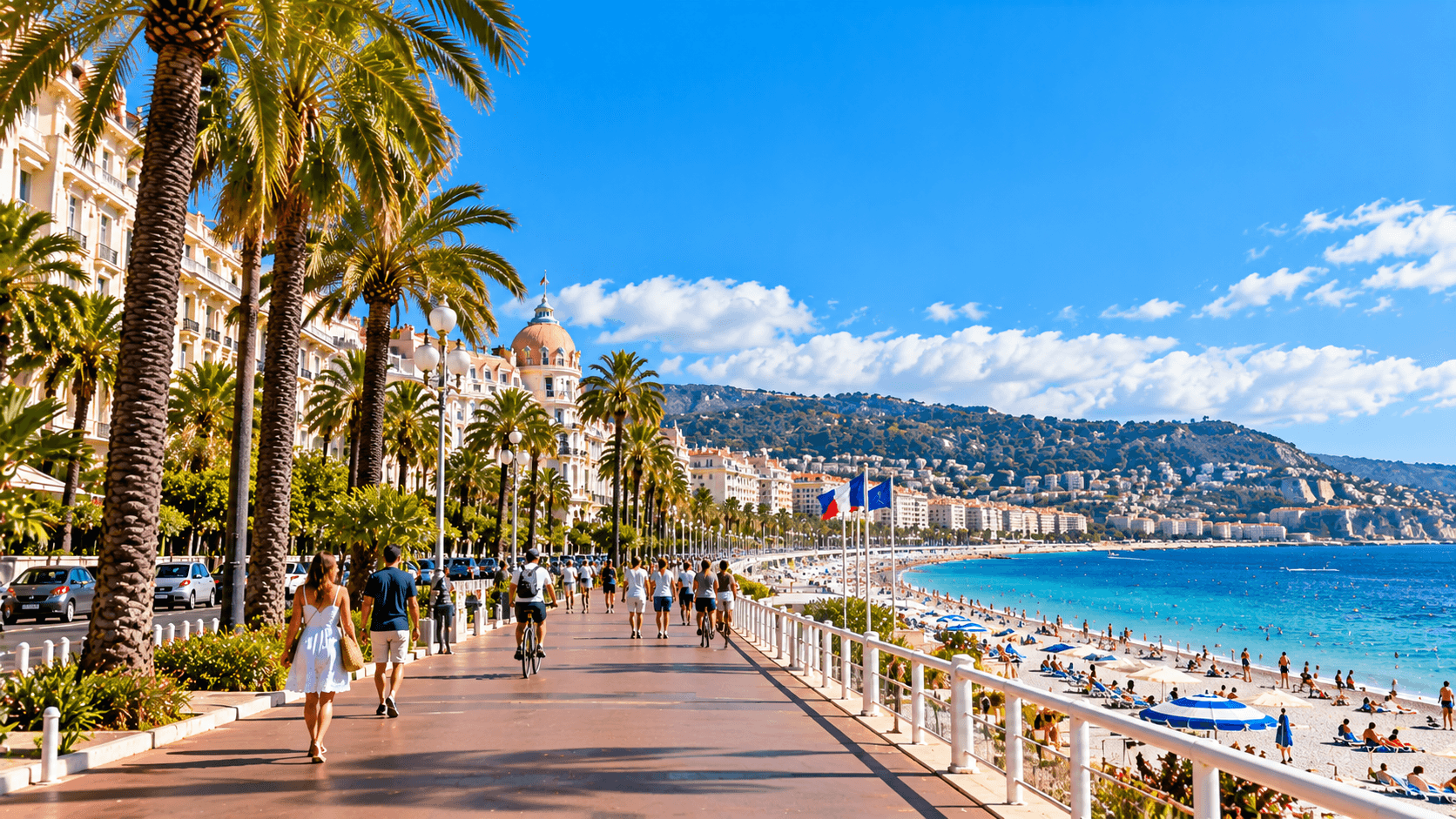
walk
walk
Promenade des Anglais
Nice's public seafront and a contextual finish for the Gary walk. Choose a manageable section; a seaside route is not a certification of uninterrupted step-free access or current conditions.
Promenade des Anglais, Nice
11. A practical literary walking itinerary
Nice is larger than Menton, and the principal Gary locations are spread across several neighbourhoods. The most useful approach is to divide them into two parts.
Route A: The family and the pension
Recommended time: Approximately 1–1.5 hours, excluding long breaks. Explore Rue Shakespeare, the area around Boulevard François-Grosso, and the Buffa neighbourhood. Finish at Hôtel Negresco and the Promenade des Anglais. This is the strongest route for understanding Mina's work and Roman's everyday adolescence.
Route B: The student and the emerging writer
Recommended time: Approximately 1–1.5 hours. Begin with Lycée Masséna. Continue through central Nice towards Cours Saleya. Spend time at the market and finish near the waterfront. This route concentrates on education, identity and the emotional relationship between mother and son.
Which route should you choose?
If you've read only the Nice chapters of the novel, Route A offers the clearest historical connection. If you're interested in Gary's development as a writer and the broader cultural environment, Route B provides a good complement. For a full literary day, combine both, allowing time for lunch and transport between districts. These are editorial walking allowances, not measured GPS routes. Check your chosen paths and accessibility requirements before travelling.
| Stop | Historical connection | Visitor access |
|---|---|---|
| Rue Shakespeare | Early family accommodation | Public street |
| 7 Boulevard François-Grosso | Former Hôtel-Pension Mermonts; memorial plaque | Exterior only |
| Buffa / Avenue Dante | Family's commercial surroundings | Public streets |
| Hôtel Negresco | Mina's commercial activity | Exterior context |
| Promenade des Anglais | Wider Riviera and personal history | Public promenade |
| Lycée Masséna | Gary's education | Exterior only |
| Cours Saleya | Biographical account of buying flowers for his mother | Public market |
12. Visiting from Menton without a car
Nice is one of the easiest major cultural day trips from Menton. Regional TER trains connect the two towns. The published average journey between Nice and Menton is approximately 40 minutes, depending on the service.
An example day
9:00–10:00: Travel from Menton to Nice and reach the starting point. 10:00–11:30: Explore Boulevard François-Grosso, Rue Shakespeare and the Buffa neighbourhood. 11:30–12:30: Walk towards Hôtel Negresco and the waterfront. 12:30–14:00: Lunch and a break. 14:00–15:30: Visit the Lycée Masséna exterior and Cours Saleya, using an appropriate local connection where helpful. Afterwards: Return to Menton on a confirmed service. The times are a planning example, not a booked train itinerary. You don't need a car, but Nice's local tram and bus network can be useful, especially if you want to reduce the amount of walking.
Check the actual return train and any engineering works for your travel date.
Menton to Nice
Good for museums, events, Jazz Fest, Carnival and airport access planning.
Useful links
13. Romain Gary beyond Nice: a connection near Menton
Gary's relationship with the eastern Riviera didn't end with his adolescence. He later owned a property in Roquebrune-Cap-Martin, at 4 Impasse Scarouget, during the 1950s. The area has a commemorative connection with the writer. This belongs to a later period of his life, rather than the teenage Nice chapters of Promise at Dawn. It's therefore better treated as a separate literary extension.
A useful distinction
The Nice route is about his formative years with Mina. Roquebrune-Cap-Martin is connected with the mature writer's later life. Both are real historical links, but they shouldn't be collapsed into the same autobiographical episode. The house at Impasse Scarouget is not established as a regularly open public attraction. Don't enter private property.
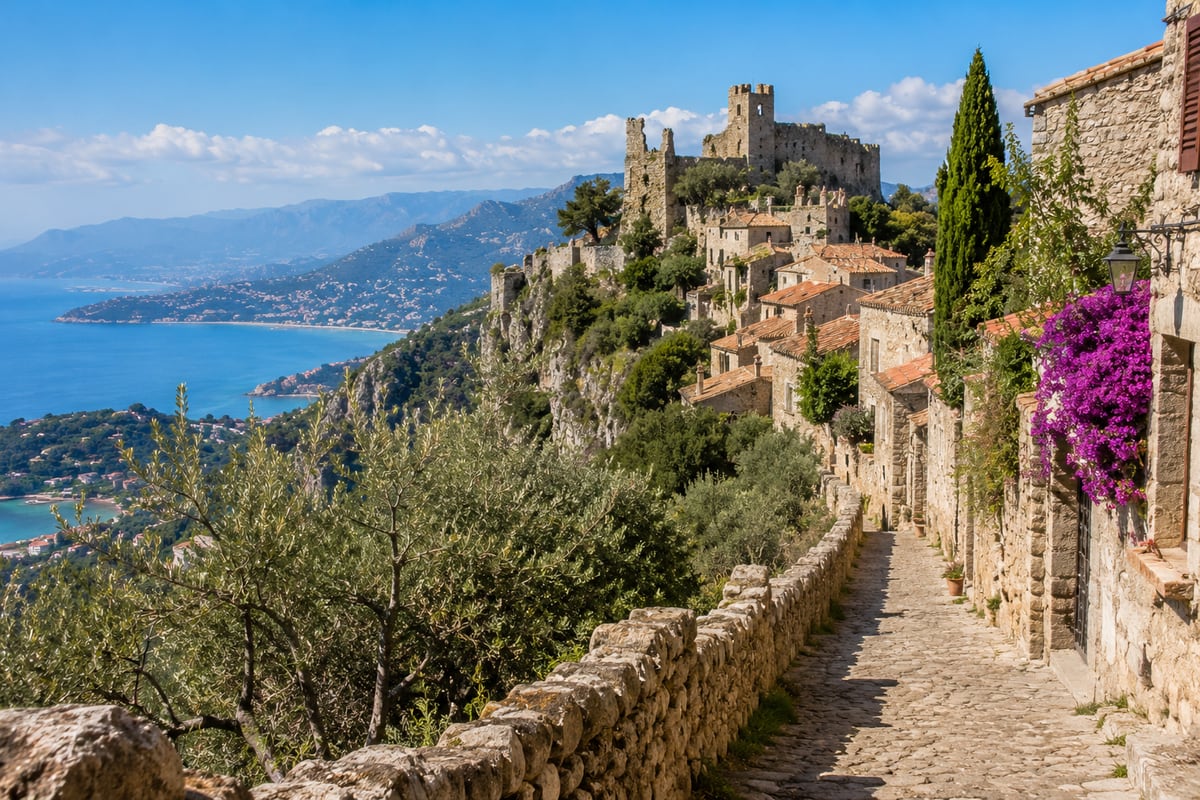
neighbourhood
neighbourhood
Roquebrune Medieval Village
A hill village walk from the coast with olive trees, stone lanes, a historic castle and sea-and-mountain views.
Roquebrune-Cap-Martin
14. The two Goncourt Prizes and Gary's many identities
Romain Gary's later literary career was almost as extraordinary as the destiny his mother imagined for him. He won the Prix Goncourt in 1956 for Les Racines du ciel. Then, under the pseudonym Émile Ajar, he won the prize again in 1975 for La Vie devant soi. The two awards were given without the literary world initially recognising that the authors were the same person. The Goncourt is normally awarded only once to a writer, making Gary's achievement unique.
Why does it matter to Promise at Dawn?
Because the book is partly about the creation of an identity. Mina imagines an extraordinary future for her son. Roman gradually becomes Romain Gary. He later creates further literary identities. The story of his life demonstrates how complicated the relationship can be between the person someone is, the person others imagine them to be and the person they choose to present to the world. The book's comic exaggerations become even more interesting when read alongside the author's later reinventions.
15. What about the film adaptations?
Promise at Dawn has been adapted for cinema more than once.
Promise at Dawn (1970/1971), directed by Jules Dassin
The earlier screen adaptation stars Melina Mercouri and Assaf Dayan. It belongs to the film history of Gary's work, but its production geography should be researched separately from the historical addresses listed above.
Promise at Dawn (2017), directed by Éric Barbier
The later adaptation stars Pierre Niney as Romain Gary and Charlotte Gainsbourg as his mother. It follows the broad movement of the book from Eastern Europe to Nice and then into the war years. The production used filming locations in several regions and countries. Film France identifies Nice and Beaulieu-sur-Mer among its French Riviera filming locations. But a location used in the film isn't automatically the actual building where Gary lived.
A different approach to the same story
Barbier's production notes explain that the novel's chronology moves between different periods of memory. The screenplay reorganised material into a more linear form for the cinema. This is a useful reminder that the book, the historical biography and the film are three distinct representations. A visitor following Gary's real addresses should not assume that a movie scene was filmed at that same address.
16. Who will enjoy Promise at Dawn?
Readers interested in family relationships will find an extraordinary portrait of a mother and son, affectionate but not sentimental. Readers of autobiographical fiction will appreciate the way Gary turns lived experience into a consciously crafted narrative. Readers interested in migration and identity will find the family's arrival in France especially meaningful. Readers of Second World War literature will discover the development of a young man who eventually serves in the Free French forces. Travellers interested in Nice beyond tourism will encounter the city's working neighbourhoods, educational institutions and ordinary commercial life.
And readers who expect a straightforward factual autobiography should approach the book with appropriate caution. Gary was telling the story of his life, but he was also shaping a literary persona.
17. What to read before visiting Nice
If you only have time for a short introduction, begin with the chapters describing Roman and his mother's arrival in France and their establishment in Nice. Pay particular attention to the passages concerning the pension, Mina's business activities and Roman's schooling. These sections provide the strongest direct connections with the places in the walking itinerary. For a wider understanding, read the whole novel. The later episodes change how the reader interprets the earlier dreams and promises. You may also want to explore Gary's subsequent books, especially Les Racines du ciel and La Vie devant soi, to see how his literary concerns developed beyond autobiography.
Frequently asked questions
Did Romain Gary live in Nice?
Yes. He arrived with his mother in 1928, studied at Lycée Masséna and lived in the city during his adolescence.
Where was his family home?
One of the best-documented addresses is 7 Boulevard François-Grosso, the former Hôtel-Pension Mermonts, where he lived from 1930 to 1933.
Can you visit the former pension?
The building is now residential and is not an ordinary public museum. A memorial plaque can be viewed from the public street.
Was Promise at Dawn written in Nice?
No. It was published in 1960, decades after Gary's adolescence. Nice is one of its major remembered settings, not a verified location where the whole book was composed.
Is the novel completely autobiographical?
No. Gary explicitly distinguished autobiographical inspiration from a literal autobiography, acknowledging the role of literary transformation.
Who was Nina?
Nina is the name used in the novel for Gary's mother, Mina Kacew. Her determination and belief in her son's future form the emotional centre of the book.
What school did Gary attend?
Lycée Masséna in Nice, where he completed his baccalauréat in 1933.
Why are there two Prix Goncourt dates on Gary memorials?
Gary won in 1956 under his own literary name and again in 1975 under the pseudonym Émile Ajar.
Can you visit the route without a car?
Yes. Nice is accessible by regional train from Menton, and the route can be combined with the local bus or tram network.
Is the 2017 film an exact reconstruction of his life?
No. It is a cinematic adaptation of an already literary version of Gary's autobiographical experiences.
Does this guide contain spoilers?
It explains Gary's historical biography and central themes, but avoids recounting the novel's principal late narrative revelations.
Final thoughts: Nice before the famous writer
Today, Romain Gary is remembered as an extraordinary figure. A novelist. A decorated wartime aviator. A diplomat. A writer who reinvented himself so convincingly that he won France's most prestigious literary prize twice. But before all of that, he was a teenager in Nice. His mother was trying to earn a living. He was attending school. They lived in ordinary rooms, walked ordinary streets and faced an uncertain future. The places are still there. A residential building on Boulevard François-Grosso. The school on Avenue Félix-Faure. The great façade of Hôtel Negresco.
The market streets and the Mediterranean waterfront. Visiting them won't reproduce every scene from Promise at Dawn. The book itself is too imaginative, too funny and too deliberately shaped for that. But the streets offer something valuable. They remind us that one of French literature's most extraordinary careers began with a mother and son trying to make a life in a new city. The rest came later.
Sources and further reading
Promise at Dawn, New Directions
La Promesse de l'aube, University Côte d'Azur Literary Archive
Romain Gary: Promenade à Nice, University Côte d'Azur
Mina and Roman Kacew at Hôtel-Pension Mermonts, University Côte d'Azur
Romain Gary in Nice: Biographical Walking Research
Romain Gary: Literary Biography, Larousse
Promise at Dawn (2017), Film France
Explore More AzurMenton Guides
Research reviewed on 1 November 2026. Biographical locations are based on university literary records and independent biographical research. The route combines documented addresses with contextual public places; it is not a reconstruction of every scene in the novel. Private homes, schools and hotel interiors are not assumed open for public literary visits. Travel times and access arrangements should be checked for the actual date.