The town that helped make the stories possible
In September 1920, Katherine Mansfield arrived at Villa Isola Bella in Menton.
She was thirty-one, seriously ill and determined to keep writing.
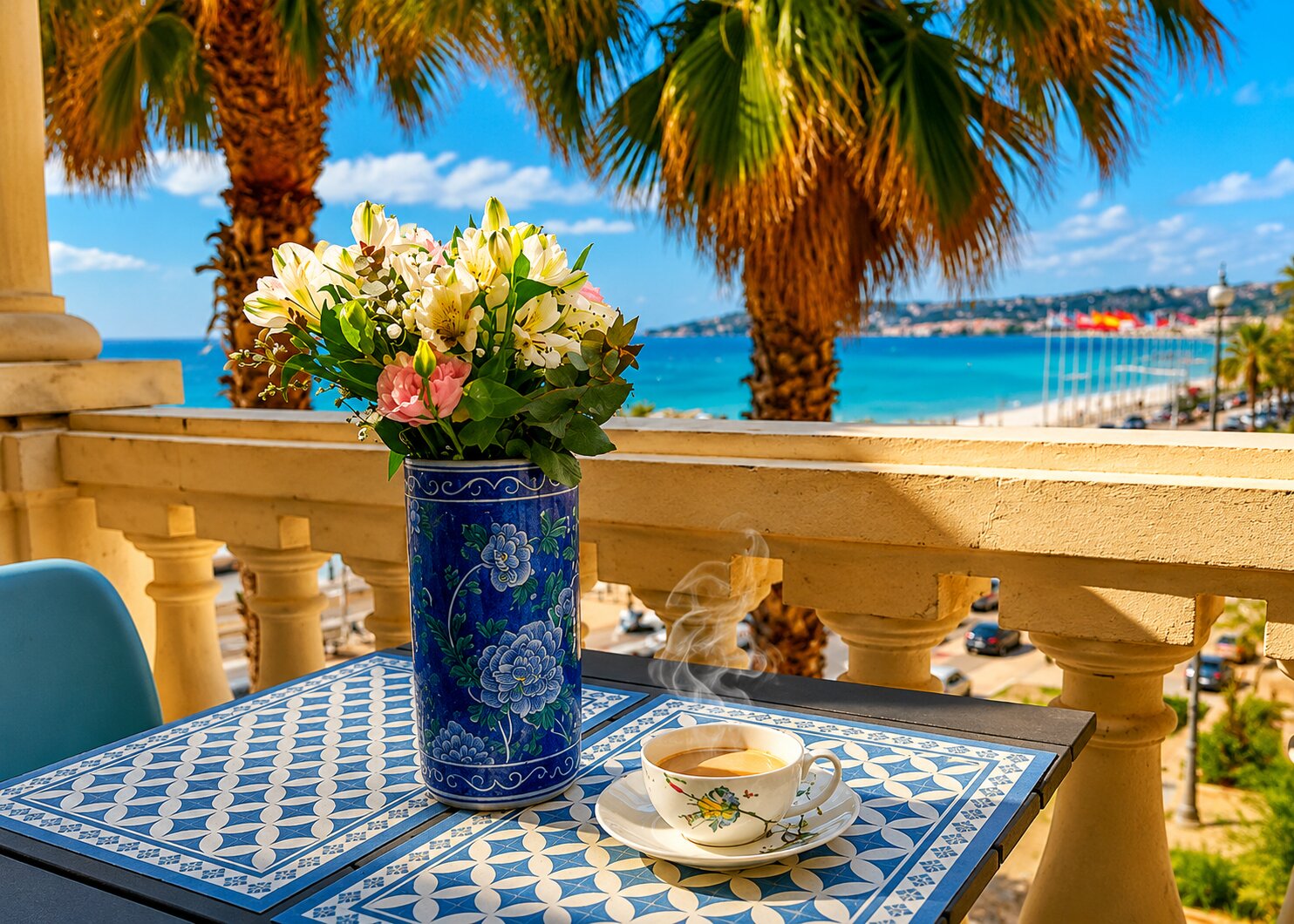
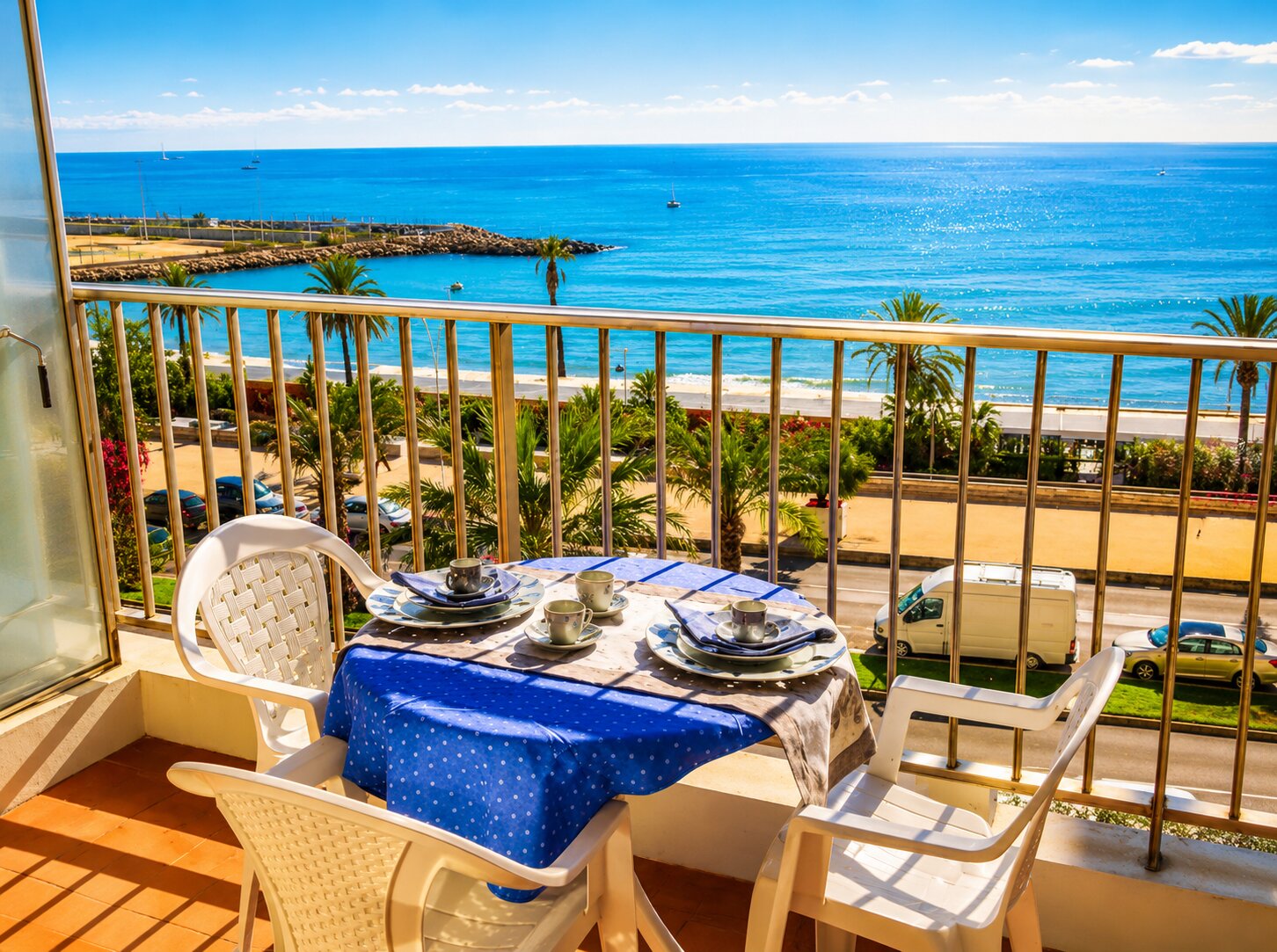
The house stood in Garavan, above the Mediterranean, surrounded by gardens and subtropical vegetation. From its windows and terraces, Mansfield could observe the sea, the changing light and the everyday activity of a town that had become an international winter resort.
It must have seemed an attractive place to work.
But this was no ordinary literary holiday.
Tuberculosis had made travel, relationships and even the simplest daily decisions increasingly difficult. Mansfield was searching for a climate she could tolerate, a household she could live in and enough uninterrupted time to produce the stories she knew she still wanted to write.
Her stay at Isola Bella became one of the most productive periods of her career.
Here she worked on stories including Miss Brill, The Stranger, Life of Ma Parker and The Daughters of the Late Colonel.
Yet these are not simply stories about Menton.
Their fictional settings and characters often belong elsewhere. Some explore London life, others return imaginatively to New Zealand, and others are deliberately less geographically specific.
That distinction is essential.
Menton matters to Katherine Mansfield's literature not because every story takes place here, but because it was one of the places where she transformed observation, memory and personal experience into fiction.
This guide explores the real Menton behind her writing, explains which works are associated with her time here and suggests what to read before visiting Garavan and Villa Isola Bella.
1. Who was Katherine Mansfield?
Katherine Mansfield, born Kathleen Mansfield Beauchamp in Wellington, New Zealand, in 1888, became one of the most influential writers of the modern short story.
She left New Zealand for Europe as a young woman and established herself within the literary world of early twentieth-century London.
Her work developed alongside the modernist experiments of writers such as Virginia Woolf and James Joyce.
Rather than depending on elaborate plots or dramatic conclusions, Mansfield often concentrated on brief experiences that revealed something unexpected about a character's inner life.
A conversation.
An awkward social encounter.
A sound from another room.
A memory arriving without warning.
Something apparently ordinary could become the centre of a story.
Her fiction is particularly attentive to loneliness, class, relationships, emotional uncertainty and the distance between what people say and what they feel.
After developing tuberculosis, she spent much of her later life moving between England, Italy, France and Switzerland in search of better conditions.
She died in France on 9 January 1923, aged thirty-four.
Her literary career was short, but its influence has been exceptionally lasting.
2. Mansfield's time in Menton: the essential chronology
Mansfield did not spend one continuous period in Menton.
There were two main stays in 1920–1921, separated by several months in England.
The chronology helps avoid a common misunderstanding.
The famous title The Garden Party doesn't mean the story was written in a garden in Menton.
And the publication of Bliss and Other Stories during Mansfield's time at Isola Bella doesn't mean that the entire collection was written there.
To understand her Menton period accurately, we need to distinguish between when a story was conceived, when it was written, when it was revised and when it was eventually published.
| Period | Where she stayed | What happened |
|---|---|---|
| January 1920 | L'Hermitage, Menton | Arrived from the Italian Riviera seeking care and a more suitable climate |
| February–April 1920 | Villa Flora, Menton | Stayed with her cousin Connie Beauchamp and Connie's companion Jinnie Fullerton |
| Late April–August 1920 | England | Returned to London and continued literary work |
| September 1920 – May 1921 | Villa Isola Bella, Garavan | Her most significant sustained period of writing in Menton |
| December 1920 | Villa Isola Bella | Bliss and Other Stories published while she was living there |
| May 1921 | Departure for Switzerland | Left Menton and continued writing elsewhere |
| February 1922 | Living outside Menton | The Garden Party and Other Stories published |
3. Villa Flora: Mansfield's first months in Menton
Mansfield reached Menton in January 1920 after a difficult period of illness on the Italian Riviera.
She initially stayed at L'Hermitage, a residential medical establishment associated with her cousin Connie Beauchamp.
In February, she moved to Villa Flora, where Connie lived with Jinnie Fullerton.
This earlier Menton period is important because it preceded the more famous Isola Bella stay.
A town experienced through illness
Mansfield's circumstances limited her ability to explore.
The mild climate, flowers and sea were deeply attractive to her, but the experience cannot be described simply as a pleasant winter escape.
She needed rest.
Her health influenced where she stayed, how much she could move and how she managed the relationship between everyday life and writing.
The town appears in her letters and notebooks as a place of beauty, but also as a place where vulnerability and uncertainty remained present.
The connection with The Man Without a Temperament
The Man Without a Temperament is particularly relevant to this period.
The story was written in January 1920, in the context of Mansfield's deteriorating health and complex relationship with her husband, John Middleton Murry. Te Ara places its composition before her move from Ospedaletti to Menton later that month: it is a pre-Menton context, not an Isola Bella composition.
It explores the uncomfortable emotional consequences of illness within a marriage.
But it should not simply be labelled an Isola Bella story.
Its composition belongs to the period before Mansfield's September return to the villa.
Nor should its fictional situation be treated as a literal account of Mansfield and Murry's private conversations.
4. Villa Isola Bella: the centre of Mansfield's literary Menton
Area: Garavan, eastern Menton.
When Mansfield returned to Menton in September 1920, she rented Villa Isola Bella with the support and companionship of Ida Baker.
The house provided a setting she valued enormously.
Its balconies, garden and views appear repeatedly in her correspondence.
The surrounding vegetation included palms, mimosa and flowering plants.
These details mattered because Mansfield's illness often restricted her physical world.
A garden or terrace could offer a considerable range of observation without requiring a long journey.
Ida Baker: an essential part of the story
The history of Isola Bella is incomplete without Ida Constance Baker, sometimes referred to by Mansfield as Leslie Moore or LM.
Baker travelled with Mansfield, helped with practical arrangements and photographed her during the stay.
The Alexander Turnbull Library in New Zealand preserves a collection of photographs from this period.
One particularly significant image shows Mansfield at Villa Isola Bella in 1920, photographed by Baker.
Other surviving photographs record the villa's garden and terrace.
These images offer evidence of the lived environment rather than a later reconstruction created for visitors.
They also remind us how much a writer's ability to work could depend on other people managing the demands of daily life.
The difference between the real writing space and the memorial
A further complication makes Villa Isola Bella especially interesting.
The room later known as the Katherine Mansfield Memorial Room was not Mansfield's actual writing room.
The memorial space was created in the villa's lower level decades after her departure, as part of a commemorative project associated with New Zealand writers.
It became the working space for visiting fellowship recipients.
The room therefore represents another chapter in the building's history, not a perfectly preserved original study.
The distinction matters for visitors and readers alike.
A memorial can be meaningful without being historically identical to the space it commemorates.
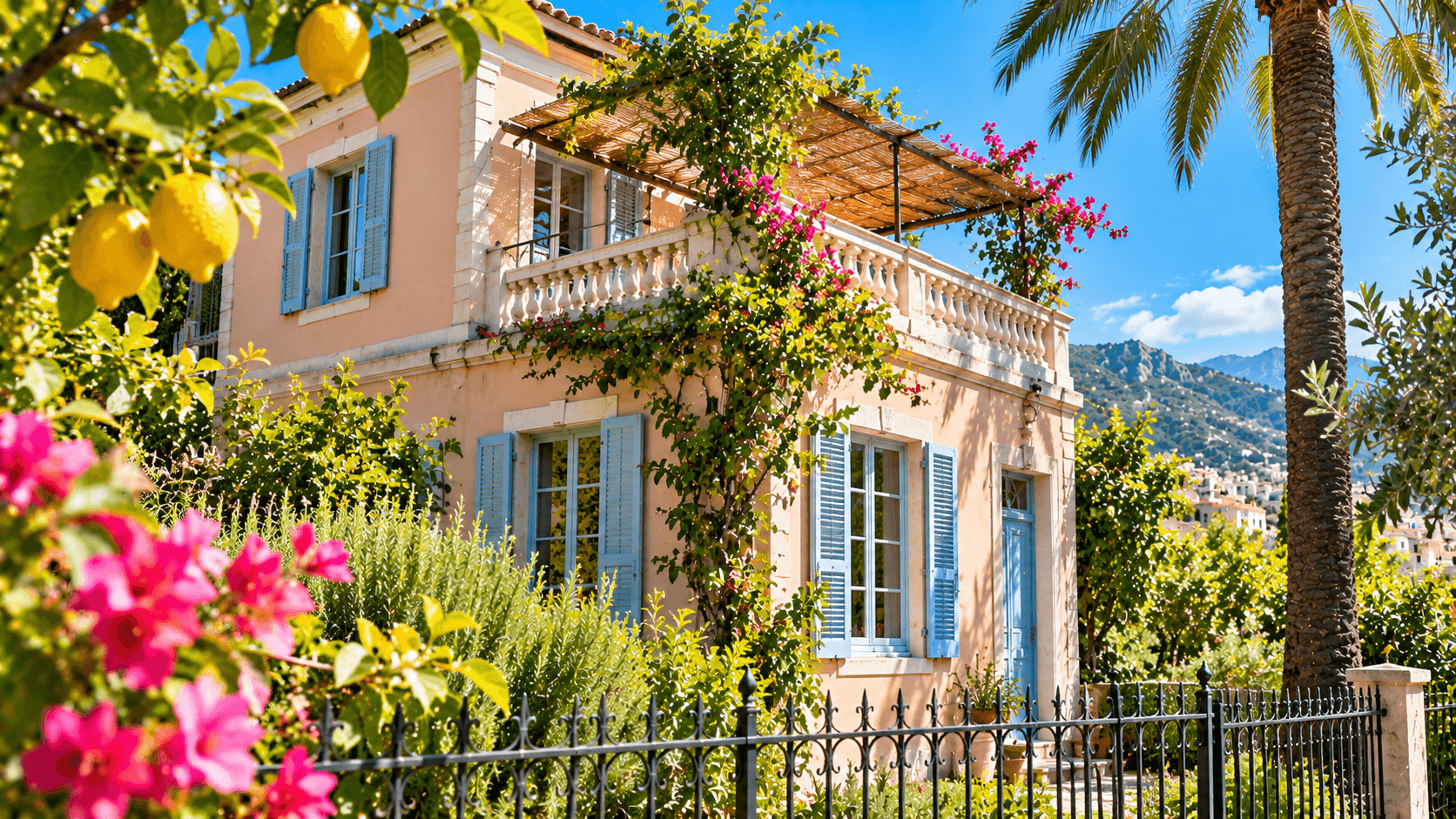
viewpoint
viewpoint
Villa Isola Bella
Katherine Mansfield's Garavan home is literary heritage, not a confirmed walk-in museum. View only from public spaces; respect residential doors and grounds.
Garavan, Menton; public-street context only
Check current hours before visiting
5. Which stories did Mansfield write in Menton?
This is the central literary question.
Several stories can be linked to her Isola Bella period through correspondence, manuscripts and established biographical scholarship.
But their relationship to Menton is one of composition and creative circumstances, not necessarily fictional setting.
The exact stages of drafting and revision may differ between stories. The important point is that multiple independent scholarly sources identify Isola Bella as a major centre of Mansfield's literary production.
These stories are not interchangeable.
Each uses a different situation and narrative voice to explore questions that interested Mansfield.
| Work | Connection with Menton | What readers should know |
|---|---|---|
| The Daughters of the Late Colonel | Written and completed during the Isola Bella period | One of the strongest direct links |
| Miss Brill | Written during her Menton period | Set in a public-garden world, not securely identified as Menton |
| Life of Ma Parker | Associated with the Isola Bella period | Explores hardship, loss and vulnerability |
| The Stranger | Written during the Menton period | A story of relationships and emotional uncertainty |
| The Young Girl | Associated with the same period | Observes social behaviour and uncomfortable personal dynamics |
| The Lady's Maid | Included among works connected with Isola Bella | A study of service, sacrifice and dependency |
| The Singing Lesson | Associated with the Isola Bella period | Examines emotional experience through ordinary daily events |
| Poison | Written during the Menton period, published posthumously | Connected with tensions in intimate relationships |
| The Man Without a Temperament | Written in January 1920 before her move to Menton, according to Te Ara | Relevant context for illness and emotional isolation, not an Isola Bella composition |
6. The Daughters of the Late Colonel: the essential Menton story
If you read only one Mansfield work before visiting Villa Isola Bella, this is our recommendation.
The Daughters of the Late Colonel was completed during Mansfield's stay in Menton in late 1920.
It was published in the London Mercury in 1921 and subsequently included in The Garden Party and Other Stories.
The story concerns two sisters, Constantia and Josephine, after the death of their father.
Their apparently ordinary domestic circumstances become the setting for a profound examination of dependence, fear, habit and unrealised possibilities.
Why is it particularly relevant?
Mansfield worked on this story during the Isola Bella period and considered it among her most satisfying achievements.
The manuscript and its development have attracted considerable scholarly attention.
Some biographical accounts also identify elements of the sisters' characterisation as drawing partly on Mansfield's observations of people close to her.
That does not make the fictional sisters direct portraits of identifiable individuals.
The story is a literary creation.
Is it set in Menton?
No reliable evidence establishes Menton as its fictional setting.
Its importance to this guide is that Mansfield wrote it while living here.
That connection is substantial enough without relocating the narrative to France.
What should readers notice?
Pay attention to pauses and apparently minor interactions.
Consider the relationship between duty and individual desire.
Notice how the sisters struggle to imagine lives that are not organised around the demands of others.
Mansfield's ability to find significance in ordinary domestic life is especially visible here.
7. Miss Brill: a public garden and the experience of isolation
Miss Brill is another excellent choice for visitors interested in the Menton period.
The story follows a solitary woman whose regular visits to a public garden become an important part of her emotional life.
It is brief, beautifully controlled and deeply attentive to the way an individual constructs meaning from a public scene.
Was Miss Brill's garden in Menton?
It is tempting to connect the story's atmosphere with the Mediterranean gardens Mansfield saw while living in France.
But there is no reason to identify the fictional public garden as a particular park in Menton without specific textual or documentary evidence.
The story's literary geography should remain distinct from its composition history.
What makes it worth reading here?
The story invites readers to think about spectatorship.
What does it mean to sit somewhere and watch other people?
How much of the world around us do we genuinely understand?
And how much is shaped by our own loneliness, expectations and imagination?
Those questions can accompany any quiet moment in a public garden.
You don't need to discover the exact bench that inspired the story.
The literary connection is deeper than that.
8. Life of Ma Parker: hardship far from Mediterranean sunshine
Life of Ma Parker is an especially useful corrective to the idea that writers automatically produce cheerful stories when surrounded by beautiful scenery.
The narrative explores the life of an older working-class woman whose existence has been shaped by exhausting labour and repeated loss.
Its emotional world is very different from the sunny Mediterranean setting of Villa Isola Bella.
Yet Mansfield's later experience of illness, dependence and loneliness provides a relevant context for academic discussions of the story.
A necessary distinction
The story is not a travel account of Menton.
It does not describe an identifiable local neighbourhood or a French Riviera excursion.
Its association with the town is literary-historical.
Mansfield was writing about human vulnerability while confronting vulnerability in her own life.
That parallel can enrich a reading, but it should not be reduced to a simple claim that her illness directly caused a particular fictional scene.
9. The Stranger and The Lady's Maid: relationships under pressure
Two more works associated with the Isola Bella period reveal Mansfield's interest in the emotional arrangements people create around one another.
The Stranger
The Stranger examines expectation, separation and intimacy.
Its narrative demonstrates Mansfield's ability to make a relatively contained situation psychologically complex.
The story's relationship with the Menton period lies in its composition, not an established Menton setting.
The Lady's Maid
The Lady's Maid uses a distinctive voice to explore loyalty, personal sacrifice and the limits imposed by service.
This makes it particularly interesting alongside the historical circumstances of Mansfield's own household and the practical support provided by Ida Baker.
But the maid in the story should not be treated as a direct documentary representation of Baker.
The fictional narrative and the historical relationship belong to different kinds of evidence.
10. Bliss and Other Stories: published in Menton, written across several places
Original publication: December 1920.
Bliss and Other Stories was one of Mansfield's most important lifetime collections.
Its publication coincided with her residence at Villa Isola Bella.
But the collection's title story, Bliss, was written earlier, during her time in Bandol on the French Mediterranean coast.
Other stories in the collection emerged from different places and periods of her career.
Why include it in a Menton literary guide?
Because its publication was a major event during Mansfield's Isola Bella stay.
She was living in Menton when the collection reached readers and when its reception became part of her professional life.
The book therefore belongs to the biography of her Menton period even though it cannot be described as a collection wholly written there.
What should a first-time reader choose?
Start with Bliss if you're interested in Mansfield's handling of social discomfort, perception and the instability of apparently happy domestic life.
Read The Man Without a Temperament for an especially relevant connection with her illness and travel around the time of her first Menton stay.
These works provide useful context for the writer who later settled at Isola Bella.
11. The Garden Party and Other Stories: the collection with the strongest Isola Bella connections
Original publication: February 1922.
This collection brings together many of Mansfield's celebrated late stories.
It includes several works associated with her Menton stay, including The Daughters of the Late Colonel, Miss Brill, The Stranger, The Young Girl, The Singing Lesson, The Lady's Maid and Life of Ma Parker.
For visitors interested specifically in her literary activity at Isola Bella, it is therefore an especially useful book.
But the title requires caution.
Was The Garden Party written in Menton?
The title story The Garden Party was written after Mansfield had left Menton, during her stay in Switzerland.
The same applies to At the Bay, another of her most celebrated New Zealand stories.
Their fictional worlds are strongly associated with the New Zealand experiences and memories that Mansfield continued to explore while living abroad.
Why does the confusion happen?
Because readers often encounter Mansfield through collection titles rather than the chronology of individual stories.
A collection can contain stories written in several places over several years.
Its publication date is not the composition date of every text inside it.
The relationship between the collection and Menton is substantial, but it needs to be described precisely.
12. A beginner's reading itinerary
You don't need to read Mansfield's complete works before visiting Garavan.
A carefully chosen selection is more useful.
Our suggested reading order
Begin with Miss Brill.
Then read The Daughters of the Late Colonel.
Afterwards, explore Life of Ma Parker and The Man Without a Temperament.
Only then move into the wider collections if the writing appeals to you.
This provides a compact introduction to Mansfield's style while keeping the Menton connection historically meaningful.
| If you have… | Read | Why |
|---|---|---|
| 15–20 minutes | Miss Brill | A concise introduction to her psychological precision |
| 30–45 minutes | The Daughters of the Late Colonel | The clearest major connection with her work at Isola Bella |
| Another short session | Life of Ma Parker | Vulnerability, labour and grief |
| A longer evening | The Man Without a Temperament | Illness and its effect on intimate relationships |
| Time for a collection | The Garden Party and Other Stories | Several works from the Menton period alongside later stories |
| An interest in biography | Selected letters from Menton | Mansfield's own observations of Isola Bella and daily life |
13. Walking through Mansfield's Garavan
The strongest physical connection between Mansfield and Menton is Villa Isola Bella.
But this isn't a conventional museum route.
The villa and memorial area do not have a confirmed public walk-in programme, and the surrounding neighbourhood includes private residential property.
A responsible literary visit therefore focuses on the public setting.
Stop 1. Menton-Garavan railway station
Begin in the eastern part of Menton.
The station places you within the neighbourhood where Mansfield lived in 1920–1921.
The railway and its surrounding infrastructure also remind us that the supposedly secluded villas were part of a connected international resort.
Menton was not isolated from the wider world.
Visitors moved between France, Italy, England and Switzerland, sometimes for pleasure and sometimes for health.
Stop 2. Avenue Katherine Mansfield and Chemin Fleuri
The streets around Villa Isola Bella provide the strongest geographical association with Mansfield's stay.
The villa is located in the Garavan area, between Chemin Fleuri and the avenue bearing the writer's name.
It is important not to treat the property as a public museum.
You may be able to appreciate parts of the exterior from authorised public viewpoints, but do not enter gates, gardens or residential areas.
The private character of the site is part of the modern history of its preservation.
Stop 3. The Garavan hillside
Choose a manageable public section of the surrounding hillside streets.
Historic villas, garden walls and Mediterranean views help explain why the area appealed to international winter residents.
Mansfield experienced this environment under very different physical conditions from a healthy modern tourist.
Her letters record her response to the light, vegetation and landscape.
But her illness often prevented her from exploring as freely as visitors can today.
The contrast is worth remembering.
Stop 4. Promenade Reine Astrid and the waterfront
Finish with a quieter walk near the sea.
From the waterfront, look back towards the hillside.
The physical landscape offers a connection with Mansfield's descriptions of Menton, but it should not be used to assign a particular fictional story to a specific beach, bench or promenade.
The view provides context for her lived experience.
Her stories remain works of imaginative literature.
Suggested duration
Allow approximately one to two hours, depending on the exact public paths selected and your comfort with slopes.
This is an original editorial walk, not a measured accessibility route or a reconstruction of Mansfield's own daily movements.
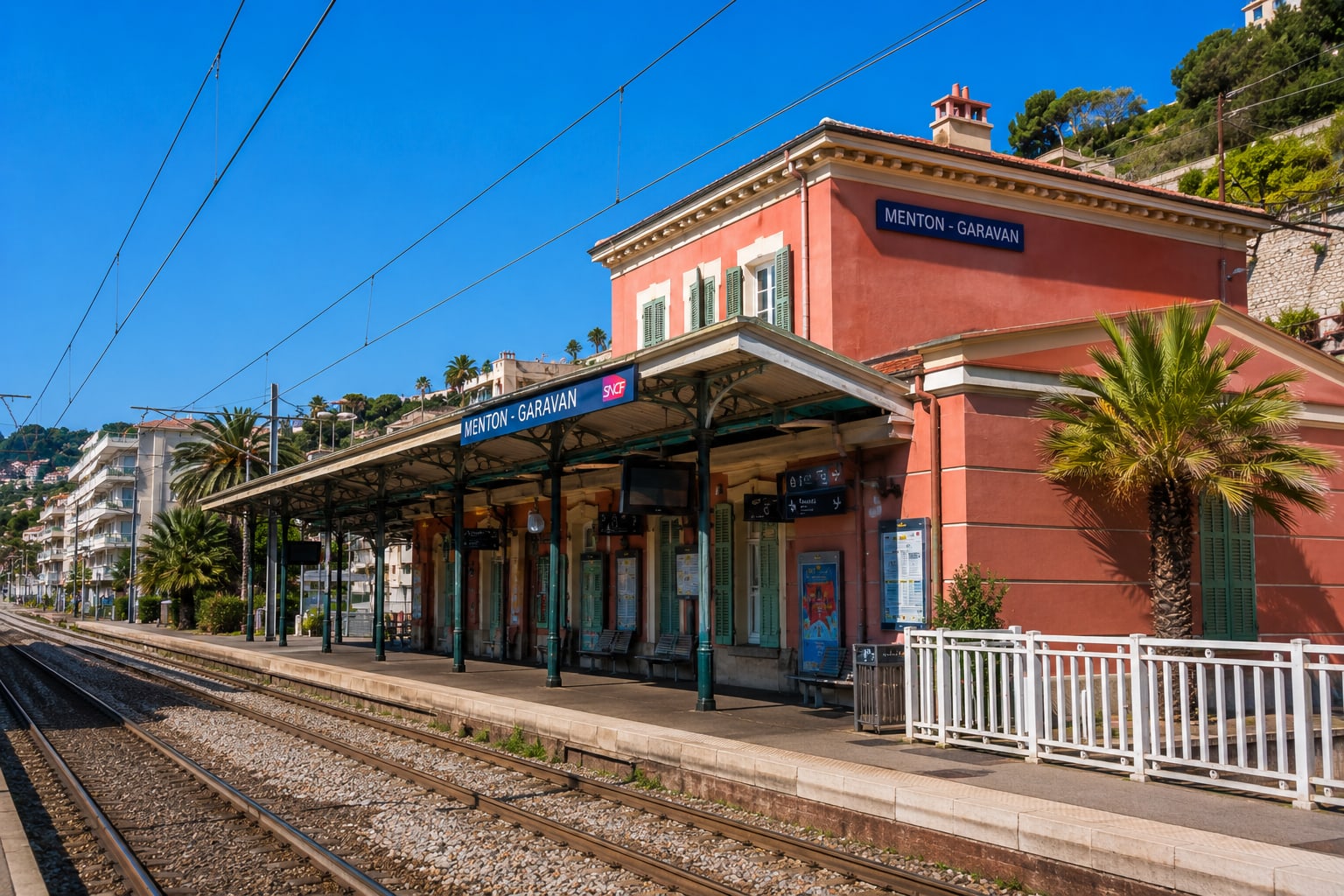
station
station
Menton Garavan Station
Eastern Menton station useful for Garavan, the port and some Italian Riviera train plans.
Garavan, 06500 Menton
Check current hours before visiting
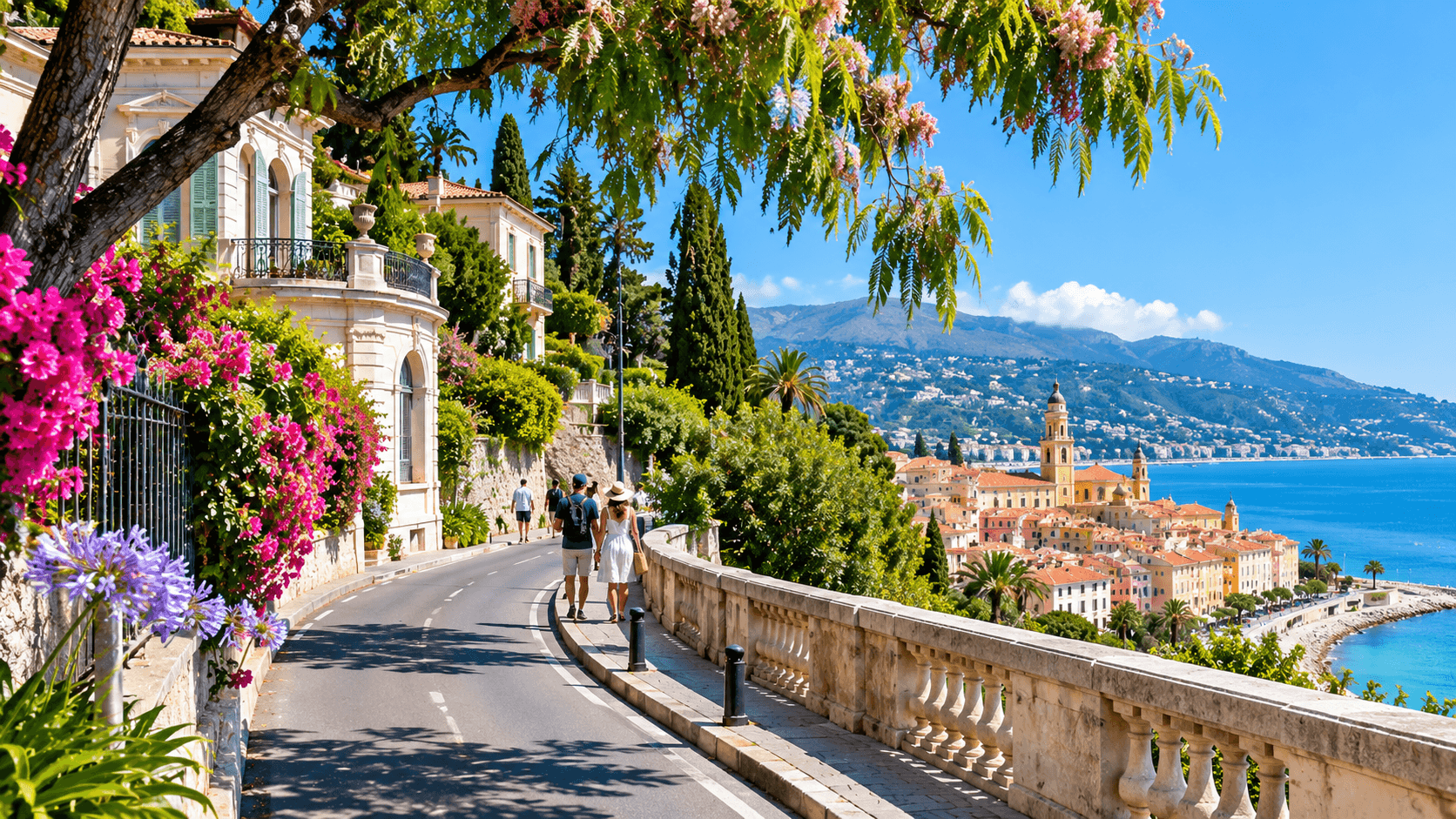
viewpoint
viewpoint
Boulevard de Garavan
Historic hillside boulevard above Garavan, with villas and bay views. Slopes, traffic and variable pedestrian space: choose a suitable public section, not an assumed step-free route. Villa grounds remain private.
Boulevard de Garavan, 06500 Menton
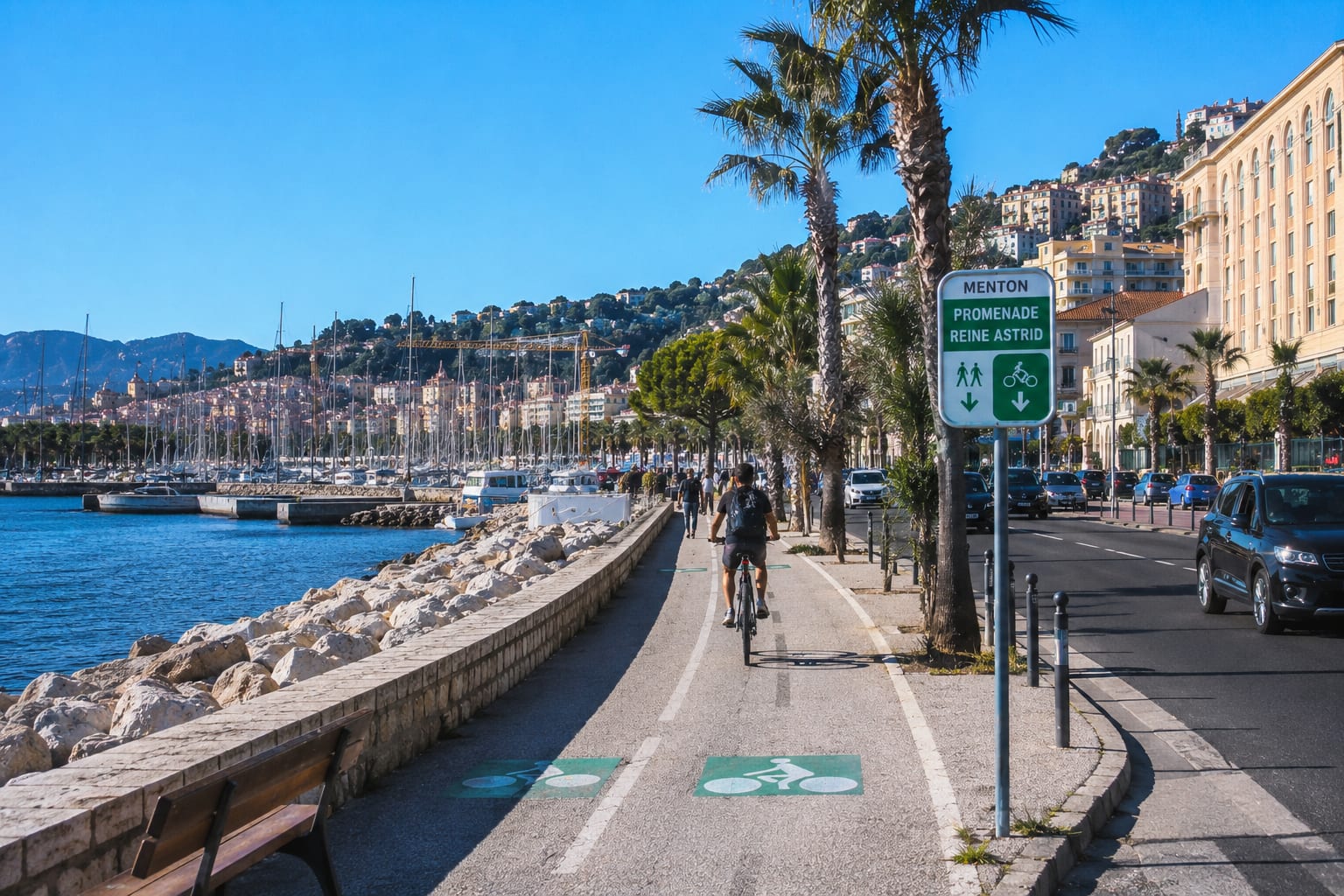
cycle route
cycle route
Promenade Reine Astrid
Scenic Garavan-side promenade used by the official local cycling route toward the border.
Garavan seafront
14. An optional garden visit: Val Rahmeh
Val Rahmeh is one of Menton's most remarkable botanical gardens.
It's located in Garavan, within the broader area associated with Mansfield's stay.
Its tropical and subtropical plant collections help visitors appreciate the unusual botanical environment that made this part of the Riviera attractive to winter residents.
However, Val Rahmeh should not be represented as a documented Mansfield writing location or as the setting of a specific short story.
It's a contextual extension.
The garden has its own independent history, involving Lord Radcliffe and later botanical development under Maybud Sherwood Campbell.
Check current seasonal hours and any announced restoration closures before planning a visit.
At this review on 5 November 2026, the garden announces closure for works from 2 to 27 November inclusive. Do not add an interior garden visit during that period; check the operator again for any later date. The public Garavan walk remains a separate proposal, subject to local conditions.
For visitors interested in historic gardens, it offers a rewarding additional experience alongside the literary walk.
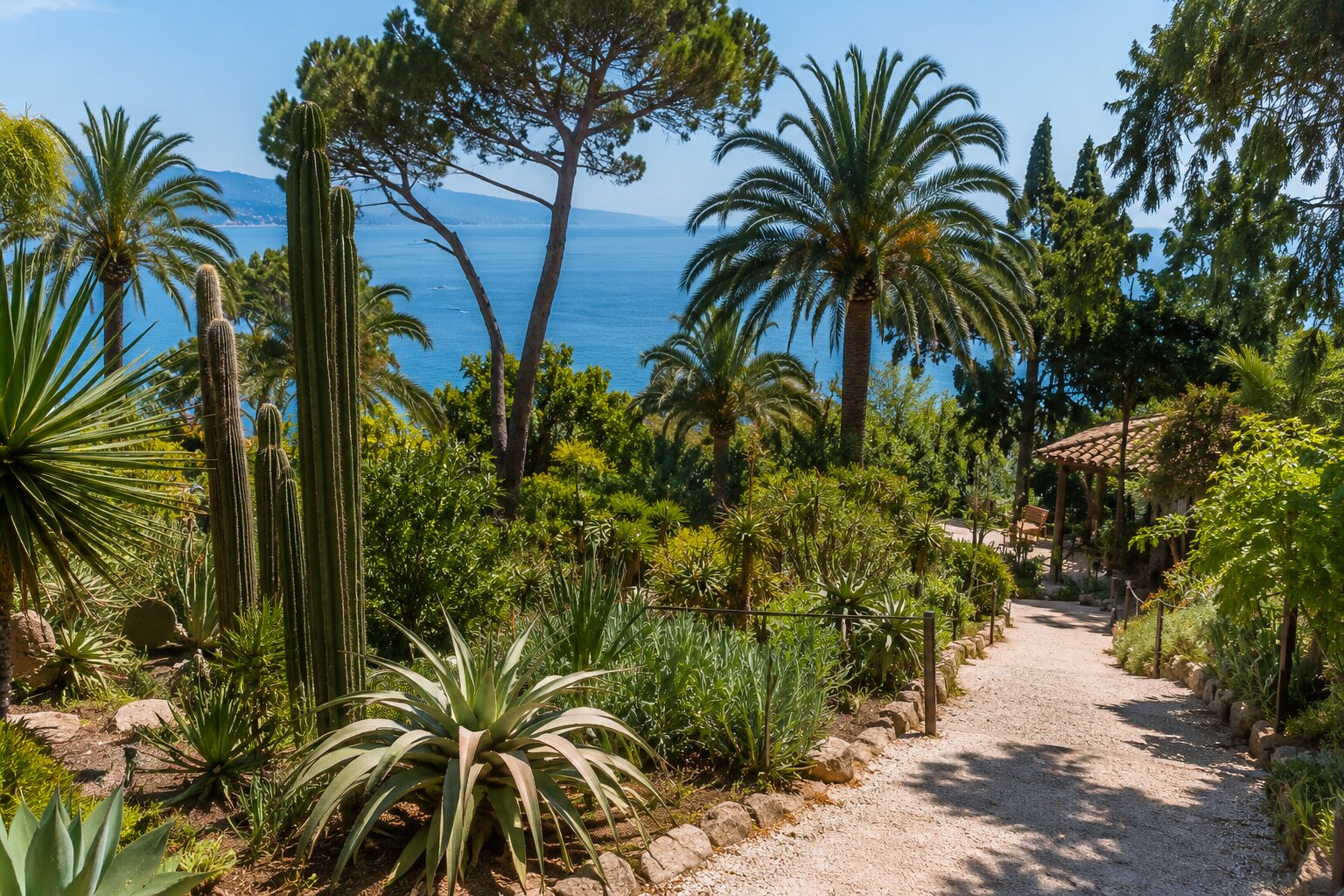
garden
garden
Jardin Botanique Val Rahmeh
A botanical stop to consider for garden lovers and slower itineraries.
Avenue Saint-Jacques, 06500 Menton
Check current hours before visiting
15. The legacy of the Katherine Mansfield Memorial Room
The story of Villa Isola Bella doesn't end with Mansfield's departure in 1921.
Decades later, the lower part of the property became a memorial writing space.
The associated Katherine Mansfield Menton Fellowship has enabled New Zealand writers to spend time in Menton since its first award in 1970.
This brought a new generation of literary activity to the town.
Janet Frame was among the fellowship recipients.
She came to Menton in 1974 and drew on the experience in her novel In the Memorial Room, published posthumously in 2013.
Her satire examines the peculiar expectations placed on a writer working in a room dedicated to another writer's memory.
This provides an extraordinary literary connection.
Mansfield lived and worked in the villa.
Later writers were invited to work in her name.
And one of those writers turned the experience of commemoration itself into a novel.
For visitors interested in literature, that story may be as fascinating as the original historical house.
16. What is real, what is remembered and what is fictional?
For this guide, three different types of evidence must remain separate.
Documented biography
Mansfield lived in Menton, stayed at Villa Isola Bella and worked on specific stories there.
Her correspondence, manuscripts and contemporary photographs support these facts.
Literary interpretation
Illness, isolation, memory and dependence are important themes in many of her works.
Scholars have explored the relationship between those themes and Mansfield's lived experience.
But interpreting a story is not the same as proving that every event in it corresponds to a personal experience.
Fictional geography
The settings of Mansfield's stories often belong to New Zealand, England or other imagined social environments.
A story written in Menton is not automatically a story about Menton.
That distinction is what makes this literary route historically responsible.
Frequently asked questions
Did Katherine Mansfield live in Menton?
Yes. She spent time in Menton in early 1920 and returned in September 1920 to live at Villa Isola Bella until May 1921.
Where did Katherine Mansfield live in Menton?
She stayed at L'Hermitage, Villa Flora and later Villa Isola Bella in the Garavan district.
Which stories did she write at Villa Isola Bella?
The best-documented works associated with her Isola Bella period include The Daughters of the Late Colonel, Miss Brill, The Stranger, Life of Ma Parker and several other stories later collected in The Garden Party and Other Stories.
Was The Garden Party written in Menton?
The title story was written after she left Menton, in Switzerland. However, the collection includes several works composed during her Menton stay.
Was Bliss written in Menton?
No. The title story Bliss belongs to an earlier period associated with Bandol. The collection Bliss and Other Stories was published while Mansfield was living at Isola Bella in December 1920.
Is Miss Brill set in Menton?
No specific identification with a public garden in Menton has been established. Its association with Menton is through the period of composition.
Can you visit Villa Isola Bella?
Ordinary public access has not been confirmed. The villa and memorial spaces have restricted arrangements, so visitors should remain on public streets unless authorised entry has been explicitly arranged.
What is the Katherine Mansfield Memorial Room?
A later commemorative writing space established in the lower part of Villa Isola Bella. It is not Mansfield's original writing room.
How is Janet Frame connected with the villa?
Frame received the Katherine Mansfield Fellowship and worked in Menton in 1974. Her novel In the Memorial Room draws on the experience of the literary residency.
What should I read first?
Miss Brill is a short, accessible introduction. The Daughters of the Late Colonel is particularly rewarding before visiting Garavan because of its direct association with Mansfield's work at Villa Isola Bella.
Final thoughts: the town behind the writing
Katherine Mansfield came to Menton looking for conditions that would allow her to continue working.
She found beauty in the sea, gardens and Mediterranean light.
She also lived with serious illness, emotional difficulties and the practical demands of making a temporary household function.
The stories she wrote here rarely describe the town directly.
Instead, they examine people in moments of vulnerability, dependence, isolation and unexpected recognition.
That is why Menton matters.
Not because the streets of Garavan appear in every famous Mansfield story.
But because Villa Isola Bella became a place where she could carry on writing about lives far beyond its walls.
If you visit the neighbourhood today, look towards the gardens and hillside villas.
Remember the writer who lived there, the friend who helped her and the work that emerged from their shared circumstances.
Then read the stories.
You may discover that the most powerful connection between a writer and a place isn't always visible on a map.
Sources and further reading
Katherine Mansfield Society: Timeline and Biography
Te Ara: Katherine Mansfield Biography
Read NZ: Katherine Mansfield's Literary Career
National Library of New Zealand: Katherine Mansfield
Te Ara: Katherine Mansfield Photographed at Menton
Katherine Mansfield Society: Literature and the French Riviera
Edinburgh University Press chapter listing: Writing from the Cellar, Revisiting Villa Isola Bella
Menton Tourist Office: Garavan Heritage Walk
Katherine Mansfield Society: freely available stories
Arts Foundation: Katherine Mansfield Menton Fellowship
Val Rahmeh: closure 2–27 November 2026
Sources reviewed on 5 November 2026. Chronology and composition are checked against the Society timeline, Te Ara and Read NZ; exact manuscript drafting/revision stages of every secondary story have not been independently audited. The supplied research describes the later memorial as distinct from Mansfield's room; the full scholarly chapter was not accessible in this check, so this is not a newly inspected original study. Stories written or revised in Menton are not automatically set there. Isola Bella has no confirmed regular public interior programme. This is an editorial public-street walk, not a measured accessible route or a reconstruction of Mansfield's movements. The supplied cover is an artistic composition: its book and portrait are not a verified published edition or authenticated archival photograph. Historical library images are linked, not reproduced; reuse requires the library's permission.