When Menton became somewhere else
A grand palace in Menton becomes a railway station in Nice.
A seaside villa becomes the home of an aristocratic family.
A narrow street in the old town becomes part of an elegant Riviera mystery.
And the luxurious train at the centre of the story? Much of its railway footage was created hundreds of kilometres away, in England.
Welcome to the world of Agatha Christie's Poirot: The Mystery of the Blue Train.
This television adaptation, starring David Suchet as Hercule Poirot, brought one of Christie's most glamorous mysteries to the screen in 2005.
The story follows a luxurious train journey from England towards the French Riviera, where a wealthy passenger is murdered and valuable jewels disappear.
Poirot's investigation unfolds amid the wealthy international society of the Mediterranean coast.
But the locations you see on screen aren't always the places they're supposed to represent.
Several scenes were filmed in Menton, a town just east of Monaco.
The production used historic buildings, gardens and streets to create the atmosphere of a pre-war Riviera.
Today, you can visit several of those locations and discover how television transforms real architecture into fictional geography.
This guide follows the evidence behind the filming locations, explains what each building represents and offers a practical walking itinerary.
You don't need to have watched the episode to enjoy the route.
But if you have, you may find yourself looking at Menton's familiar streets rather differently.
1. The episode: The Mystery of the Blue Train
Series: Agatha Christie's Poirot
Episode: The Mystery of the Blue Train
Series: 10, Episode 1
Starring: David Suchet as Hercule Poirot
Director: Hettie MacDonald
Screenplay: Guy Andrews
Production dating: generally catalogued as 2005; the Christie estate describes the adaptation as 2006. An exact first-broadcast date is not independently verified here.
Running time: Approximately 94 minutes
Based on: Agatha Christie's 1928 novel of the same name
The episode is a feature-length television production, not a separate theatrically released feature film.
Its cast includes Georgina Rylance, Lindsay Duncan, Elliott Gould, James D'Arcy, Jaime Murray and Alice Eve.
The adaptation preserves the central idea of Christie's mystery: a murder and a missing collection of jewels aboard a luxurious train travelling towards the Mediterranean.
But it also changes elements of the novel, including parts of its characterisation, chronology and dramatic presentation.
The television version is set in the late 1930s, reflecting the visual world established in the wider David Suchet series.
This matters when exploring its locations.
The production's Menton is partly a real French Riviera town, partly another place entirely and partly a carefully designed image of the 1930s.
2. The real filming locations in Menton
Four principal Menton locations have been identified in filming-location research.
These locations are supported by published location research, but the exact frame-by-frame identification has not been independently audited for this guide.
They also don't form a single compact walking route.
Rue de Bréa and the basilica are in Menton's old town.
Palais de Carnolès lies farther west.
Villa Maria Serena is near the Italian border to the east.
For visitors, it makes more sense to divide them into manageable outings.
| Real location | What it represents on screen | Evidence |
|---|---|---|
| Palais de Carnolès | Exterior of the railway station at Nice | Independent location research |
| Rue de Bréa | Street scene associated with Corky and his vehicle | Specialist episode location research |
| Villa Maria Serena | Attributed as fictional Villa Marguerite | Specialist episode attribution; regional inventory confirms the series, not this shot |
| Basilique Saint-Michel-Archange | Church location in the episode | Independent location references |
3. Palais de Carnolès: the palace that became a railway station
Address: 3 Avenue de la Madone, Menton.
This is perhaps the most surprising transformation in the entire Menton filming itinerary.
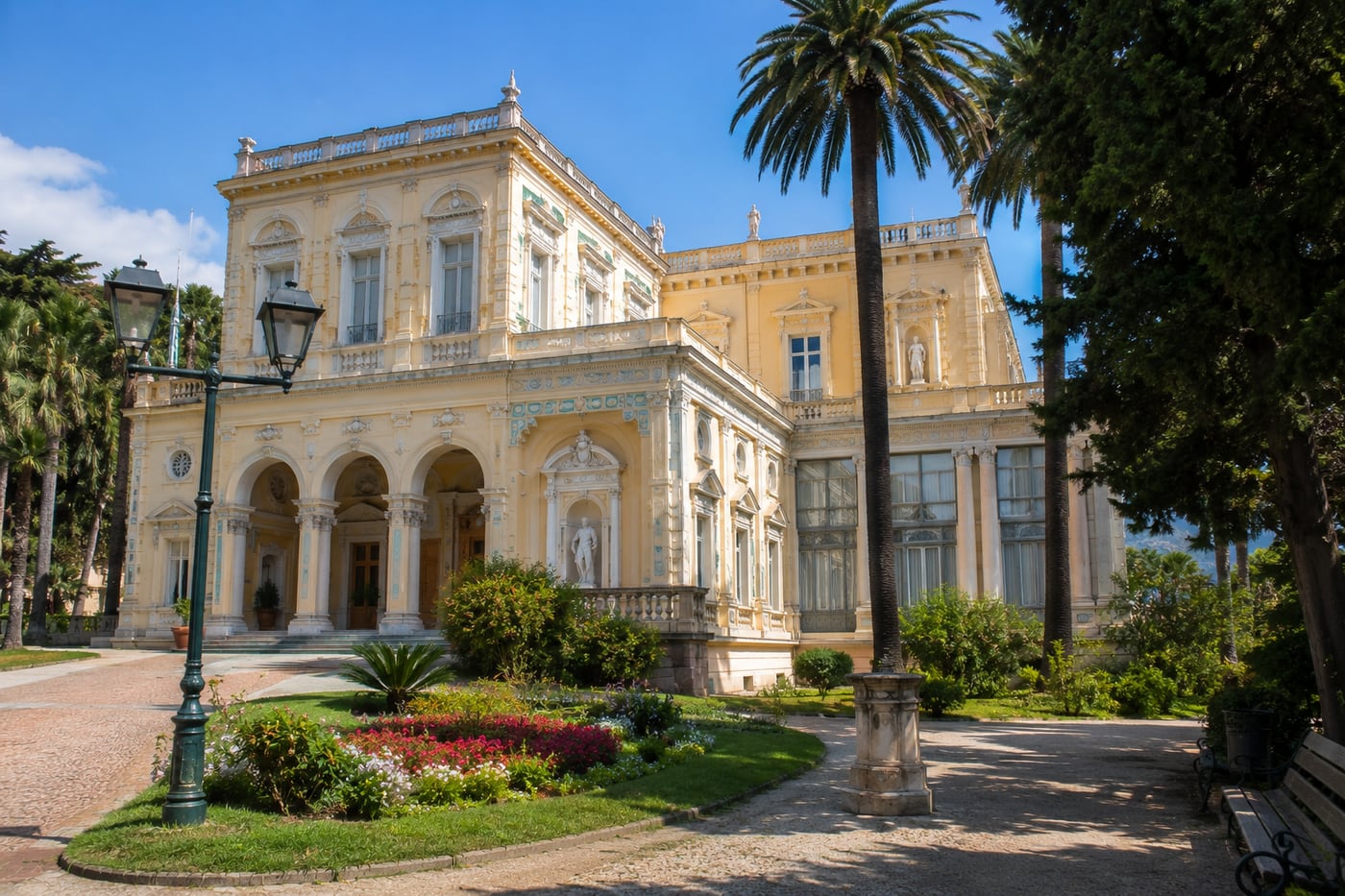
The Palais de Carnolès was once a summer residence of Monaco's ruling family.
Built from the early eighteenth century under Prince Antoine I, it was designed as an elegant aristocratic retreat.
Its symmetrical façade, monumental entrance and formal architectural details make it an unmistakably prestigious building.
In The Mystery of the Blue Train, however, it serves another purpose.
The production uses the building to represent the exterior of Nice railway station.
How does a palace become a station?
On screen, a location only has to convince the viewer for the duration of the scene.
The building's original function is secondary.
What matters is how its façade is framed, how people move in front of it and which details the production chooses to show.
Palais de Carnolès has a large formal frontage suitable for a convincing period arrival scene.
The camera can use its proportions and architectural grandeur to suggest a significant public building.
Costumes, vehicles, signage and editing help complete the illusion.
The audience sees a railway station.
But the actual building remains a historic palace in Menton.
What about the trains and platforms?
Here's where the production becomes particularly interesting.
The railway sequences weren't all filmed at the same location.
Peterborough City Council lists The Mystery of the Blue Train among productions using the Nene Valley Railway. Specialist episode research further attributes railway and platform material to it; exact shots are not independently matched here.
British railway locations and visual effects helped create the appearance of French stations.
So the fictional geography was assembled from different physical places.
A palace façade in Menton could serve as one part of Nice station, while another part was represented by an English railway platform.
The finished episode makes them belong to the same fictional world.
What is Palais de Carnolès today?
The building became Menton's Musée des Beaux-Arts.
The museum is currently closed for restoration works.
Its historic building and citrus garden remain important elements of Menton's cultural heritage.
Checked 3 November 2026: the municipality lists garden access on weekends only, 10:00–12:00 and 14:00–18:00, while other heritage descriptions give broader opening hours. Use the stricter municipal notice and confirm your actual date. The museum remains closed for works.
Do not plan an interior museum visit while the building remains closed.
What to look for
Stand in an authorised public viewing area and examine the central façade.
Look at its symmetry, architectural decoration and entrance.
Then imagine the production removing its present-day context and presenting it as a glamorous railway terminus.
It's a perfect example of the difference between a building's real identity and its screen identity.
museum
museum
Palais Carnolès
A historic Menton palace and garden complex, used as a screen stand-in for a railway station in Poirot: The Mystery of the Blue Train.
3 Avenue de la Madone, 06500 Menton
Check current hours before visiting
4. Rue de Bréa: a narrow street becomes part of Poirot's Riviera
Location: Rue de Bréa, Menton's historic centre.
Rue de Bréa is a small street in the old town, close to Saint-Michel Basilica.
It has the characteristics that make Menton's historic centre so attractive on screen: closely spaced buildings, varied architectural details, narrow perspectives and richly coloured façades.
Specialist location research associates the street with a scene involving Corky's car.
AzurMenton's broader filming guide also identifies it as a location for a street conversation.
Why use a street like this?
Period dramas often need urban spaces without too many obvious modern visual references.
Narrow streets can be easier to control visually.
The camera may show only a short stretch of pavement, a doorway and the surrounding façades.
With careful framing and appropriately selected vehicles, an ordinary street can feel several decades older.
Menton's old town provides precisely that kind of environment.
What should visitors look for?
The angle of the street, its architectural details and the relationship between façades and the narrow roadway.
Compare the perspective with the episode if you've watched it recently.
Avoid assuming that every visible doorway remains unchanged since filming in 2005.
Shopfronts, shutters, signage, lighting and street furniture may have been altered.
Visiting considerations
Rue de Bréa is part of a working residential neighbourhood.
There is no film-set admission fee and no need to enter private buildings.
Keep photographs to publicly accessible areas, avoid obstructing residents and be careful around steps or vehicles.
A note on exact scenes: The street is independently identified as a location. The precise shot and camera position still require direct comparison with episode footage before publishing a definitive frame-matching guide.
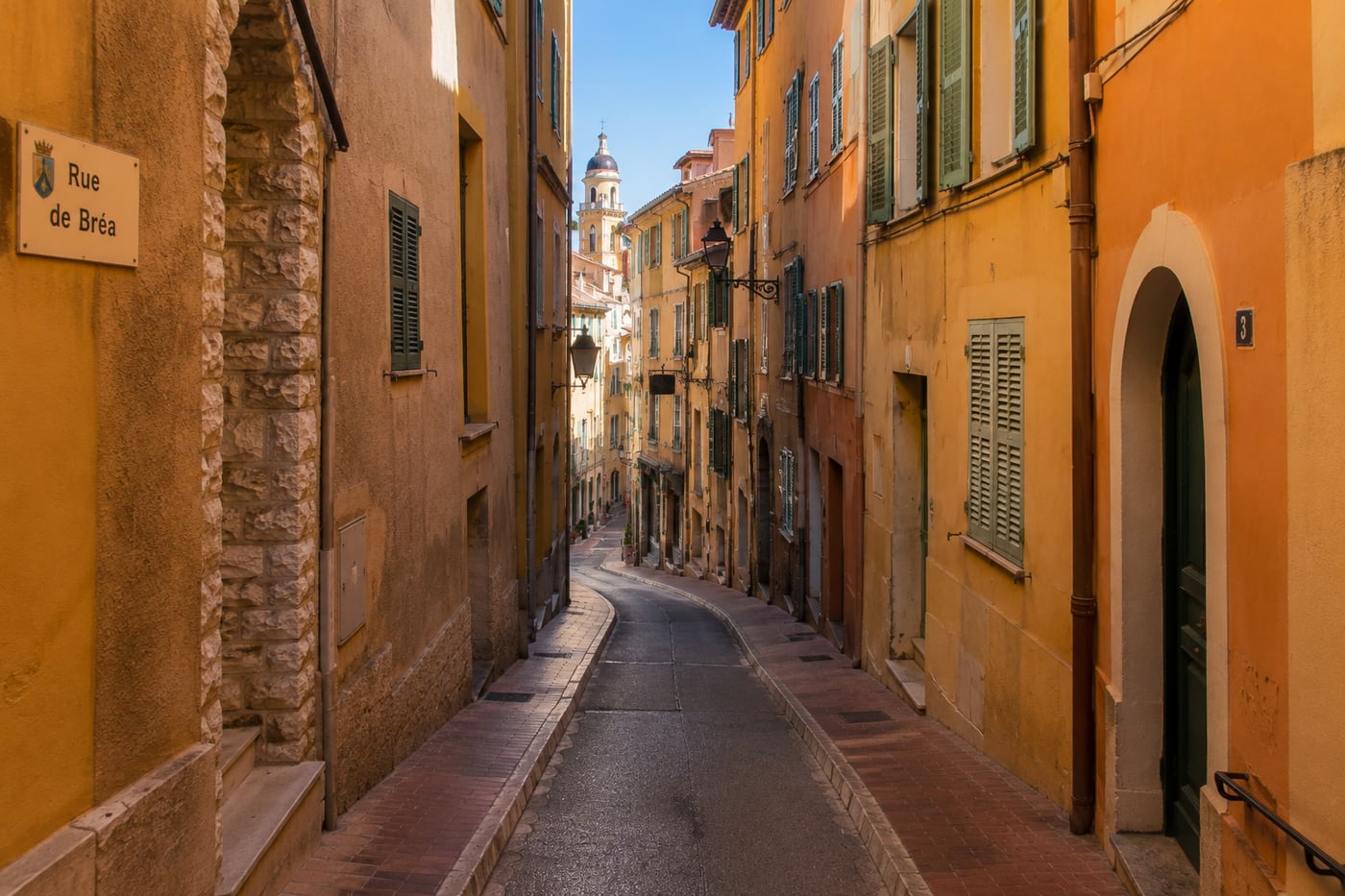
neighbourhood
neighbourhood
Rue de Bréa
A compact old-town street near Saint-Michel, used as a screen location and easy to include in a slow central walk.
Rue de Bréa, 06500 Menton
5. Basilica of Saint-Michel-Archange: real Menton, fictional Riviera
Location: Parvis Saint-Michel, Menton's old town.
Above the old port stands one of Menton's most recognisable landmarks.
The Basilica of Saint-Michel-Archange is a magnificent baroque church whose bell tower rises above the colourful old-town buildings.
Its architectural history reaches back to the seventeenth century, although the building continued to change in later periods.
The church is also identified in specialist location records for The Mystery of the Blue Train.
Why is it useful for period television?
The basilica offers a dramatic historical setting.
Its architecture creates an immediate impression of age and ceremony.
When filmed without obvious modern interruptions, it can represent the older cultural world the production wishes to evoke.
But its real location should not automatically be confused with the location it is meant to represent within the story.
A church filmed in Menton can stand in for a religious setting elsewhere on the Riviera.
What to see today
Climb to the square and admire the façade.
Notice the old-town streets leading towards it and the view over Les Sablettes.
If the basilica is open, the interior is also worth exploring.
Respect religious services and visitor restrictions.
The climb involves stairs and gradients, so it may be unsuitable for visitors with limited mobility.
What remains to verify?
The published filming research supports the identification of the basilica as a location.
However, a scene-by-scene visual comparison would be needed to confirm the exact interior or exterior viewpoints used in the final edit.
For now, the safest description is simply that the basilica is an identified filming location.
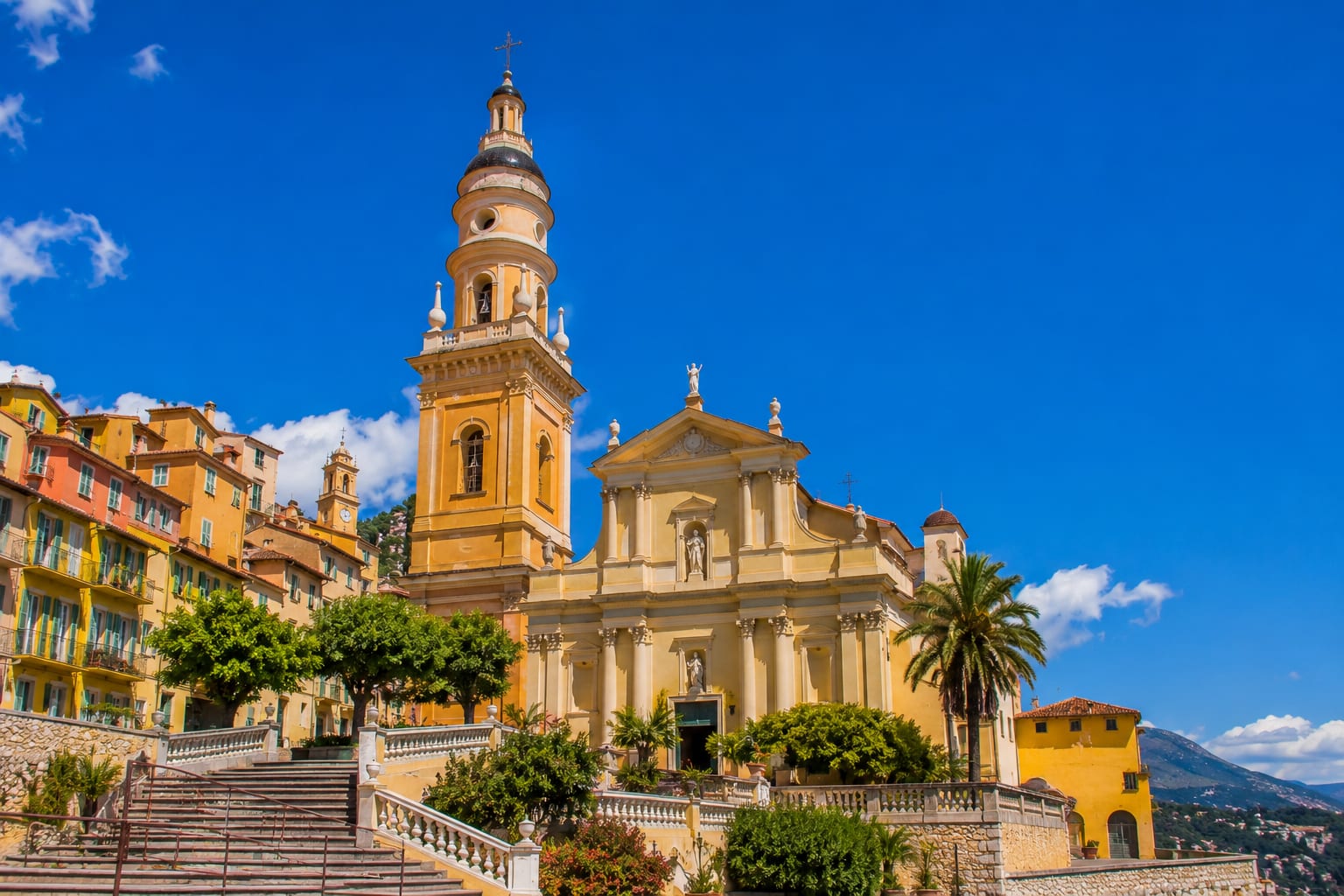
civic
civic
Basilica Saint-Michel-Archange
Menton's old-town landmark above the sea, useful for classic views, music-video mood and visual walks.
Place de l'Eglise, 06500 Menton
6. Villa Maria Serena: the real villa behind fictional Villa Marguerite
Address: 21 Promenade Reine Astrid, Menton.
Near the Italian border stands Villa Maria Serena, one of Menton's most beautiful historic villas and gardens.
The villa was created in 1886 for the Foucher de Careil family, in a setting overlooking the Mediterranean.
It later belonged to British banker Henry Konig, who bequeathed it to the City of Menton.
Today, its gardens are known for subtropical plants, palms and an exceptionally sheltered coastal climate.
In The Mystery of the Blue Train, Villa Maria Serena represents the fictional Villa Marguerite.
The Villa Marguerite identification appears in the supplied specialist location research. The regional heritage inventory independently records use of Maria Serena in the Poirot series, but does not identify this episode or a camera position. IMDb returned 403 during this check and is supplementary, not newly verified proof.
Why does it work on screen?
The villa has precisely the visual qualities associated with the elegant French Riviera of Poirot's world.
An impressive historic residence.
A garden filled with subtropical vegetation.
Architectural details suggesting wealth and privacy.
Views over the Mediterranean.
Together, these elements create a convincing setting for the wealthy international society represented in the adaptation.
But the name Villa Marguerite belongs to the fictional geography of the episode.
The actual property is Villa Maria Serena.
Can you visit?
Villa Maria Serena is not an unrestricted public museum.
Its garden can be visited through organised guided tours on published dates.
The tourist office has listed guided visits during October 2026, with admission charges and advance booking.
The published schedule includes Tuesday, Thursday and Saturday morning sessions through 31 October 2026.
Checked 3 November 2026: these October sessions have ended. No later session is confirmed here. Confirm a newly published date and book before travelling; the official listing requires advance booking and no on-site payment.
The full villa interior should not be assumed accessible simply because a garden tour is available.
Our recommendation
If you're especially interested in The Mystery of the Blue Train, this is one of the most rewarding locations to investigate.
It combines a documented series-level filming connection and a published episode attribution with a genuinely beautiful Riviera garden.
But book the authorised visit rather than turning up expecting the gates to be open.
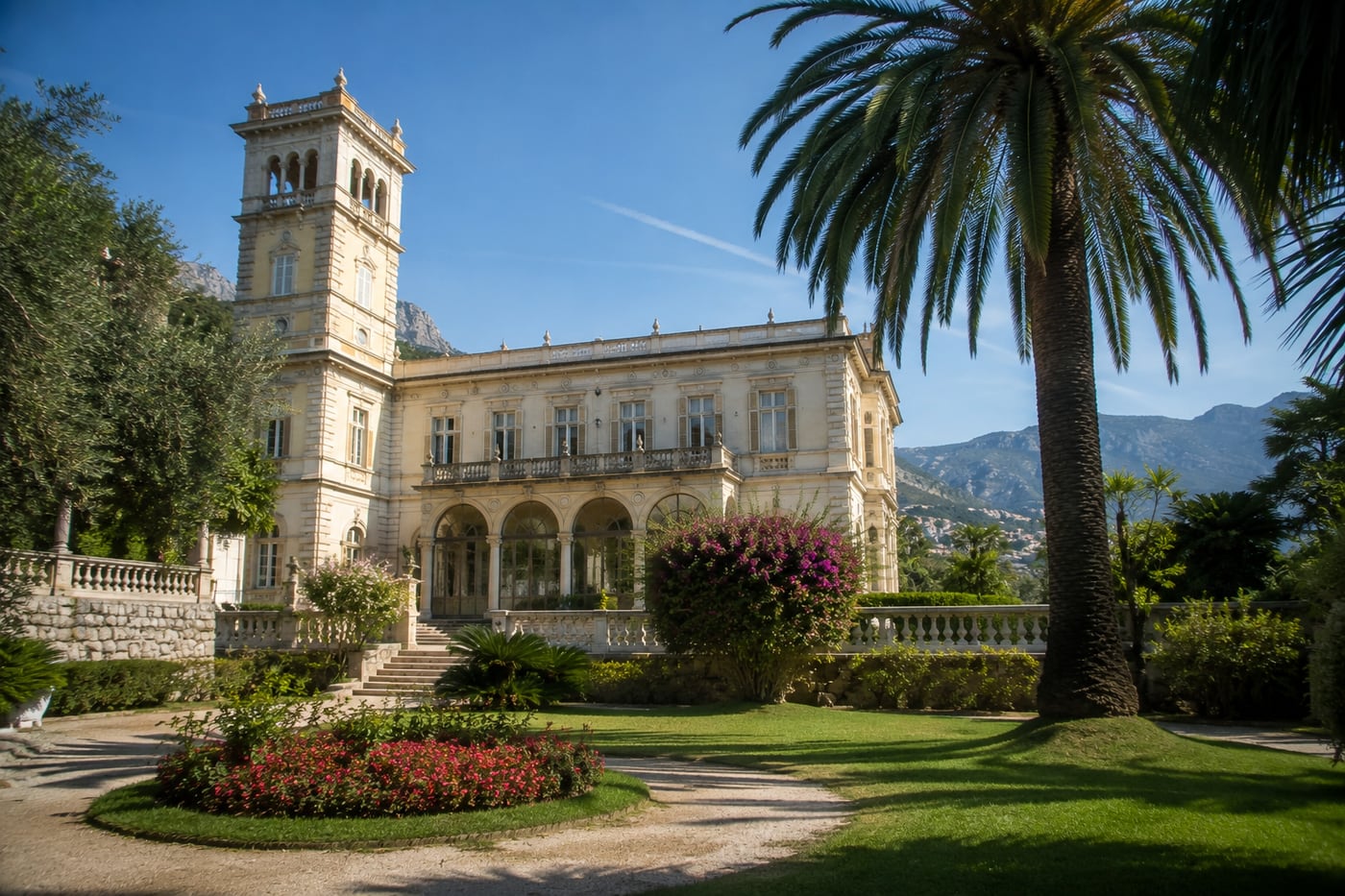
garden
garden
Villa Maria Serena
A historic Garavan villa and garden used as a filming location; access depends on municipal arrangements, tours or events.
21 Promenade Reine Astrid, 06500 Menton
Check current hours before visiting
7. The Blue Train: literary geography versus filming geography
One of the most important distinctions in this guide is the relationship between Agatha Christie's original novel and the television adaptation.
The novel The Mystery of the Blue Train was published in 1928.
Its central setting is the luxurious Blue Train travelling from Britain towards the French Riviera.
The train brings together wealthy passengers, complicated relationships and a murder investigation.
Nice and the surrounding Riviera are important to the story's atmosphere.
Is Menton the principal setting of the novel?
No.
Menton should not be presented as the central literary setting of Christie's original book simply because the television adaptation filmed there.
The novel's railway journey and Riviera society are part of its fictional geography.
The choice of Menton as a filming location belongs to the production history of the television episode.
These are different things.
Was the Blue Train a real service?
Yes.
The historical Train Bleu was associated with the Calais–Méditerranée luxury sleeper service and the Compagnie Internationale des Wagons-Lits.
It helped carry wealthy travellers between northern Europe and the French Mediterranean coast.
The Blue Train was a symbol of the Riviera's international resort culture.
Christie used that world as the setting for her mystery.
The television production then recreated it using preserved railway equipment, studios, real Riviera buildings and visual effects.
Three different maps
A single location may belong to more than one layer, but the layers shouldn't be treated as interchangeable.
For example, the screen may identify a building as Nice station while the actual camera was positioned at a palace in Menton.
| Layer | What it describes |
|---|---|
| Christie's novel | Fictional railway journey and destinations in the original 1928 story |
| Television adaptation | The settings represented within the 2005 episode |
| Actual filming locations | Real buildings and railway facilities used during production |
8. How television turns one building into another
This is perhaps the most enjoyable part of the itinerary for anyone interested in filmmaking.
A screen location isn't always a faithful representation of the physical world.
Sometimes it is deliberately misleading.
Architecture provides the illusion
A period building may have the right scale, proportions and decorative style to represent somewhere entirely different.
Palais de Carnolès works as a railway-station exterior because its frontage can suggest civic importance.
Villa Maria Serena works as a fictional aristocratic residence because its architecture and gardens convey wealth and privacy.
Framing removes inconvenient details
A camera doesn't show everything.
Modern signs, road markings or surrounding buildings can be excluded.
A narrow street may be filmed from an angle that hides contemporary features.
What the audience doesn't see can be as important as what remains in the frame.
Editing connects separate locations
A character approaches a grand building.
The next shot shows a railway platform.
The viewer assumes the two spaces connect.
In reality, they may have been filmed in different countries.
The programme creates continuity through editing and design.
Digital effects complete the setting
Visual effects can alter the perceived environment, adding or removing features that would reveal the real location.
Railway scenes are particularly well suited to this technique because trains, station signs, platforms and surrounding architecture may all need to convey a specific time and place.
The result is a convincing screen world that never existed exactly as shown.
And that's what makes this Menton itinerary so interesting.
You're not merely visiting locations.
You're discovering how the illusion was constructed.
9. Two practical Poirot walks from Menton
The four filming locations are spread across the town.
Rather than creating one inconvenient cross-town walk, we recommend two separate outings.
Route A: The old-town Poirot walk
Best for: Visitors interested in historic streets and architecture.
Time: Approximately 1–2 hours, including pauses.
Begin near Rue de Bréa.
Explore its narrow setting and architectural details.
Continue towards Saint-Michel Basilica, following the public old-town streets.
Climb to the square if you're comfortable with stairs.
Enjoy the views over Les Sablettes and the old port.
Finish with a short walk towards the waterfront.
This is the most compact part of the itinerary.
It also works well as an ordinary introduction to Menton's historic centre, even if you haven't watched the episode.
Route B: The palace and villa locations
Best for: Visitors interested in heritage buildings, gardens and production design.
Time: A half-day or longer, depending on transport and guided-tour availability.
Start with Palais de Carnolès, on the western side of Menton.
Admire the exterior from a publicly accessible area and explore the garden only when current access is confirmed.
Then travel towards the eastern side of town for Villa Maria Serena.
If a guided garden tour is available, arrange your day around that reservation.
Otherwise, treat Maria Serena as a private heritage location and avoid assuming entry.
This route covers two very different ways the production used historic buildings.
One became a railway station.
The other became a fictional residence.
Getting between locations
Menton's lower waterfront is walkable, but Carnolès and Garavan lie on opposite sides of town.
The full distance is not a short casual detour.
Use local transport or plan a longer coastal walk if the weather and your mobility allow.
Check bus and regional train timetables for your actual date.
10. Watch the episode before you walk
For film-location enthusiasts, the most rewarding approach is to watch the episode once before visiting.
Pay particular attention to the architecture around the railway arrival, the scenes involving Villa Marguerite and the street settings in the Riviera.
Don't worry about recognising every location immediately.
The production was designed to make the places look like part of the same fictional world.
That's precisely why comparing them with their real identities is interesting.
A useful viewing exercise
Notice what the camera includes.
The main doorway.
A church façade.
A section of road.
A garden terrace.
Then visit the real place and consider what has been omitted from the screen.
Sometimes the difference is more revealing than the resemblance.
11. What if you only have one hour?
Choose the old town.
Rue de Bréa and Saint-Michel Basilica provide a compact combination of filming history and attractive public architecture.
If you have more time and access has been confirmed, plan a separate visit to Villa Maria Serena.
For visitors fascinated by production design, Palais de Carnolès is particularly worthwhile because of its surprising screen transformation.
You don't need to visit all four locations to appreciate what makes the episode's use of Menton distinctive.
12. What is confirmed and what still needs checking?
Filming-location research is often more complicated than identifying the town named in production credits.
A production may shoot at a building but use only a small detail in the final edit.
A published location list may correctly identify a site without explaining precisely which shot was filmed there.
For this guide, we've separated those different levels of evidence.
The purpose isn't to cast doubt on every filming location.
It's to distinguish the geographical identification of a site from a precise reconstruction of the finished scene.
| Claim | Current evidence | Editorial treatment |
|---|---|---|
| The episode filmed in Menton | Published specialist references; IMDb unavailable in this check | Published attribution, not a new production-record audit |
| Villa Maria Serena portrays Villa Marguerite | Specialist episode attribution; official inventory confirms series-level filming | Retain attribution, not independent shot confirmation |
| Palais de Carnolès portrays Nice station exterior | Specialist filming research | Published specialist attribution; no frame match |
| Rue de Bréa appears in the episode | Specialist filming research | Published specialist attribution; no frame match |
| Saint-Michel Basilica was used | Specialist location records | Published specialist attribution; no frame match |
| Exact camera angles and timestamps | Not independently compared with full episode | Further verification needed |
| All railway footage was filmed in Menton | Contradicted by railway-location research | False |
| The original Christie novel is principally set in Menton | Not supported by the novel's published description | Do not claim |
Frequently asked questions
Was The Mystery of the Blue Train filmed in Menton?
Published specialist records identify several Menton locations, including Villa Maria Serena, Palais de Carnolès, Rue de Bréa and Saint-Michel Basilica. This guide has not independently matched the episode frame by frame; the official heritage inventory confirms Maria Serena at series level only.
Is The Mystery of the Blue Train a film or television episode?
It's a feature-length episode of Agatha Christie's Poirot, starring David Suchet, rather than a standalone cinema film.
Which building was used as Nice railway station?
Specialist filming research identifies Palais de Carnolès in Menton as the station's exterior.
Were the railway platforms also filmed there?
No. Railway material was filmed at other locations, including the Nene Valley Railway in England.
Which villa appears in the television episode?
Villa Maria Serena in Menton is identified as the location representing the fictional Villa Marguerite.
Can you visit Villa Maria Serena?
Guided garden visits are available on published dates. The villa and its grounds are not freely accessible at all times.
Is Palais de Carnolès open?
The fine-arts museum is currently closed for restoration. Garden access is subject to the municipality's current published arrangements.
Is Rue de Bréa open to visitors?
It's a public old-town street. Visitors should respect residents, private entrances and traffic conditions.
Is the original Agatha Christie novel set in Menton?
The novel is principally associated with the Blue Train journey and the Riviera, particularly Nice. Menton's role as a television filming location should not be confused with the original novel's geography.
Can I follow the exact camera positions?
The main locations have been identified, but a complete scene-by-scene matching of exact shots and camera positions has not yet been completed for this guide.
Does the guide reveal the solution to the mystery?
No. It discusses the production, setting and location history without identifying the murderer.
Final thoughts: the real Menton behind Poirot's Riviera
When you watch The Mystery of the Blue Train, the world of Hercule Poirot appears beautifully complete.
The luxurious train, grand houses, elegant streets and Mediterranean landscapes belong together.
But the production created that world from fragments.
A real Menton palace became a fictional railway station.
A historic villa became another family's home.
An old-town street became part of the drama.
And preserved railway locations in England helped complete the journey.
For visitors to Menton, those transformations offer a wonderful reason to explore the town.
You can admire the buildings for their real history, then imagine how the production used them to create something entirely different.
It's a reminder that places can have more than one identity.
The one they possess in reality.
And the one cinema gives them.
Sources and further reading
Peterborough City Council: railway filming
Regional heritage inventory: Maria Serena and Poirot
Agatha Christie: The Mystery of the Blue Train
IMDb: The Mystery of the Blue Train, Filming Locations
Wikimedia Commons: Poirot Filming Locations in Menton
Poirot Episode Location Research
Menton Municipality: Villa Maria Serena
Menton Municipality: Palais de Carnolès
Menton Tourist Office: Villa Maria Serena Guided Visits
Source and visitor-access check: 3 November 2026. The supplied filming research was dated 31 October 2026. The principal location identifications are supported by publicly available specialist records, but exact episode timestamps and camera positions haven't been independently verified. Visitor access and heritage-site opening arrangements may change.